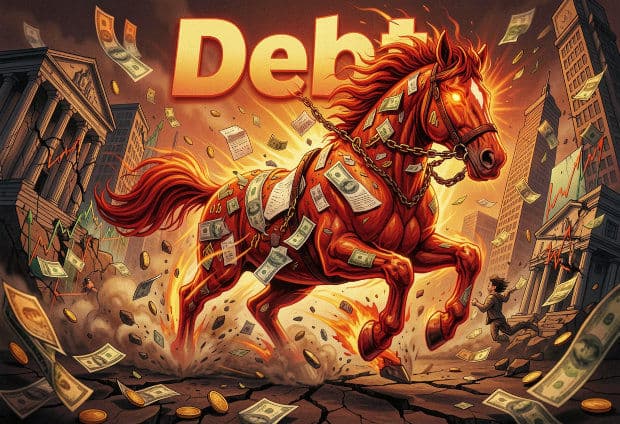
Debt: The Runaway Horse -- When Borrowing Becomes the Economy's Greatest Threat
G
GeoRenus Editorial Team
634 views
Summary
According to the Institute of International Finance (IIF) 2025 report, global debt has surpassed $315 trillion — approximately 330% of global GDP. IMF Fiscal Monitor data shows government debt alone exceeds $100 trillion, the highest level since World War II. Over 60% of low-income countries are now in IMF debt distress classification. Every major economic crisis in modern history (1929 Great Depression, 1982 Latin American crisis, 1997 Asian crisis, 2008 global crisis, 2022 Sri Lanka collapse) was rooted in uncontrolled debt. This article uses data from IMF, World Bank, IIF, BIS, and the Federal Reserve to prove one core argument: the mad horse is already running, and the world is riding on its back.
Key Takeaways
- Per IIF 2025 data, global debt has crossed $315 trillion — approximately 330% of global GDP — the runaway horse is already loose
- IMF Fiscal Monitor: government debt now exceeds $100 trillion (93% of GDP) — the highest level since World War II
- Per IMF classification, over 60% of low-income countries are in or at high risk of debt distress and spending more on debt service than health and education
- Every major economic crisis in modern history (1929, 1982, 1997, 2008, 2010, 2022) was rooted in uncontrolled debt — documented by IMF, FCIC, World Bank
- BIS research: 15-20% of listed companies in advanced economies are zombies — surviving only because of artificially low interest rates
- At 12% compound interest, debt doubles every 6 years and grows tenfold in 20 years — debt creates more debt automatically
- IMF, BIS, World Bank all agree: current debt trajectory is unsustainable — the question is not IF but WHEN it breaks
- Solutions exist (restructuring, fiscal discipline, structural reform) but are slow, politically difficult, and may not match the scale of the problem
Introduction -- The Mad Horse Is Already Running
According to the Institute of International Finance (IIF) Q1 2025 Global Debt Monitor, global debt has surpassed $315 trillion -- a number so vast it defies human comprehension. That equals approximately 330% of global GDP. In plain terms: the world owes 3.3 times more than it produces in an entire year. Every dollar of output carries more than three dollars of debt riding on its back.
IIF historical data shows that in 2000, this number stood at $87 trillion. In just 25 years, $228 trillion has been added to the world's debt pile -- without any world war, without colonizing other planets, without any cataclysm that might justify it. Simply by borrowing. Simply by spending money that does not exist.
"Global debt levels are at record highs and pose significant risks to economic stability." -- Kristalina Georgieva, IMF Managing Director, 2024
This is not just a number -- it is a ticking time bomb. In 2008, when global debt was approximately $150 trillion, the world economy collapsed into its worst crisis since the Great Depression. Today, total debt is more than double that figure. The kindling is far larger. The spark needed to ignite it is far smaller. And the firefighters have already spent most of their water.
IIF data indicates that in the first nine months of 2024 alone, global debt rose by approximately $12 trillion -- averaging roughly $44 billion of new debt added every single day. That is $510,000 of new debt every second, around the clock, every day of the year. At this rate, global debt could breach $400 trillion before 2030 even arrives.
The IMF's Fiscal Monitor 2025 confirms the alarm is not theoretical. Approximately 60% of low-income countries are already classified by the IMF's own Debt Sustainability Analysis as being in 'high risk' of debt distress or already 'in distress.' These are not predictions. These are current, published, official classifications from the world's foremost multilateral financial institution.
IMF Chief Economist Pierre-Olivier Gourinchas warned in early 2025 that the global economy stands at 'a critical juncture' -- with high debt, high interest rates, and slowing growth converging simultaneously. The IMF World Economic Outlook (January 2025) describes this combination as unprecedented in the post-World War II era.
The question is no longer 'is debt dangerous?' That debate is over. The real question in 2025 is: when government debt, corporate debt, and household debt are all simultaneously at record highs -- what does the explosion look like? And who gets buried in the rubble?
This article is not a debate. It is a prosecution. Every claim will be backed by published data from the IMF, World Bank, IIF, BIS, Federal Reserve, Eurostat, and other authoritative sources. No personal opinions. No speculation. Only numbers, only history, only the evidence that is already on the table.
The G20 Financial Stability Board (FSB) 2024 Annual Report adds another layer of concern: non-bank financial intermediation -- the shadow banking sector -- now holds over $218 trillion in assets. A large portion of global debt sits outside traditional banking regulation. In the next crisis, how that unregulated mountain behaves is something no one can predict with confidence.
History gives us the answer to whether this ends well. 1929. 1982. 1997. 2008. 2010. 2022. Every major economic catastrophe in modern history had uncontrolled debt at its center. This is not a coincidence. It is a pattern. And that pattern is forming again -- at a scale the world has never seen before.
But how bad is the situation, really? Let the numbers speak. What does $315 trillion actually mean?
$315 Trillion -- How Terrifying Is the Number?
Numbers in the trillions lose their meaning quickly. The human brain simply was not built to feel the difference between a billion and a trillion. So before we analyze the global debt crisis, we need to make $315 trillion feel real. Because once it does, the alarm becomes impossible to dismiss.
Imagine $315 Trillion
$315 trillion divided by the world's population of approximately 8 billion people equals roughly $39,375 of debt for every man, woman, and child on Earth -- including every newborn, every subsistence farmer, every person who has never touched a credit card. That is the per-capita share of a debt most people had no say in creating.
If you stacked $100 bills to count out $315 trillion, that stack would reach the Moon and back approximately 17 times. If you tried to pay it off at $1 million per day, it would take over 860,000 years. These are not rhetorical flourishes -- they are mathematical facts that illustrate why 'paying off' global debt is not a realistic goal under any plausible scenario.
The IIF breaks global debt into four categories. Government debt exceeds $100 trillion (IMF Fiscal Monitor 2025). Corporate (non-financial) debt stands above $90 trillion (BIS Annual Report 2025). Household debt exceeds $55 trillion (central bank aggregates). Financial sector debt adds another $70 trillion (IIF Global Debt Monitor). Every category is at or near a historical record.
Debt Is Growing Faster Than the Economy
IIF data shows that from 2010 to 2025, global GDP grew approximately 40% -- but global debt grew approximately 58%. Debt is outpacing economic output by a factor of 1.45x. The engine is growing, but the load it is being asked to pull is growing faster. At some point, the engine cannot keep up.
The COVID-19 years were a debt explosion unlike anything seen in peacetime. According to IMF Fiscal Monitor data, governments alone borrowed over $17 trillion in 2020-2021 to fund emergency spending, stimulus packages, and economic stabilization. This was historically unprecedented -- more borrowing in two years than many countries accumulate in decades.
Here is the most telling data point of all: despite the Federal Reserve raising interest rates from 0% to 5.25% between 2022 and 2024 -- the most aggressive rate-hiking cycle in four decades -- global debt did not decrease. It increased. Higher borrowing costs did not stop borrowing. The addiction is that deep.
Debt-to-GDP: We Crossed the Danger Line Long Ago
In their landmark 2010 research paper, economists Carmen Reinhart and Kenneth Rogoff analyzed 800 years of financial history. Their finding: when a country's debt-to-GDP ratio exceeds 90%, economic growth slows significantly. This 90% threshold became the most widely cited danger line in fiscal economics (National Bureau of Economic Research Working Paper 15639, 2010).
The global average debt-to-GDP ratio today is 330% (IIF) -- 3.7 times the historical danger threshold. Advanced economies average over 120% of GDP in government debt alone (IMF WEO 2025). The danger line is not approaching. It is far behind us in the rearview mirror.
| Year | Total Debt ($T, IIF) | Global GDP ($T, IMF) | Debt/GDP % | Notable Context |
| 2000 | $87T | $34T | 256% | Pre-dot-com bubble |
| 2007 | $142T | $58T | 245% | Pre-2008 financial crisis |
| 2010 | $200T | $66T | 303% | Post-crisis QE begins |
| 2015 | $220T | $75T | 293% | ZIRP era (near-zero rates) |
| 2019 | $253T | $87T | 291% | Pre-COVID peak |
| 2020 | $281T | $85T | 331% | COVID emergency borrowing |
| 2025 | $315T | $105T | 330% | Current -- all-time record |
Note: All figures from IIF Global Debt Monitor and IMF World Economic Outlook. Historical figures are approximate and may vary by source methodology.
The table tells a story no amount of optimism can rewrite: global debt has never meaningfully declined as a share of GDP in the last 25 years. Every crisis was met with more borrowing. Every recovery was built on new debt. The ratchet only turns one way.
The numbers are staggering. But the more disturbing question is: where is all this debt actually going -- and is it buying anything worth the price?
Where Is the Debt Going -- And Why It's Not Coming Back
Debt is not inherently evil. A government that borrows to build highways, hospitals, and power grids is making an investment -- it takes on debt today and gains productivity tomorrow. But when governments borrow to pay salaries, subsidize fuel prices, or win elections -- and when corporations borrow not to grow but to survive -- that debt is not an investment. It is a slow poison. The evidence suggests far too much of today's global debt is the poisonous kind.
Government Debt -- Spent on Consumption, Not Investment
World Bank analysis consistently shows that a significant portion of government borrowing in developing and middle-income countries goes toward subsidies, civil service wages, and politically driven projects -- not toward infrastructure, education, or technology that generates future returns. This is consumption debt: it is spent today and leaves nothing productive behind.
UNDP's 2025 Human Development Report documents a particularly grim consequence: many developing countries now spend more on debt servicing than on health and education combined. Money that should be building schools and hospitals is instead flowing to foreign creditors as interest payments. Future generations are paying for their parents' consumption spending.
The World Bank International Debt Report 2024 documents the scale: developing countries paid a record $443.5 billion in external debt service in 2023 -- money that could have financed healthcare, infrastructure, and education across the Global South. Instead, it left these countries and paid creditors in richer nations.
Corporate Debt -- Keeping Zombies Alive
BIS 2025 research identifies one of the most dangerous consequences of years of ultra-low interest rates: the rise of 'zombie companies.' According to BIS data, 15-20% of listed companies in advanced economies are zombies -- firms that cannot cover their interest payments from operating earnings. They survive only by continuously rolling over debt at low rates.
When the Federal Reserve and other central banks raised rates sharply between 2022 and 2024, these zombie firms began dying. S&P Global Ratings data shows that corporate defaults rose approximately 80% in 2023 compared to 2022. The BIS has specifically warned about approaching 'maturity walls' -- periods when large volumes of corporate debt come due and must be refinanced at much higher rates, triggering a wave of defaults.
Capital tied up in zombie companies is capital not available for healthy, productive firms. The BIS Annual Economic Report 2024 describes this as a critical drag on resource allocation efficiency -- the economy's ability to direct money toward its most productive uses. Zombie debt does not just waste money. It crowds out growth.
Household Debt -- The Credit Card Trap
Federal Reserve Bank of New York data (Q1 2025) shows US household debt has exceeded $17.5 trillion -- covering mortgages, auto loans, student loans, and credit cards. This is not a crisis yet. But the composition of that debt is alarming.
US credit card debt alone has surpassed $1.2 trillion -- at average interest rates exceeding 20% (Federal Reserve consumer credit data). At 20% annual interest, a debt doubles in approximately 3.6 years under the Rule of 72. Households paying only minimums are trapped on a treadmill that never stops.
The problem is not uniquely American. Bank of England data shows UK household debt at approximately 140% of disposable income. Bank of Canada data places Canadian household debt-to-income at approximately 180%. Across the developed world, households have borrowed against future income to fund present consumption. When income stops growing, the math breaks.
New Debt to Pay Old Debt -- Ponzi Economics
IMF analysis of multiple sovereign debt cases documents a pattern that economists describe informally as 'Ponzi dynamics' in public finance: governments borrowing new money specifically to service interest on existing debt. This works as long as new creditors keep lending. The moment they stop, the entire structure collapses.
The parallels to Charles Ponzi's 1920 scheme are not rhetorical. The mathematics are identical: new inflows fund payouts to earlier participants; the scheme grows until the pool of new money runs dry. Lebanon (2020) and Sri Lanka (2022) are documented case studies of this exact dynamic. IMF Staff Reports for both countries detail precisely how debt-service obligations crowded out all other government spending until the system snapped.
| Category | Amount (2025) | Productive Use? | Key Risk | Source |
| Government (global) | $100T+ | Partially -- varies by country | Crowding out services in developing countries | IMF Fiscal Monitor 2025 |
| Corporate (non-financial) | $90T+ | Increasingly NO (zombie firms) | Mass defaults as rates rise | BIS Annual Report 2025 |
| Household | $55T+ | Mostly consumption | Income shock triggers defaults | IIF / Fed NY Q1 2025 |
| Financial sector | $70T+ | Systemic -- amplifies all risks | Contagion in a liquidity crisis | IIF Global Debt Monitor 2025 |
Note: Productive use assessment is qualitative and reflects consensus view in cited IMF, BIS, and World Bank research. Dollar figures approximate per IIF Global Debt Monitor Q1 2025.
Debt is rising. It is going to unproductive uses. But the most terrifying part is not where the money goes -- it is what happens when the interest bill comes due. Because compound interest does not forgive. It does not negotiate. It just grows.
The Interest Trap -- When Debt Creates More Debt
Debt has a quiet accomplice that most people forget about until it is too late: interest. Not a crisis, not a market crash, not a sudden event -- just the silent, relentless, mathematical grinding of compound interest. Left unchecked, interest does not just grow debt. It transforms it into something entirely unrepayable. The numbers below are not dramatic projections. They are basic arithmetic.
Compound Interest -- Debt's Most Dangerous Weapon
A $1 million debt at 12% annual interest grows to $3.1 million after 10 years. After 20 years: $9.6 million. After 30 years: $29.96 million. The original borrower borrowed $1 million. Three decades later, they owe almost $30 million -- having never spent another cent.
The Rule of 72 states that at any given interest rate, debt doubles in the number of years equal to 72 divided by the rate. At 12%, debt doubles every 6 years. At 20% (the rate US households pay on credit card balances per Federal Reserve data), debt doubles every 3.6 years. This is not metaphor. This is the mechanism destroying household finances across the developed world.
"Compound interest is the eighth wonder of the world. He who understands it, earns it. He who doesn't, pays it." -- Attributed to Albert Einstein
The Debt Spiral -- When There Is No Way Out
The death spiral of sovereign debt follows a documented sequence: debt grows, interest payments grow, the government needs to borrow more to pay interest, which grows the debt further, which grows the interest bill further -- until either the economy grows fast enough to escape (rare) or the system collapses (common). The IMF has documented this exact pattern in multiple countries across multiple decades.
Argentina has defaulted on its sovereign debt 9 times in its history (per S&P Global sovereign default research) -- a record unmatched by any other major economy. Each default was preceded by the same spiral: unsustainable interest costs, emergency borrowing, loss of market access, collapse.
Greece's debt crisis (2010-2015) is documented exhaustively in the IMF Independent Evaluation Office report (2016). Debt-to-GDP reached 180%+. Interest payments consumed over 4% of GDP annually -- money that could not go to healthcare, pensions, or investment. The IMF's own evaluation acknowledged that its initial bailout projections were overly optimistic about Greece's ability to grow out of the debt.
Sri Lanka's 2022 default is documented in the IMF Staff Report (July 2023). External debt stood at approximately $51 billion against an economy of $80 billion. Foreign reserves collapsed to under $50 million -- barely enough to cover a single day of imports (Central Bank of Sri Lanka data). Fuel lines stretched for miles. Medicine ran out in hospitals. A textbook debt spiral, live and in color.
Rising Interest Rates -- Making the Mad Horse More Furious
The Federal Reserve's rate-hiking cycle (2022-2024) took the benchmark rate from 0% to 5.25% -- the most aggressive tightening in 40 years. For context: for every $1 trillion in variable-rate or newly refinanced debt, that rate increase translates to an additional $52.5 billion in annual interest costs. Global debt is $315 trillion. The math compounds fast.
The World Bank estimates that a 1 percentage point rise in global interest rates increases developing countries' debt service burden by approximately $500 billion or more over five years. That is half a trillion dollars diverted from schools, roads, and healthcare to interest payments -- in developing nations alone. Rate hikes designed to fight inflation in the US and Europe become humanitarian crises in the Global South.
| Initial Debt | Interest Rate | After 10 Years | After 20 Years | After 30 Years |
| $1,000,000 | 8% | $2,159,000 | $4,661,000 | $10,063,000 |
| $1,000,000 | 10% | $2,594,000 | $6,727,000 | $17,449,000 |
| $1,000,000 | 12% | $3,106,000 | $9,646,000 | $29,960,000 |
| $1,000,000 | 15% | $4,046,000 | $16,367,000 | $66,212,000 |
| $1,000,000 | 20% | $6,192,000 | $38,338,000 | $237,376,000 |
Note: Calculations based on standard compound interest formula (no payments made). 20% rate reflects average US credit card APR per Federal Reserve G.19 consumer credit data. Illustrative of compounding mechanics -- actual debt outcomes depend on repayment structure.
The table above is not theoretical. It is the lived reality of households paying minimum credit card payments, of governments rolling over debt at higher rates, of companies refinancing maturity walls. The numbers do not lie, and they do not forgive.
History has watched this movie before. Every time, it ends the same way. Let us look at the evidence.
History as Witness -- Every Major Crisis Was a Debt Crisis
The most powerful argument against the claim that global debt is manageable is not an economic model. It is history. Every major economic catastrophe of the last 100 years -- without exception -- had uncontrolled debt at its core. This is not a coincidence. It is a pattern so consistent that ignoring it requires extraordinary willful blindness.
1929: The Great Depression -- Margin Debt and Bank Leverage
Federal Reserve historical data documents how margin debt fueled the speculative bubble of the late 1920s. Investors borrowed to buy stocks, driving prices to unsustainable levels. When prices fell, margin calls triggered forced selling, which drove prices lower, which triggered more calls -- a debt-driven collapse. FDIC historical records show that over 9,000 US banks failed between 1930 and 1933, wiping out depositors and destroying the credit system.
1982: The Latin American Debt Crisis
IMF historical data documents that Latin American external debt exceeded $300 billion by 1982 -- much of it borrowed at variable rates from US commercial banks during the 1970s petrodollar recycling era. When US interest rates surged under Federal Reserve Chairman Paul Volcker, debt service costs exploded. Mexico announced it could not service its debt in August 1982, triggering a regional collapse. The 'lost decade' that followed set back Latin American development by a generation.
1997: The Asian Financial Crisis
IMF Working Paper WP/98/21 (Corsetti, Pesenti, Roubini) identified short-term foreign-currency debt as the primary trigger. Thailand, Indonesia, and South Korea had borrowed heavily in US dollars at short maturities. When sentiment shifted, currencies collapsed 40-80% against the dollar, making foreign-currency debt immediately unpayable. IMF analysis shows GDP fell 10-15% in the worst-affected countries -- decades of economic progress erased in months.
2008: The Global Financial Crisis -- The Leverage Machine Breaks
The Financial Crisis Inquiry Commission (FCIC) Final Report (2011) is the definitive official account. FCIC documentation shows major US investment banks were leveraged 30:1 to 40:1 at the peak -- for every dollar of equity, they had borrowed $30-40 in debt. Lehman Brothers had $613 billion in liabilities when it failed. The FCIC concluded: the crisis was 'avoidable' but was caused by 'widespread failures in financial regulation' and 'dramatic breakdowns in corporate governance.'
Federal Reserve data shows that over $10 trillion in US household wealth was destroyed by the crisis -- in home equity, retirement savings, and financial assets. The direct cause: subprime mortgage debt packaged into securities, sold by leveraged banks, purchased by leveraged investors. Debt layered on debt, until it collapsed.
2010: The European Sovereign Debt Crisis
Eurostat data shows that Greece's debt-to-GDP reached over 180%, Portugal exceeded 130%, and Ireland exceeded 120% in the years following the 2008 crisis. Each country had borrowed heavily -- either directly (Greece for government spending) or via bank bailouts (Ireland). ECB intervention through its Securities Markets Programme was required to prevent complete eurozone collapse. Austerity programs imposed as conditions for bailout caused widespread unemployment and social hardship across southern Europe.
2022: Sri Lanka's Sovereign Default
Sri Lanka became the first Asia-Pacific country in decades to default on its sovereign debt (per S&P Global sovereign classification). Central Bank of Sri Lanka data shows foreign exchange reserves collapsed to under $50 million -- barely covering a day of imports. The IMF Staff Report (July 2023) documents external debt at approximately $51 billion. The result: fuel shortages, medicine running out, a political crisis that forced the president to flee. A debt crisis became a humanitarian disaster.
2022: The Crypto Collapse -- Leveraged Speculation
Even the supposedly 'new paradigm' of cryptocurrency followed the oldest script in financial history: leverage and collapse. SEC investigations and US court documents show Three Arrows Capital, once managing over $10 billion, was destroyed by leveraged crypto positions. FTX's bankruptcy proceedings revealed $8 billion in customer funds used for leveraged trading (per court records and trustee filings). Founder Sam Bankman-Fried was convicted of fraud and sentenced to 25 years imprisonment (US Department of Justice, November 2023).
The pattern is unmistakable. It has repeated across a century, across continents, across asset classes -- from stock margin debt in 1929 to mortgage-backed securities in 2008 to cryptocurrency leverage in 2022. Every time, the mechanism is the same: debt grows beyond the capacity to service it, confidence cracks, the system collapses. This is not a theoretical warning. It is an empirical observation backed by dozens of IMF, World Bank, and academic studies.
| Crisis | Year | Debt Type | Primary Trigger | GDP Impact | Key Source |
| Great Depression | 1929-33 | Margin / bank leverage | Margin calls, bank failures | GDP fell ~30% (US) | Federal Reserve historical data; FDIC records |
| Latin American Debt Crisis | 1982-89 | External sovereign debt (USD) | Volcker rate hike; USD appreciation | Lost decade; -3% to -10% GDP | IMF historical data |
| Asian Financial Crisis | 1997-98 | Short-term foreign-currency corporate debt | Currency collapse; rollover failure | GDP fell 10-15% (worst cases) | IMF Working Paper WP/98/21 |
| Global Financial Crisis | 2008-09 | Mortgage debt + financial leverage | Subprime defaults; Lehman failure | $10T+ US wealth destroyed | FCIC Final Report 2011 |
| European Sovereign Debt Crisis | 2010-15 | Government sovereign debt | Deficit exposure post-2008 bailouts | Multi-year recessions | Eurostat; ECB data |
| Sri Lanka Default | 2022 | External sovereign debt | Forex reserve collapse | GDP fell ~8.7% (2022) | IMF Staff Report 2023; Central Bank of Sri Lanka |
| Crypto Collapse | 2022 | Leveraged crypto positions | Liquidity crisis; fraud exposure | ~$2T crypto market cap lost | SEC filings; US DOJ; court records |
Note: GDP impact figures are approximate from cited sources. Crypto market cap loss from CoinMarketCap aggregated data. All crisis analyses sourced from official government, central bank, or multilateral institution reports.
History does not just warn us. It screams. But is the current situation worse than any of these historical episodes? Look at the 2025 danger map -- and judge for yourself.
Where Is the Mad Horse Today -- The 2025 Danger Map
The historical record proves that debt crises are not rare accidents -- they are recurring events that happen wherever debt grows faster than the capacity to service it. So where does the world stand today? Not based on speculation. Not based on fears. Based on the IMF's own published classifications, the World Bank's own data, and the official figures that governments themselves report.
Countries in Debt Distress -- IMF DSA Classification 2025
The IMF's Debt Sustainability Analysis (DSA) framework classifies countries into four categories: low risk, moderate risk, high risk, and 'in distress.' As of the IMF's own 2025 published assessments, approximately 60% of low-income countries are either in 'high risk' of debt distress or already 'in distress.' This is not an outside analyst's opinion. This is the IMF's own, official, published classification of the countries it monitors.
Countries the IMF has classified as already in debt distress include Zambia, Ghana, Ethiopia, and several others (IMF DSA country reports, 2024-2025). These are not abstract statistics -- they represent populations where governments cannot fund basic services because every available dollar must go toward debt service. The UNDP has documented the direct human cost: lower vaccination rates, higher child mortality, deteriorating school enrollment in heavily indebted developing nations.
Advanced Economies' Debt Bombs
The debt problem is not confined to the developing world. IMF World Economic Outlook 2025 data shows: Japan's debt-to-GDP stands at approximately 264% -- the highest among major advanced economies. US debt-to-GDP is approximately 124% (Congressional Budget Office and US Treasury data). Italy's ratio exceeds 140% and France exceeds 112% (Eurostat 2025).
US national debt exceeded $36 trillion in 2025 (US Treasury published data). The Congressional Budget Office (CBO) projects that by 2034, US interest payments alone will exceed the entire defense budget. Interest on debt is already the fastest-growing line item in the US federal budget -- not defense, not healthcare, not Social Security.
Important context: these advanced economy debt levels come with mitigating factors that reduce (but do not eliminate) risk. Japan's debt is approximately 90% domestically held, reducing rollover risk. The US dollar's status as the global reserve currency gives the United States unique borrowing capacity. Italy has the implicit backstop of the European Central Bank. These factors matter. But they reduce risk -- they do not eliminate it. And they do not exist for the 60% of low-income countries already in distress.
Hidden Debt -- The Most Dangerous Kind
Perhaps the most alarming finding in recent research is the scale of debt that does not appear in standard databases. AidData research (William & Mary University, 2021) estimated China's overseas lending -- much of it through state-owned banks and non-transparent contracts -- at over $1.3 trillion, with a large portion not reported to the World Bank's Debtor Reporting System or the IMF. This 'hidden debt' means many countries' actual debt burdens are significantly higher than official figures suggest.
IMF Article IV consultations regularly flag off-balance-sheet liabilities, contingent guarantees to state-owned enterprises, and public-private partnership obligations as hidden fiscal risks. When these materialize -- as they did in countries like Angola, Ecuador, and Pakistan -- they can instantly transform a country from 'moderate risk' to 'in distress' with little warning.
OECD data estimates that global pension fund implicit liabilities -- money promised to retirees that is not fully funded -- could run into tens of trillions of dollars across advanced economies. These do not appear on government balance sheets as formal debt, but they represent real future obligations. When these come due and assets are insufficient, governments must borrow -- adding to already record debt levels.
The Maturity Wall -- The Approaching Wave
BIS 2025 research highlights a structural danger that markets have begun to price in: a significant volume of both corporate and sovereign debt issued during the low-interest-rate era (2015-2021) matures between 2025 and 2027. This debt must be refinanced -- not at the 2% rates at which it was originally borrowed, but at today's 4-5%+ rates. The interest burden does not just increase marginally. For some borrowers, it doubles.
S&P Global projects that corporate default rates will continue rising through 2025-2026 as this maturity wall hits. Moody's Investors Service has flagged multiple speculative-grade (junk) bond issuers as facing 'refinancing cliffs' -- points at which they simply cannot afford to roll over their debt at current rates. The BIS has described the maturity wall as one of the key near-term risks to global financial stability.
| Country / Region | Debt/GDP (%) | Risk Level (IMF) | Key Vulnerability | Source |
| Japan | ~264% | Moderate (domestically held) | Aging demographics; fiscal space exhaustion | IMF WEO 2025 |
| United States | ~124% | Moderate (reserve currency) | Rising interest costs; political gridlock on fiscal reform | CBO; US Treasury 2025 |
| Italy | ~140% | Elevated (ECB backstop) | Low growth; political instability | Eurostat 2025 |
| France | ~112% | Moderate-elevated | Pension obligations; fiscal consolidation resistance | Eurostat 2025 |
| Ghana | ~>80% + arrears | In Distress (IMF DSA) | Debt restructuring underway; IMF program | IMF DSA 2024 |
| Zambia | In Distress | In Distress (IMF DSA) | First sub-Saharan default post-COVID; restructuring | IMF Staff Report 2023 |
| Sri Lanka | ~120%+ | High Risk post-default | Post-default restructuring; reserves still fragile | IMF Staff Report 2023; Central Bank of Sri Lanka |
| Low-Income Countries (avg) | Varies | ~60% High Risk or In Distress | Crowding out of health/education spending | IMF Fiscal Monitor 2025 |
Note: All data from IMF WEO 2025, IMF DSA country assessments, Eurostat, US CBO, AidData (William & Mary University), and respective central bank publications. Debt/GDP figures are approximate and may differ by methodology.
The horse is not approaching a cliff. It is already over the edge -- and running. The only question now is: who put it there, what do the world's best minds predict comes next, and is there anything left that can be done? Part 2 examines the architects, the forecasts, and the slim possibilities that remain.
Who Is Responsible -- Who Made the Horse Mad?
Let us be precise here: this section does not blame individuals or assign personal guilt. It blames systems, institutional patterns, and structural incentives that have been documented in official research. The debt horse did not go mad on its own. It was fed too much sugar for too long -- and the feeders had names, mandates, and published records.
Ultra-Low Interest Rate Policies -- Creating Debt Addiction
The Bank for International Settlements (BIS) Annual Reports from 2010 through 2024 contain a consistent warning: "prolonged accommodative monetary policy encouraged excessive risk-taking and debt accumulation." This is not a fringe critique. This is the central bank of central banks warning about the very environment that central banks created.
From 2008 to 2022 -- approximately 14 years -- the world's major central banks kept benchmark interest rates at or near zero percent. The US Federal Reserve, the European Central Bank, the Bank of Japan, and the Bank of England all maintained emergency-level rates during peacetime economic periods. Debt became artificially cheap. Borrowing became rational. Saving became irrational. And the entire global economy restructured itself around cheap money.
The BIS Annual Report 2023 stated it plainly: "prolonged monetary easing has contributed to debt vulnerabilities." That is not a political opinion. That is the official, published conclusion of the most authoritative institution in global monetary policy. The low-rate era did not just enable more borrowing -- it made excessive borrowing the only logical response to the incentive structure governments had created.
The arithmetic of near-zero rates is straightforward and devastating in retrospect. When a government can borrow for 10 years at 0.5% interest, the incentive to delay fiscal discipline is nearly irresistible. Why raise taxes today when you can borrow cheaply and let future governments deal with the consequences? The Federal Reserve's own balance sheet -- which expanded from approximately $900 billion before the 2008 crisis to over $8.9 trillion at its 2022 peak (Federal Reserve statistical releases) -- illustrates how far the system traveled from historical norms. Every dollar of that expansion was a dollar that made additional government and private borrowing feel safe when it was not.
Political Debt Cycles
IMF research papers have consistently documented a troubling pattern: government borrowing tends to accelerate in election years. The IMF Fiscal Monitor has flagged this dynamic repeatedly across multiple editions. Politicians face a structural incentive that most economists acknowledge openly -- it is easier and more popular to borrow today and make future governments pay the bill than it is to raise taxes or cut spending before an election.
The IMF's technical term for this is the "political budget cycle" -- a well-documented empirical phenomenon in which fiscal deficits widen in pre-election periods across both advanced economies and developing nations. IMF working papers, including studies by Shi and Svensson (published through IMF channels), have found this effect statistically significant across dozens of countries. The system rewards politicians who borrow and punishes those who practice fiscal discipline.
The US Congressional Budget Office provides a particularly stark illustration. Its historical data shows that US federal debt held by the public was approximately 31% of GDP in 2001. By 2024 it had risen to approximately 97% of GDP. This rise spans multiple administrations, multiple parties, multiple economic cycles, and multiple crises. It is not the product of one political agenda. It is the product of a system where both parties, when given the choice between borrowing and cutting, consistently chose borrowing. The CBO's own baseline projection shows this ratio continuing to rise without fundamental policy change. That is the political debt cycle in documented form.
Financial Sector Greed and Misconduct
The US Financial Crisis Inquiry Commission (FCIC) Report, published in January 2011, concluded with unusual directness: "The crisis was the result of human action and inaction, not of Mother Nature or a computer model gone haywire." This government-mandated report documented how the financial sector built, sold, and insured instruments they knew were fragile -- and did so at enormous scale.
The FCIC documented that credit rating agencies including Moody's, S&P, and Fitch assigned AAA ratings to toxic mortgage-backed securities that were, in practice, near-worthless. These ratings enabled pension funds, insurance companies, and foreign banks to buy instruments they believed were safe. When those instruments failed, the contagion spread globally in weeks. SEC investigations confirmed that banks created complex derivatives -- CDOs, CDSs, synthetic CDOs -- specifically to amplify and obscure risk.
COVID -- Emergency Borrowing That Became Permanent
The IMF Fiscal Monitor 2021 acknowledged what governments needed to hear: "extraordinary fiscal support was necessary" to prevent economic collapse during the COVID-19 pandemic. No credible economist disputes that. Governments were right to spend. The problem is what happened after.
The same IMF Fiscal Monitor 2021 included a critical warning that most governments quietly ignored: "exit strategies are critical." By 2025, the IMF's own assessments show that most countries have NOT returned to pre-COVID spending levels. Emergency borrowing became structural spending. Temporary support became permanent entitlement. The fiscal scaffolding built for a health crisis became the architecture of the post-pandemic budget -- and the debt that came with it became a permanent fixture on every nation's balance sheet.
IIF data tracks total global debt by quarter. The numbers tell the COVID story with brutal clarity: global debt stood at approximately $255 trillion at end-2019. By end-2020, it had surged to approximately $290 trillion -- a $35 trillion single-year increase, the largest in recorded history per IIF data. By 2025, it has crossed $315 trillion. The COVID emergency was real. But the $60 trillion added since 2019 cannot all be attributed to pandemic necessity. A substantial portion reflects spending decisions that went well beyond emergency response -- and that no government has reversed.
| Actor | Mechanism | Evidence | Source |
| Central Banks | Near-zero rates 2008-2022 made debt artificially cheap | 14 years of accommodative policy enabled record borrowing | BIS Annual Reports 2010-2024; BIS Annual Report 2023 |
| Governments | Political budget cycles -- borrowing spikes pre-election | Fiscal deficits systematically wider in election years | IMF Fiscal Monitor; IMF Working Papers (Shi & Svensson) |
| Financial Sector | Toxic instruments rated AAA; CDO/CDS complexity hid risk | FCIC concluded crisis was result of human action, not market forces | US FCIC Report 2011; SEC investigations |
| COVID Policy | Emergency spending not wound back; temporary became permanent | IMF 2025 assessments show most countries above pre-COVID spending | IMF Fiscal Monitor 2021; IMF Fiscal Monitor 2025 |
| Rating Agencies | AAA ratings on near-worthless securities misled global investors | Enabled massive mispricing of risk across $trillions in instruments | US FCIC Report 2011; Senate Permanent Subcommittee on Investigations 2011 |
Note: Table sources: BIS Annual Reports 2010-2024 (bis.org), IMF Fiscal Monitor editions (imf.org), US Financial Crisis Inquiry Commission Report 2011 (fcic.law.stanford.edu), SEC public enforcement records. All quoted text is directly from cited documents.
The debt horse did not go mad randomly. It was fed, whipped, and then released -- by policies that all had documentation, all had warnings, and all had constituencies who benefited in the short term. Now, everyone pays in the long term.
There is a particularly uncomfortable irony in the record. The institutions that are now warning most loudly about global debt -- the IMF, the BIS, the World Bank -- were themselves part of the architecture that enabled it. They recommended the low-rate policies. They approved the fiscal stimulus packages. They signed off on the debt restructuring deals that bought time but did not solve the underlying problem. This is not an accusation. It is an acknowledgment that systems produce outcomes that no single actor intended, and that collective action problems are real. Understanding how we got here is not about blame -- it is about not repeating it.
The BIS Working Papers series has produced some of the most rigorous academic documentation of how monetary policy transmits into debt behavior. BIS Working Paper No. 684 (Borio et al.) established empirically that low interest rates systematically shift risk-taking across the financial system, a dynamic the authors called the 'risk-taking channel of monetary policy.' This was published in 2017 -- well before the full scale of post-COVID debt accumulation materialized. The warning was in the literature. The policy response was insufficient.
What Will Happen Next -- What the Experts Are Warning
When the world's most respected financial institutions and most credible economists converge on the same warning -- at the same time -- that convergence itself is the signal. It is not one pessimist in a corner. It is the chorus. Here is what they are saying, all on the record, all sourced.
IMF's Warnings
The IMF Global Financial Stability Report 2025 states that "elevated debt levels pose significant risks to financial stability." This is not buried in a footnote. It is a headline finding from the report that the IMF presents to every finance minister and central bank governor on the planet twice a year. When the IMF puts a risk in the headline finding of the GFSR, the world is supposed to pay attention.
IMF Managing Director Kristalina Georgieva stated in 2024: "We are in an era of high debt and must prepare for potential shocks." That statement came directly from the head of the institution that was created after World War II precisely to prevent global financial collapse. When she says 'prepare for shocks,' that is not a rhetorical flourish. That is an institutional assessment.
The IMF has placed debt sustainability among its top-tier global risks in its World Economic Outlook for multiple consecutive years. The April 2025 WEO notes that government debt-to-GDP ratios in advanced economies remain near post-World-War-II highs, while developing country debt service burdens are at levels that crowd out investment in health, education, and infrastructure. The IMF does not use alarmist language lightly. Its institutional culture favors understatement. That makes these warnings more significant, not less.
BIS Concerns
The BIS Annual Report 2025 concluded that "the global financial system remains vulnerable to debt-related risks," pointing specifically to the concentration of debt in sectors with limited ability to service obligations under higher-for-longer rate environments. This is the institution that literally oversees the global banking system. Its warnings carry the weight of direct regulatory observation.
BIS General Manager Agustin Carstens has repeatedly highlighted two specific risks: zombie companies and refinancing walls. Zombie companies -- firms that can only survive by rolling over debt and cannot cover interest from operating earnings -- were estimated by BIS researchers to account for a rising share of corporate borrowers in major economies. Refinancing walls refer to the concentration of debt maturities in narrow windows, where large volumes of debt come due simultaneously, creating systemic pressure regardless of individual borrower quality.
BIS researchers have produced a significant body of working papers documenting debt overhang risks -- the dynamic where excessive debt suppresses productive investment even before a formal crisis occurs. Their research demonstrates that debt overhang is not a cliff-edge event. It is a slow suffocation of economic potential that operates silently for years before the formal breakdown arrives.
World Bank's Alarms
The World Bank Global Economic Prospects 2025 report raises explicit concerns about debt sustainability across the developing world, noting that rising borrowing costs combined with slowing growth are creating an increasingly precarious fiscal position for low- and middle-income countries. This is not a marginal observation -- it is the central framing of the World Bank's primary annual assessment of the global economy.
The World Bank International Debt Report 2024 revealed that developing country debt service payments hit a record $1.4 trillion in 2023, up sharply from prior years. For the world's poorest countries, debt service consumed funds that could have built hospitals, trained teachers, and maintained infrastructure. The World Bank's own data shows that in the most debt-distressed countries, debt service now exceeds combined spending on health and education.
The former World Bank President David Malpass made headlines repeatedly in 2022 and 2023 for warning that the combination of rising global interest rates and record developing country debt was creating a 'silent crisis' -- one that would not produce dramatic headlines in wealthy country financial media but would devastate living standards across Africa, South Asia, and Latin America. His warnings were documented in World Bank press statements and public speeches. The crisis he described was not hypothetical. The World Bank's own data has since confirmed it.
Ray Dalio's Big Debt Cycle Theory
Ray Dalio, founder of Bridgewater Associates and one of the most data-driven macro investors in modern finance, published "Principles for Navigating Big Debt Crises" -- a research work documenting over 50 historical debt crisis case studies. His core finding: long-term debt cycles end in one of three ways -- orderly restructuring, inflationary deleveraging, or crisis. His 2024 and 2025 public statements have consistently placed the current global cycle in its late stages.
Dalio's framework is particularly valuable because it is based on historical pattern recognition rather than ideological conviction. He identifies the late stage of a long-term debt cycle by specific markers: debt service costs consuming an increasing share of income, central banks losing effectiveness, wealth inequality at extreme levels, and political polarization intensifying. His published research argues that all four of these markers are currently present simultaneously. Dalio is not predicting doom -- he is describing a stage in a cycle that has historical precedent, and offering a framework for navigating it.
Nouriel Roubini -- Dr. Doom
Nouriel Roubini, the NYU economist who correctly predicted the 2008 financial crisis when mainstream economists dismissed his warnings, identified debt as one of ten existential economic threats in his 2022 book "MegaThreats." His track record earns him an audience that goes beyond the contrarian fringe. His methodology is data-based, not ideological -- and his debt warnings mirror the institutional concerns of the IMF, BIS, and World Bank, even if his language is sharper.
Carmen Reinhart and Kenneth Rogoff
Harvard economists Carmen Reinhart and Kenneth Rogoff spent years studying 800 years of financial crises across 66 countries -- published in their landmark 2009 book "This Time Is Different: Eight Centuries of Financial Folly." Their most important finding applies directly to today: every generation facing a debt buildup believes its situation is unique, its institutions stronger, its policymakers smarter. Every generation is wrong. The phrase "this time is different" is, according to their research, the most expensive sentence in economic history.
Their research is now foundational to modern debt crisis economics and is cited regularly in IMF and BIS publications. The framework they built does not predict when a crisis occurs -- it predicts that the denial phase always precedes the breaking point. We are currently in that denial phase. The data says so. The warnings say so. The only question is: how long does denial last?
What makes the current moment different from previous warning periods is the convergence of expert consensus. In 2006 and 2007, before the financial crisis, a handful of analysts -- Roubini, Shiller, a few hedge fund managers -- were warning about systemic risk. The mainstream dismissed them. Today, in 2025, the warnings come from the IMF's chief economist, the BIS general manager, the World Bank's flagship reports, and Dalio's published research simultaneously. The warning chorus has never been louder or more credentialed. When every lifeguard on the beach is pointing at the same wave, the correct response is not to dive in anyway.
There is a specific technical risk that ties all of these warnings together: the refinancing cliff. Globally, enormous volumes of corporate and government debt issued at near-zero interest rates between 2020 and 2022 are now coming due between 2025 and 2027 -- and must be refinanced at current higher rates. The BIS has calculated that this represents a substantial and concentrated pressure point in global debt markets. When cheap debt must be replaced with expensive debt at scale, those who borrowed the most are squeezed hardest. That refinancing process is happening right now, in real time.
The IMF's April 2025 Fiscal Monitor quantifies another dimension of the problem that is rarely discussed in public discourse: interest payments as a share of government revenue. For some of the most indebted developing countries, interest payments now consume between 20% and 40% of government revenues -- leaving progressively less for everything else. The IMF notes that when interest-to-revenue ratios exceed 20%, fiscal space becomes critically constrained. The ability to respond to future shocks -- whether pandemics, climate disasters, or financial crises -- diminishes directly as debt servicing costs rise. Countries are paying for yesterday's borrowing with tomorrow's resilience.
The experts are not warning about a distant theoretical possibility. They are warning about a process already underway. The question is not whether the debt burden is damaging economies. The IMF's own growth accounting shows that high debt is already suppressing potential GDP in dozens of countries. The question is whether the damage remains gradual and manageable, or whether a trigger event converts it into a sudden, severe correction. The experts cannot answer that question. They can only note that the preconditions for the severe scenario are in place.
Is Everything Lost? -- The Realistic Response
Let us be honest here -- honestly, not comfortingly. Solutions to the debt crisis exist. They are real. They have worked in specific cases, under specific conditions. But the honest assessment, supported by the very institutions that advocate for these solutions, is that the solutions are slower, smaller, and harder than the problem they are meant to solve. This section does not say everything is lost. It says the tools available may not match the scale of what has been built.
Debt Restructuring -- Works But Not Enough
The G20 Common Framework for debt restructuring, supported by the IMF and World Bank, provides a multilateral process for helping over-indebted developing countries negotiate with creditors. The framework is real. The intent is genuine. But the execution has been painfully slow. Zambia, which sought debt restructuring in 2020, did not reach a final agreement until June 2023 -- over three years later. During those three years, the country faced ongoing financial uncertainty, limited market access, and compounding social strain. IMF program documentation confirms the timeline.
Sri Lanka defaulted in April 2022 and entered an IMF Extended Fund Facility program in March 2023. As of 2025, recovery remains incomplete. The IMF's own program reviews acknowledge that the adjustment process is long, socially painful, and highly dependent on political continuity that cannot be guaranteed. When a country needs 5-7 years to recover from a debt crisis, and new crises can develop faster than that, the math is not reassuring.
Inflating Away Debt -- Dangerous Path
Throughout history, governments have used inflation to erode the real value of debt. If you owe $100 and inflation cuts the dollar's purchasing power in half, you effectively owe only $50 in real terms. Governments love this option because it is politically invisible -- no one votes on inflation the way they vote on tax increases. But the people who pay the price are ordinary citizens whose wages, savings, and purchasing power shrink in real terms.
IMF Article IV consultation reports for Turkey and Argentina -- both of which have used inflationary financing extensively -- document the consequences clearly. In Turkey, annual inflation exceeded 80% in 2022 (Turkish Statistical Institute data, cited in IMF Article IV 2022), obliterating household savings. In Argentina, chronic inflation has impoverished successive generations despite multiple debt restructuring programs. The government's debt burden eased temporarily in real terms. The citizens bore the full cost. The IMF documents this outcome; it does not endorse it.
The post-2021 global inflation episode provides the most recent case study. Advanced economies that ran extremely loose fiscal policy during COVID saw inflation surge to multi-decade highs -- the US reached 9.1% CPI in June 2022 (Bureau of Labor Statistics data), the Eurozone peaked at 10.6% (Eurostat October 2022), and the UK hit 11.1% (ONS October 2022). Central banks responded by raising interest rates at the fastest pace in decades, which solved the inflation problem but dramatically increased debt servicing costs for every government, corporation, and household with variable-rate or maturing fixed-rate debt. The inflation strategy punishes citizens twice: once through higher prices, once through the higher rates that follow.
Fiscal Discipline -- Easy to Say, Hard to Do
The IMF recommends fiscal consolidation in almost every Article IV consultation with high-debt countries. Cut deficits. Reduce spending. Broaden the tax base. The IMF itself acknowledges, in its own evaluation literature, that these recommendations face enormous political resistance and that implementation rates are consistently lower than projected. Austerity is not a theory problem -- it is a politics problem.
The evidence is documented globally. Greece's austerity program following its 2010 bailout triggered years of social unrest, mass unemployment reaching 27%, and a humanitarian crisis (Eurostat and IMF Greece program documentation). France's Yellow Vest movement in 2018-2019 erupted partly in response to fuel tax increases framed as fiscal reform. IMF Independent Evaluation Office reports have noted that conditionality attached to IMF programs frequently fails to be sustained after political transitions. Governments change; fiscal commitments do not always survive.
Structural Reforms -- Long-Term but Uncertain
The World Bank and IMF both recommend structural reforms: broadening the tax base, improving public expenditure efficiency, reducing corruption, building institutional capacity. These are sensible recommendations. IMF Article IV consultations repeat them across dozens of country assessments annually. The IMF's own program review literature, however, shows a persistent pattern: reforms get diluted during implementation and reversed after political changes.
The South Korean recovery after the 1997-1998 Asian Financial Crisis is often cited as a success story -- and it was. Korea implemented genuine corporate restructuring, bank recapitalization, and labor market reforms with IMF support. Within three years it had returned to growth. But that success required a democratic government willing to impose painful changes on powerful corporations and financial institutions with strong political connections. It required institutional capacity, social cohesion, and export-led growth options that not every country possesses. The IMF's own retrospective notes these factors as critical to Korea's success -- and largely absent from many of today's most indebted countries.
The honest message is this: the solutions are real, but they are slow. The problem is vast and accelerating. A $315 trillion debt pile does not respond to gradual reforms at the speed the reforms can realistically be implemented. This does not mean giving up. It means understanding the true magnitude of the task before declaring that the tools at hand are sufficient. They may be necessary. They are not, by themselves, sufficient.
One more mechanism deserves mention because it has gained traction in recent years: financial repression. This is the practice by which governments use regulatory requirements to channel savings into government bonds at below-market interest rates, effectively transferring wealth from savers to governments. The IMF has documented this approach historically, particularly in post-World War II advanced economies. It reduces the debt burden over time but at the cost of suppressed returns for pension funds, insurance companies, and ordinary savers. It is a solution that works -- and whose costs are largely invisible to the public until decades later.
The IMF's own Fiscal Affairs Department has published research noting that while a combination of growth, fiscal adjustment, and inflation can reduce debt ratios over time, the scale of current debt -- particularly in advanced economies -- is historically unprecedented outside of major war periods. The tools exist. The question of whether they are being applied at sufficient scale and speed, given the magnitude of the problem, is one the IMF's own research answers cautiously: probably not.
How Different Countries Stand -- A Data-Based Look
Not all debt is equal. Not all countries face the same risks. The debt crisis is not a uniform flood -- it is a rising tide that hits lower ground first and higher ground later. This section uses only published official data from the IMF, World Bank, Eurostat, US Congressional Budget Office, and central banks. No personal assessments. Only published numbers.
Most-At-Risk Countries (IMF Classification)
The IMF's Debt Sustainability Analysis (DSA) framework classifies low-income countries publicly and transparently into four categories: 'sustainable,' 'moderate risk,' 'high risk,' and 'in distress.' As of 2025 IMF assessments, approximately 60% of low-income countries fall into the 'high risk' or 'in distress' categories. These classifications are published on the IMF website -- anyone can verify them. Countries in distress include several in sub-Saharan Africa and some in the Caribbean and Pacific regions. These are not predictions. These are current official classifications.
Advanced Economies' Position
Japan holds the world's highest debt-to-GDP ratio among major economies: approximately 264% per IMF World Economic Outlook 2025. The critical qualifier is that roughly 90% of Japan's government debt is held domestically, primarily by the Bank of Japan and Japanese institutions (Bank of Japan data). This domestic ownership structure reduces external vulnerability but creates its own long-term complications around monetary policy independence and potential financial repression.
The United States carries over $36 trillion in federal debt as of early 2025 (US Treasury data), equivalent to approximately 124% of GDP per Congressional Budget Office (CBO) figures. The CBO's long-term projections show this ratio continuing to rise without policy changes. The Federal Reserve's role as dollar issuer provides the US with unique buffers unavailable to other nations -- but those buffers are not infinite, and the CBO's own baseline projects debt reaching 166% of GDP by 2054 absent intervention.
Within the Eurozone, Italy stands at approximately 140% debt-to-GDP (Eurostat 2025) and France at approximately 112% (Eurostat 2025). Both countries face the constraint of operating within the euro currency framework -- they cannot print money to inflate away debt the way a sovereign currency issuer can. Italy in particular has been flagged in ECB and IMF assessments as carrying risks given its combination of high debt, low growth, and banking sector fragilities.
The UK's debt trajectory also warrants mention. UK public sector net debt surpassed 100% of GDP in 2024 (UK Office for Budget Responsibility data), the first time since the early 1960s. The OBR's own projections show the ratio remaining above 90% for the foreseeable future without significant policy changes. The Bank of England's Financial Stability Reports have flagged the combination of high public debt and significant household mortgage debt as a compounding risk factor in any economic downturn scenario. The UK situation illustrates that even countries with strong institutions and reserve currency status can accumulate debt at rates that constrain future policy options significantly.
Emerging Markets at Various Risk Levels
China's official government debt appears manageable in isolation, but IMF Article IV consultations have consistently flagged that local government financing vehicle (LGFV) debt and state-owned enterprise (SOE) liabilities substantially increase China's true consolidated debt burden. IMF estimates of China's augmented fiscal deficit -- which includes off-budget items -- run significantly higher than headline figures. The property sector's ongoing stress (Evergrande, Country Garden) adds further systemic complexity documented in IMF and World Bank reports.
India's general government debt stands at approximately 83% of GDP per Reserve Bank of India data and IMF WEO 2025 estimates. The IMF classifies this as manageable given India's growth trajectory and predominantly domestic currency debt structure. Bangladesh's public debt stands at approximately 40% of GDP per Bangladesh Bank data and IMF assessments -- relatively low in global context, though the country faces rising external debt-service pressure as concessional financing shifts toward more commercial terms.
Brazil's situation illustrates the middle ground that many emerging markets occupy. Brazil's gross government debt stands at approximately 88% of GDP per IMF WEO 2025 estimates, with high domestic interest rates making debt servicing particularly costly -- Brazil's interest-to-revenue ratio has been among the highest in the emerging world, documented in IMF Article IV consultations. Pakistan, Egypt, and Kenya have each required IMF program support in recent years precisely because their debt service obligations became unmanageable relative to government revenues. These are not outliers -- they are markers along a spectrum that multiple other countries are approaching.
| Country | Debt/GDP (%) | Source | IMF Risk Assessment |
| Japan | ~264% | IMF WEO 2025 | High but domestically held; unique risk profile |
| United States | ~124% | US CBO 2025; US Treasury | Rising trajectory; CBO projects 166% by 2054 |
| Italy | ~140% | Eurostat 2025 | Flagged by ECB/IMF; limited monetary flexibility |
| France | ~112% | Eurostat 2025 | Above EU Stability Pact limits; under surveillance |
| China | High (augmented) | IMF Article IV (augmented) | LGFV/SOE off-balance risks flagged |
| India | ~83% | RBI; IMF WEO 2025 | Manageable; growth-dependent assessment |
| Bangladesh | ~40% | Bangladesh Bank; IMF | Relatively low; rising external service pressure |
| ~60% of LICs | Varies | IMF DSA 2025 | High risk or In Distress (official IMF classification) |
Note: All data from IMF WEO 2025, Eurostat, US CBO, central bank publications. Figures approximate and subject to revision. IMF augmented debt estimates for China include local government financing vehicles and off-budget items. LICs = Low-Income Countries per IMF classification.
No country is immune. Japan has scale and domestic ownership as buffers. The US has the reserve currency. Europe has institutional frameworks. But buffers are not guarantees -- they are just reasons the crisis arrives later, not reasons it does not arrive.
One pattern cuts across every country in this table: the gap between official headline debt figures and true consolidated debt exposure. The US has contingent liabilities through Fannie Mae, Freddie Mac, and federal loan guarantees that exceed official debt. Japan's financial system carries implicit guarantees that the government could not easily walk away from. China's LGFV structure means local government debt is both real and officially unacknowledged. The IMF and World Bank have each produced technical papers quantifying these gaps. In every case, true exposure is larger than the headline number. The table above shows what governments officially report. Reality is larger.
The divergence between emerging market and advanced economy risks is real but should not breed complacency in either direction. Emerging markets typically face sharper, faster crises: capital outflows, currency collapses, and sudden stops in financing. Advanced economies face slower, longer deterioration: zombie companies, financial repression, structural underinvestment, and gradual erosion of living standards. Both paths lead somewhere worse than where we are. The IMF's World Economic Outlook consistently notes that both channels are active simultaneously in the current global environment.
Do's and Don'ts
Understanding the debt crisis is only useful if it changes behavior. This section is for individuals, business owners, and policymakers alike. The principles are grounded in IMF, BIS, and financial advisory research -- not opinion. Whether you manage a household budget or a national treasury, these guidelines apply at your scale.
Do's
1. Calculate debt service capacity before borrowing. The IMF recommends a minimum interest coverage ratio of 3x -- meaning your income or revenue should cover interest payments at least three times over before taking on additional debt. For countries, this maps to the debt-service-to-revenue ratio tracked in IMF DSA frameworks. For businesses and individuals, the principle is the same: can you service this debt comfortably, not just barely?
2. Prefer fixed-rate over variable-rate debt wherever possible. Variable-rate debt in a rising interest rate environment is a double risk: the underlying cost increases just as economic conditions often worsen. The BIS and IMF have both documented how variable-rate debt amplified distress during the 2022-2023 rate hiking cycle. Fixed-rate debt provides predictability -- a foundation for planning.
3. Monitor your debt-to-asset ratio regularly, not just your debt level. A $100,000 debt means very different things depending on whether you hold $500,000 in assets or $80,000. The ratio matters as much as the absolute figure. IMF and BIS balance sheet analysis consistently uses net debt (debt minus liquid assets) as the more meaningful metric.
4. Use debt for productive purposes only -- investment that generates returns, not consumption that generates nothing. IMF growth research consistently shows that debt used for investment in infrastructure, education, and productive capacity carries lower default risk and higher economic benefit than debt used to fund current consumption. The same principle applies at household and corporate levels.
5. Maintain emergency reserves. The IMF recommends that countries maintain foreign exchange reserves covering at least 3 months of imports as a minimum buffer. Financial advisors recommend that individuals maintain 6+ months of living expenses in liquid savings. Both recommendations exist for the same reason: shocks are not predictable, but their arrival is certain. Having reserves is the difference between a problem and a catastrophe.
6. Diversify revenue sources before diversifying debt instruments. Countries dependent on a single export commodity are disproportionately vulnerable to debt crises -- a pattern documented extensively in World Bank and IMF commodity exporter studies. Businesses reliant on one client or one product face the same concentration risk. Revenue diversification reduces the probability that any single shock becomes a debt crisis.
7. Maintain transparent and complete debt records. Hidden debt is the most dangerous debt. The IMF's Fiscal Transparency Code and the World Bank's debt reporting standards both emphasize that undisclosed contingent liabilities -- guarantees, off-balance-sheet commitments, LGFV structures -- have repeatedly triggered crises that official debt figures did not warn about. What you cannot see, you cannot manage.
These seven principles for borrowers at every level share a common thread: they are all about measuring capacity against obligation before the obligation becomes a crisis. The BIS Supervisory Framework emphasizes exactly this -- that the most important risk management happens before the loan is taken, not during the restructuring. Every debt crisis in IMF and World Bank documentation involved a moment when an additional check -- one more verification of capacity, one more stress test, one more review of maturity profile -- would have changed the outcome. The do's list is a checklist for that moment.
Don'ts
1. Do not roll over old debt with new debt indefinitely. This is the Ponzi dynamic -- the structure that makes a debt pile look sustainable right up until the moment it does not. When refinancing costs exceed debt service capacity, the game ends. The BIS and IMF have both documented how rollover risk becomes systemic when large volumes of debt mature simultaneously.
2. Do not fund long-term assets with short-term debt. Maturity mismatch -- borrowing short to invest long -- is one of the most consistently documented causes of financial crises. It was central to the 2008 crisis, the Asian Financial Crisis of 1997, and countless bank failures across history. When the short-term funding dries up, the long-term assets cannot be liquidated quickly enough to cover obligations.
3. Do not borrow in foreign currency without foreign currency revenue. Currency mismatch is among the most dangerous debt structures an emerging market or corporation can carry. If your revenues are in local currency and your debt is in dollars, any depreciation of the local currency immediately increases your real debt burden. IMF Article IV reports document this risk across multiple emerging market case studies.
4. Do not assume that GDP growth makes high debt automatically safe. Composition matters as much as magnitude. Growth driven by asset bubbles, commodity windfalls, or debt-financed consumption does not improve debt sustainability in any durable way. IMF research on debt sustainability consistently stresses that growth quality -- productive, diversified, sustainable -- matters as much as growth rate.
5. Do not blindly trust credit ratings. The US Financial Crisis Inquiry Commission Report 2011 documented comprehensively how rating agencies failed to accurately assess risk in the lead-up to 2008. Moody's, S&P, and Fitch assigned AAA to instruments that were fundamentally unsound. The conflict of interest embedded in the issuer-pays model -- where the institution whose debt is being rated pays the rating agency -- has been documented in Senate investigations and academic literature. Ratings are one input, not the final word.
6. Do not believe 'this time is different.' Reinhart and Rogoff's 800-year, 66-country dataset establishes empirically that the phrase 'this time is different' precedes virtually every major debt crisis in recorded history. The instruments change. The justifications change. The outcome -- eventual unsustainability -- does not. This applies to every era, every geography, every innovation in financial engineering.
7. Do not make debt decisions under political pressure. Economic logic must lead. The IMF's fiscal policy guidance consistently emphasizes that fiscal decisions made to satisfy short-term political objectives -- before elections, to avoid social unrest, to fund promised programs -- consistently underperform economically and accumulate fiscal vulnerabilities that are later far more costly to resolve than the original political convenience was worth.
These fourteen principles -- seven dos and seven don'ts -- are not abstract theory. Each one maps directly to a documented failure mode in the IMF's debt crisis literature or the World Bank's country risk assessments. The countries and companies that violated these principles are the ones that appear in crisis documentation. The countries and companies that followed them weathered shocks that broke others. The evidence is consistent across 800 years of Reinhart and Rogoff's dataset, across the IMF's 190-country membership, and across every corporate credit cycle the BIS has analyzed.
The hardest principle is the last one. Political pressure is the most powerful force in fiscal decision-making. Every finance minister knows what the right long-term answer is. The problem is that the right long-term answer almost always loses to the wrong short-term answer in the next election. That is not a personal failing of any individual politician. It is the structural incentive of democratic systems that reward short-term popularity and punish long-term sacrifice. Changing that dynamic requires voters to demand it -- and that requires voters to understand the stakes. Which is exactly what this article is for.
Conclusion -- Will the Mad Horse Stop?
The honest answer -- and this article has promised honesty throughout -- is: probably not soon enough. The IIF, the IMF, the BIS, and the World Bank have each, independently and in their own language, arrived at the same conclusion: the current global debt trajectory is unsustainable. These are not radical institutions. These are the establishment's own financial watchdogs. When they all say the same thing, the argument is over.
But 'unsustainable' requires a careful reading. It does not mean the system collapses tomorrow morning. It means the current path cannot continue forever without eventual correction. The correction may come gradually -- through years of slow growth, financial repression, and quiet impoverishment. Or it may come suddenly -- through a market dislocation, a sovereign default cascade, or a refinancing crisis triggered by a shock no one anticipated. The IMF and BIS cannot tell us which. They can only tell us that continuation of the current trajectory makes one of these outcomes inevitable.
History has already provided the answer to how this ends. Carmen Reinhart and Kenneth Rogoff's analysis of 800 years of financial crises documents that long-term debt cycles terminate in one of three ways: orderly restructuring, inflationary deleveraging, or outright crisis. There is no fourth option. There is no 'we thought of a new ending.' The only variable is which of the three, when, and at whose expense.
With $315 trillion in global debt -- approximately 330% of global GDP per IIF Q1 2025 data -- the world is now riding that mad horse with no functioning reins, no reliable brakes, and competing voices arguing about the destination while the horse accelerates. The kindling is historically large. The available firefighting tools are historically constrained by the very debt they were built to manage.
"When you owe the bank $100, that's your problem. When you owe the bank $100 million, that's the bank's problem. When the world owes $315 trillion -- that's everyone's problem."
Consider what $315 trillion in debt means for interest costs alone. With global average borrowing rates across governments, corporations, and households rising toward 4-5% as central banks tightened from 2022 onward, annual global interest costs are running in the range of $12-16 trillion per year. That is a recurring transfer of resources from borrowers to lenders, year after year, compounding quietly. It is the largest annual financial transfer in human history, and it is invisible in most economic reporting. The IMF's Fiscal Monitor tracks this cost as a share of GDP for governments; for many countries, interest payments now rival defense and healthcare budgets. That is not a distant risk. That is the present reality.
The IMF has flagged it. The BIS has flagged it. The World Bank has flagged it. Dalio has modeled it. Roubini has warned about it. Reinhart and Rogoff have documented 800 years of precedent for it. The data does not lack for witnesses. What it lacks is a commensurate response -- from governments, from institutions, from voters, and from the financial system itself. The gap between the diagnosis and the treatment is where the danger lives.
The mad horse will stop. That much is certain. Every historical debt cycle has eventually stopped -- in restructuring rooms, in hyperinflationary collapses, in sovereign defaults, in lost decades. The horse always stops. The question is not whether. The question is whether it stops by choice -- through deliberate, coordinated, politically painful reform -- or whether it stops by crashing into a wall that proves harder than the horse. History offers limited examples of the first outcome and abundant examples of the second.
And yet -- this is not a counsel of despair. It is a counsel of clarity. Because each of us, at whatever scale we operate, has a small but real role. Demand fiscal responsibility from the politicians you elect. Question every promise of something for nothing. Ask who pays the bill and when. Build your personal financial discipline as if the institutions you rely on may not always be there. Understand the debt on your household balance sheet before you add to it. Vote for long-term thinking even when short-term promises are more attractive.
The horse may not stop before the wall. But you can choose where you stand when it does. You can choose to be standing on solid ground -- with reserves, with manageable debt, with honest expectations -- rather than directly in the path of the animal that the world built, fed, and then lost control of. The data is on the table. The warnings are on record. The choice, at whatever scale you operate it, is yours.
There is a specific sentence that appears in nearly every debt crisis post-mortem. It appears in the IMF's retrospective on the Asian Financial Crisis. It appears in the FCIC's account of 2008. It appears in World Bank analyses of Latin American debt crises. The sentence is always some variation of: 'The warning signs were visible well in advance, but were not acted upon.' The data was available. The warnings were published. The economists were speaking. But the incentive to act was weaker than the incentive to wait. We are living through another instance of that sentence being written in real time.
For investors, the takeaway is to treat debt sustainability as a first-order risk factor in every portfolio decision -- not a background assumption. For citizens, the takeaway is to stop treating government borrowing as abstract accounting and start treating it as a bill with your name on it. For policymakers, the takeaway is in every IMF Article IV consultation, every BIS Annual Report, every World Bank country assessment -- and it has been there for years. The question is not whether the information exists. The question is whether the political will can be found to act on it before the horse stops on its own terms.
The global debt story does not have a clean ending yet. But the middle chapters -- the ones we are living through right now -- are being written by choices made today. Every government budget passed, every interest rate decision made, every election decided on fiscal promises that cannot be kept, every household that takes on more debt than it can service -- these are pages in the same book. The IIF, IMF, BIS, World Bank, and the researchers cited throughout this article have all done their part: they have provided the evidence. The rest is up to the people holding the pen.
Recommended for you

Needs, Wants, and Demands
Needs are what we lack or feel deprived of for survival or sustenance. These needs can be physical, mental, or social. Wants are the desires people express to fulfill their needs. These wants are often influenced by an individual's surroundings and many other factors. Demands occur when people have the purchasing power to satisfy their wants.
Business
Understanding Gross Profit: The Foundation of Business Profitability

Books
The $100 Startup

Crime and Fraud
Ponzi Scheme: The Investment Fraud That Has Been Fooling People for Over 100 Years
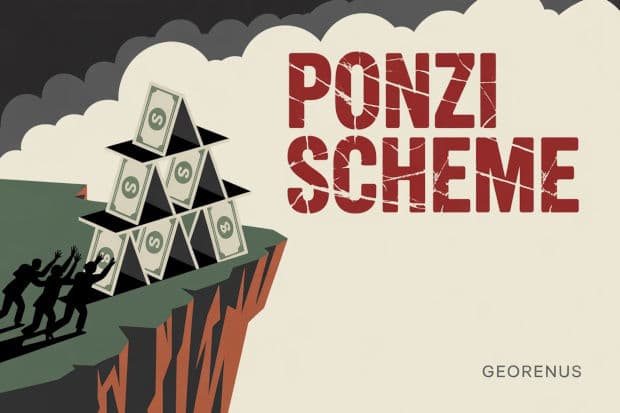
GeoPolitics
The U.S.-China Rivalry: What It Means for the World's Economy, Technology, and Military Balance

Accounting
GAAP: What It Is and Why It Matters in Accounting

Accounting
Business Accounting: What It Is and How It Works

Accounting
Accounting for Startups: A Complete Guide to Getting It Right

Accounting
Four Flavors of Accounting: Tax, Project, Financial, and Cost Accounting Explained
Accounting
Financial Recording and Transactions: The Complete Guide