Crisis Economics: How Economic Disasters Happen, Unfold, and Get Resolved
G
GeoRenus Editorial Team
1,101 views
Summary
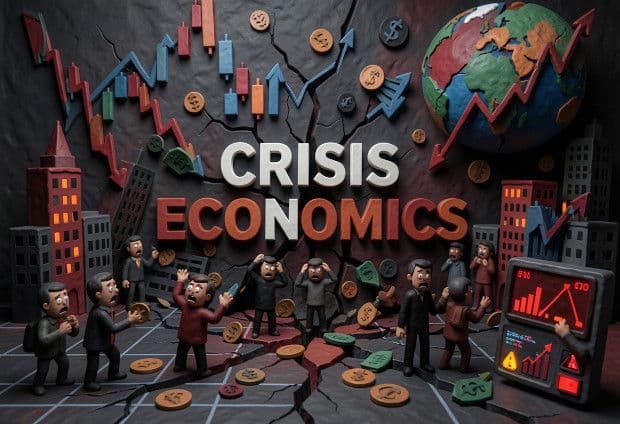
Economic crises are not random accidents — they are built up slowly by excessive debt, asset bubbles, poor policy, and human greed, then triggered by a single spark. From the 1929 Great Depression to the 2008 global meltdown, from the 1997 Asian crisis to the COVID shock of 2020 and Sri Lanka's 2022 collapse — every crisis follows a recognizable pattern. This article breaks down what an economic crisis really is, why it happens, how governments and central banks fight back, what recovery looks like, and what you personally should do to protect yourself — all in plain English with real data, facts, and examples.
Key Takeaways
- 1. Economic crises are inevitable — there have been 15+ major crises since 1900. The IMF estimates the average financial crisis costs 9.6% of GDP. Boom-bust cycles are built into market economies, but human greed and weak regulation make each crisis worse than it needs to be.
- 2. Seven root causes drive most crises: excessive debt (Minsky Moment), asset bubbles, banking system failure, external shocks, monetary policy errors, political instability, and financial contagion. In 2008, US household debt hit 98% of GDP before the crash.
- 3. Recoveries come in five shapes: V (fast bounce), U (slow grind), W (double dip), L (lost decade), and K (rich recover, poor don't). Japan's 1990s property bubble collapse produced an L-shaped recovery that lasted over 30 years.
- 4. Governments and central banks fight crises with rate cuts, Quantitative Easing (QE), fiscal stimulus, bailouts, and IMF programs. The US alone spent $5+ trillion in response to COVID-19 — the largest peacetime fiscal intervention in history.
- 5. Early warning signs can be spotted before a crisis hits: an inverted yield curve (has predicted every US recession since 1955), rising non-performing loans, VIX spikes above 30, debt-to-GDP over 90%, and inflation above 10%.
- 6. Personal preparation is the best defense: build a 6-12 month emergency fund, pay down high-interest debt, diversify income streams, avoid panic selling during downturns, and invest in skills. Every crisis in history has eventually ended.
Introduction: Why Crises Are Inevitable
Economies never move in a straight line. Look at any century of financial history and you will see the same pattern repeating: a long boom, then a sudden bust, then a painful recovery. Since 1900, the world has experienced more than 15 major economic crises. Each one has upended the lives of hundreds of millions of people — wiping out savings, destroying jobs, and toppling governments.
Nouriel Roubini — the economist the world calls 'Dr. Doom' — stood before an IMF audience in 2006 and predicted the 2008 collapse in remarkable detail: a housing bubble, reckless mortgage lending, a banking system on the edge of a cliff. The room largely laughed. Two years later, he was proved spectacularly right.
'Financial crises are not random events — they are man-made disasters.'
That quote captures everything. The economic cycle — expansion, peak, contraction, recovery — is completely normal. What turns a normal downturn into a full-blown crisis is a combination of human greed, weak regulation, and herd behavior all firing at once.
The IMF has calculated that the average financial crisis costs a country 9.6% of its GDP. For a large economy, that translates to trillions of dollars of destroyed wealth.
In this article you will learn: what an economic crisis actually is, the seven root causes behind most crises, the defining disasters of modern history, how governments and central banks fight back, how to read the warning signs before a crisis hits, what you personally should do to protect yourself, and where Bangladesh fits into this global story.
Chapter 1: What Is an Economic Crisis?
Defining a Crisis
An economic crisis is not just a slow quarter or a bad earnings season. It is a sudden, severe deterioration in economic conditions — GDP contracts sharply, unemployment surges, businesses close in waves, and the financial system comes under extreme stress.
The key difference between a normal slowdown and a genuine crisis is two things: PANIC and SYSTEMIC FAILURE. In a crisis, it is not one sector that is struggling — it is the entire backbone of the economy that is shaking. Banks stop lending to each other. Consumers stop spending. Businesses stop investing. The whole machine seizes up.
Recession vs Depression
Recession: Two or more consecutive quarters of falling GDP. A fairly common event — most developed economies experience one roughly every decade. Painful, but manageable.
Depression: A prolonged, severe recession — GDP falls 10% or more, or the downturn lasts three or more years. The 1929 Great Depression and the 2008 Great Recession are the two most famous examples in modern history.
Think of it this way: a recession is a bad fever. A depression is a life-threatening illness. Both need treatment, but the dosage is very different.
Five Types of Economic Crisis
Banking Crisis: Banks fail or freeze. People cannot access their deposits. Credit dries up across the economy. Example: the 2008 US banking collapse.
Currency Crisis: A country's currency collapses suddenly against foreign currencies. Example: Thailand's baht in 1997, losing 40% of its value overnight.
Sovereign Debt Crisis: A government cannot repay its debts and risks defaulting. Example: Greece in 2010, Sri Lanka in 2022.
Supply Shock: Production or supply chains are suddenly disrupted, causing prices to spike and output to fall. Example: the 1973 oil embargo, COVID-19 in 2020.
Speculative Bubble Burst: Asset prices have risen far above their fundamental value, then crash back to earth. Example: the Dotcom bubble in 2000, the US housing bubble in 2008.
| Crisis Type | What Happens | Classic Example | Typical Duration | GDP Impact |
| Banking Crisis | Bank failures, credit freeze | 2008 US financial crisis | 2-5 years | -4% to -10% |
| Currency Crisis | 30-80% currency devaluation | 1997 Asian crisis | 1-3 years | -5% to -13% |
| Sovereign Debt Crisis | Government default or IMF rescue | Greece 2010 | 5-10 years | -7% to -25% |
| Supply Shock | Production halts, prices spike | COVID-19 2020 | 1-2 years | -3% to -10% |
| Speculative Bubble Burst | Asset price collapse, investment slump | Dotcom 2000 | 1-3 years | -1% to -5% |
Chapter 2: Why Crises Happen — Seven Root Causes
1. Excessive Debt
Hyman Minsky's most famous insight: 'Stability breeds instability.' The better times feel, the more debt people take on — and the more fragile the system becomes.
During good times, banks lend freely, households borrow to buy homes and cars, corporations lever up to make acquisitions. Then something changes — income drops, interest rates rise, or a single shock hits. Suddenly, repayment becomes impossible. The whole house of cards collapses. In 2008, US household debt reached 98% of GDP. Economists call the moment the bubble finally pops a 'Minsky Moment.'
2. Asset Bubbles
A bubble forms when asset prices rise far beyond any rational connection to underlying value, driven by speculation and the fear of missing out.
History's most famous bubbles: Tulip Mania (Netherlands, 1637) — a single tulip bulb traded for the price of a house. The Dotcom Bubble (2000) — internet companies with no revenue were valued in billions. The US Housing Bubble (2008) — home prices detached completely from income levels.
Robert Shiller's CAPE ratio (Cyclically Adjusted Price-to-Earnings) is one of the best tools for spotting stock market bubbles. When CAPE climbs above 30, history suggests the market is dangerously overvalued.
3. Banking System Failure
Banks are the circulatory system of the economy. When they fail, the whole body goes into shock.
A classic bank run happens when depositors panic and rush to withdraw their money simultaneously. Since banks lend out most of their deposits, they cannot meet the demand. When Lehman Brothers collapsed in September 2008 — with $600 billion in assets — the global credit markets froze almost instantly. Companies could not borrow to make payroll. The entire financial plumbing seized up.
4. External Shocks
Some crises arrive from completely outside the economic system — impossible to predict with standard models.
The 1973 Oil Shock: OPEC Arab nations cut off oil exports to the West. The price of oil quadrupled from $3 to $12 a barrel in months.
COVID-19 (2020): A virus shut down the physical economy of the entire planet simultaneously — something no economic model had ever contemplated.
The Russia-Ukraine War (2022): Disrupted global food and energy supplies, triggering an inflation wave that circled the globe.
5. Monetary Policy Errors
Central banks can make crises worse — sometimes by trying to prevent them.
After the 1929 crash, the US Federal Reserve raised interest rates — exactly the wrong move. It turned a bad recession into the Great Depression. Decades later, keeping rates too low for too long in the 2000s helped inflate the housing bubble that triggered 2008. There is a brutal irony here: too loose a policy creates bubbles, too tight a policy pops them violently.
6. Political Instability
Investors need certainty. Political chaos destroys it.
Argentina in 2001 is the textbook case: political turmoil, a government default, and GDP falling 10.9%. The country went through five presidents in two weeks. Turkey and Venezuela have both shown how political decisions that undermine central bank independence can send a currency into freefall, triggering economic meltdowns that wipe out the savings of ordinary citizens overnight.
7. Contagion Effect
In a globally connected financial system, a crisis in one country spreads to others with frightening speed.
1997 Asian Crisis: Started in Thailand when the baht was devalued. Spread to Indonesia (GDP -13%), South Korea (GDP -7%), Malaysia, and the Philippines within months.
2008: US housing market problems → Lehman Brothers collapse → European bank failures → global credit freeze. What started on a few streets in Las Vegas and Miami ended up destroying wealth from London to Tokyo.
The more integrated global trade and capital markets become, the faster contagion moves. A crisis today can cross an ocean in hours.
Chapter 3: History's Most Devastating Economic Crises
1929 — The Great Depression
October 29, 1929 — 'Black Tuesday': the US stock market lost $14 billion in a single day. It was the trigger for the worst economic catastrophe in modern history.
The damage: US GDP fell 30%. Unemployment hit 25% — one in four workers without a job. 9,000 banks collapsed. Real recovery did not come until World War II ended in 1945.
The Great Depression reshaped economics permanently. It gave birth to Keynesian theory — the idea that government spending must step in when private demand collapses. Every subsequent crisis response has borrowed from the playbook written in the 1930s.
1973 — The Oil Shock
OPEC Arab nations imposed an oil embargo on the United States and Western allies in retaliation for support of Israel in the Yom Kippur War.
The result: Oil prices jumped from $3 to $12 — a 300% increase in months. 'Stagflation' was born: inflation and economic stagnation occurring simultaneously — something economists had previously thought impossible.
This crisis permanently changed global energy politics. Western nations began the long search for energy independence and alternative sources. It also exposed a fundamental weakness in the Keynesian toolkit: standard stimulus does not work when the problem is supply, not demand.
1997 — The Asian Financial Crisis
It started with Thailand's baht. When the Thai government was forced to abandon its dollar peg, the baht lost 40% of its value almost immediately.
The contagion was brutal: Indonesia GDP -13%, Thailand -10%, South Korea -7%. Currencies across the region fell 40-80%.
The IMF deployed a $117 billion rescue package — but attached strict conditions: austerity, structural reforms, higher interest rates. Many economists now argue those conditions deepened the pain unnecessarily. The crisis sparked a fierce debate about IMF conditionality that continues to this day.
2008 — The Global Financial Crisis
US subprime mortgage lending → complex financial instruments (CDOs, MBS) sold globally → Lehman Brothers collapses September 15, 2008 → global credit markets freeze.
The damage: Global GDP fell 2.1% — the first worldwide contraction since World War II. American families lost $10 trillion in household wealth. US unemployment climbed to 10%.
The 2008 crisis exposed the danger of unregulated financial innovation — instruments so complex that even the banks selling them did not fully understand the risk. It triggered the Dodd-Frank Act, Basel III banking regulations, and a fundamental rethinking of how much leverage the financial system should be allowed to carry.
2020 — The COVID Shock
This was something entirely new: a simultaneous supply shock AND demand shock hitting every major economy at the same time.
The damage: Global GDP fell 3.1% (IMF). Over 100 million people were pushed into extreme poverty (World Bank). But unprecedented government spending allowed many economies to recover faster than almost anyone expected.
The COVID crisis proved that when governments act fast enough and spend large enough, even a catastrophic shock can be cushioned. It also demonstrated the K-shaped recovery — where technology workers and investors thrived while low-wage service workers were devastated.
2022 — The Inflation Crisis
Post-COVID excess money printing + supply chain chaos + the Russia-Ukraine war = a global inflation surge not seen in 40 years.
The numbers: US inflation hit 9.1% — its highest since 1981. UK hit 11.1%. Bangladesh reached 9-10%. Sri Lanka collapsed entirely — foreign currency exhausted, fuel unavailable, medicine running out.
Central banks responded with the fastest rate-hiking cycle in decades. The Fed raised rates from near-zero to 5.25% in just 18 months.
| Crisis | Year | Root Cause | GDP Impact | Peak Unemployment | Duration | Key Lesson |
| Great Depression | 1929-39 | Stock bubble, bank failures | -30% (US) | 25% | 10 years | Government must step in — austerity kills |
| Oil Shock | 1973-75 | OPEC embargo | -3% to -5% | 9% | 2-3 years | Energy diversification is essential |
| Asian Crisis | 1997-98 | Currency pegs, debt bubble | Indonesia -13% | 20%+ | 2-5 years | Foreign reserves are a lifeline |
| Global Financial Crisis | 2008-12 | Subprime + Lehman collapse | -2.1% (world) | 10% (US) | 4-5 years | Regulate financial innovation |
| COVID-19 | 2020-21 | Pandemic + lockdowns | -3.1% (world) | 14.7% (US) | 1-2 years | Health security = economic security |
| Inflation Crisis | 2022-23 | Money printing + war | Growth slowed | Near-normal | 1-2 years | Excess QE has a long tail |
War and Economic Crisis: The Oldest and Most Devastating Connection
The oldest and most destructive cause of economic crisis is war. Every major war in history has produced economic devastation — sometimes limited to the warring nations, sometimes engulfing the entire world.
How War Creates Economic Crisis
1. Direct Destruction:
Factories, infrastructure, crops, homes — all destroyed. In World War II, over 50% of Europe's infrastructure was demolished.
2. Military Spending Drains National Wealth:
Wars consume staggering amounts of money. According to Brown University's Cost of War project, the US has spent over $8 trillion on post-9/11 wars alone. That money could have funded education, healthcare, or infrastructure for decades.
3. Supply Chain Disruption:
War shuts down trade routes. Oil, food, and raw material supplies collapse. In 2022, the Russia-Ukraine war disrupted wheat and sunflower oil supplies, driving global food prices up by over 30%.
4. Inflation and Currency Collapse:
Governments print money to fund wars. The result is inflation — sometimes hyperinflation. In Weimar Germany after WWI, a loaf of bread cost one trillion marks.
5. Refugees and Humanitarian Crisis:
According to UNHCR, over 110 million people were displaced worldwide in 2023 — the vast majority due to conflict. Refugees create economic pressure on host countries.
6. Sanctions as Economic Warfare:
Modern wars don't always require bullets. Economic sanctions — SWIFT disconnection, asset freezes, trade bans — can cripple a country's economy without a single bomb being dropped.
Historical Examples: War-Driven Economic Crises
World War I (1914-18):
Britain entered the war as the world's richest nation and exited as America's debtor. Germany's war reparations (Treaty of Versailles, 132 billion gold marks) triggered hyperinflation — which paved the way for Hitler's rise to power.
World War II (1939-45):
The most expensive war in history. Total cost approximately $1.6 trillion (1945 dollars), or $20+ trillion in today's money. Europe and Japan reduced to rubble. But America prospered — the war never touched its soil.
Korea and Vietnam Wars:
America's Vietnam War (1955-75) created massive economic pressure — rising inflation, budget deficits, and ultimately forced Nixon to sever the dollar-gold link in 1971.
Iraq War (2003-11):
According to Joseph Stiglitz and Linda Bilmes, the true cost of the Iraq and Afghanistan wars exceeded $3 trillion — a major contributor to America's ballooning national debt.
Russia-Ukraine War (2022-present):
The most recent example. Ukraine's GDP contracted by 29% in 2022. The harshest sanctions in history were imposed on Russia. Global impact: food price surges (Ukraine is the world's 5th largest wheat exporter), energy crisis (Europe was dependent on Russian gas), and inflation worldwide.
The Vicious Cycle: War and Economic Crisis Feed Each Other
Economic crisis creates social unrest, which brings populist leaders to power, who start wars, which create bigger crises. The 1929 Great Depression led to Hitler's rise, which led to World War II — the most devastating example of this cycle in history.
Sanctions — Modern Economic Warfare
In the modern world, economic sanctions have become a powerful weapon — sometimes more effective than military force. SWIFT disconnection, asset freezes, and trade bans can devastate an economy without firing a shot.
Iran example: After being partially disconnected from SWIFT in 2012, Iran's oil exports dropped 50%, its currency lost 50% of its value, and inflation exceeded 40%.
Russia example: In 2022, $300 billion of Russia's central bank foreign assets were frozen — the first time in history that a major country's central bank reserves were seized this way.
Bangladesh and War-Driven Economic Impact
Bangladesh may not fight wars directly, but it feels their economic impact acutely:
1971: The Liberation War destroyed massive infrastructure, pushing GDP below $6.5 billion. The 1974 famine was a direct consequence of post-war economic devastation.
2022: The Russia-Ukraine war forced Bangladesh to raise fuel prices by 50%, foreign reserves fell from $44 billion to $20 billion, and inflation doubled.
Middle Eastern conflicts pose special risk to Bangladesh — a large portion of overseas workers are based there. War threatens the $21.6 billion remittance lifeline.
| War | Period | Economic Impact | Global GDP Effect | Long-term Consequence |
| World War I | 1914-18 | Europe devastated, Germany hyperinflation | Europe GDP -15%+ | Hitler's rise, WWII |
| World War II | 1939-45 | Cost $20+ trillion (today's value) | Warring nations -40% | Bretton Woods, UN, Marshall Plan |
| Korea/Vietnam | 1950-75 | US inflation, budget deficits | Limited | Nixon Shock 1971 |
| Iraq War | 2003-11 | US cost $3+ trillion | Limited | US national debt surge |
| Russia-Ukraine | 2022-present | Ukraine GDP -29%, global inflation | Global GDP -0.5% (IMF) | Energy transition accelerated |
Chapter 4: How Governments and Central Banks Fight Crises
Monetary Policy — The Central Bank's Toolkit
Interest rate cuts: Borrowing becomes cheaper. Businesses invest more. Consumers spend more. Credit flows again.
Quantitative Easing (QE): The central bank creates money electronically and uses it to buy government bonds and other assets, injecting liquidity directly into the financial system.
Emergency lending: The central bank acts as 'lender of last resort' — providing instant liquidity to banks that would otherwise fail.
The Fed in 2008: Cut rates from 5.25% to essentially zero, then deployed $4 trillion in QE. In 2020, it launched another $4-5 trillion QE within weeks of the COVID shock.
Fiscal Policy — The Government's Toolkit
Stimulus spending: Building infrastructure, direct cash transfers to households, expanded unemployment benefits.
Tax cuts: Leave more money in people's pockets to spend.
Social safety nets: Unemployment insurance and welfare programs act as automatic stabilizers, keeping consumer demand from collapsing entirely.
US CARES Act (2020): $2.2 trillion. Biden's American Rescue Plan: $1.9 trillion. Total US COVID fiscal response: over $5 trillion — the largest peacetime spending program in American history.
Bailouts
When a systemically important institution is failing, governments sometimes choose to rescue it with public money rather than let it collapse.
US TARP (2008): $700 billion bank bailout. AIG alone received $185 billion.
Bailouts are deeply controversial because of 'moral hazard' — if big institutions know the government will rescue them, they take reckless risks ('too big to fail'). But the alternative — letting a Lehman-scale bank fail — can trigger a systemic collapse that hurts far more people than the bailout costs. It is a brutal choice with no clean answer.
International Assistance
When a country's own resources are exhausted, the IMF provides emergency lending — with conditions attached.
1997 Asia: $117 billion. 2010 Greece: $289 billion. Bangladesh (2023): $4.7 billion IMF program.
IMF conditions typically include austerity (cutting government spending), removing subsidies, raising interest rates, and structural reforms. These measures cause short-term pain — but the goal is to restore long-term fiscal stability and investor confidence.
| Tool | Who Uses It | How It Works | Example | Risk |
| Rate cuts | Central bank | Cheaper borrowing → more investment | Fed 2008: 5.25%→0% | Inflation, asset bubbles |
| Quantitative Easing | Central bank | Buy bonds to inject liquidity | Fed 2008-14: $4T | Asset bubbles, currency debasement |
| Stimulus spending | Government | Boost demand, create jobs | US CARES Act $2.2T | Rising national debt |
| Bailouts | Government | Rescue failing institutions | US TARP $700B | Moral hazard |
| IMF rescue | International | Emergency foreign currency loans | Bangladesh 2023: $4.7B | Harsh conditions |
Chapter 5: How to See a Crisis Coming — Early Warning Signs
Key Warning Indicators
Inverted Yield Curve: Short-term interest rates rise above long-term rates — a sign that bond markets expect economic trouble ahead. This indicator has predicted every US recession since 1955 without a single false negative in over 70 years.
Rising Non-Performing Loans (NPLs): When the share of loans that borrowers cannot repay starts climbing, it is an early signal of a coming banking crisis.
VIX Spike: The VIX is the 'fear index' of the US stock market. When it climbs above 30, markets are in high-stress mode. In 2008, VIX hit 80 — its all-time record.
Falling Consumer Confidence: When households start cutting back on spending because they fear the future, GDP growth follows them downward.
House Price-to-Income Ratio: When home prices rise far faster than incomes, a housing bubble is likely building — one of the most reliable precursors to a financial crisis.
Numbers to Watch
Monitor these indicators regularly — they can give you months of advance warning before a crisis becomes front-page news:
| Indicator | Safe Zone | Caution Zone | Danger Zone | Bangladesh (2024) |
| Debt-to-GDP | <60% | 60-90% | >90% | ~38% |
| Current Account Deficit | <3% GDP | 3-5% GDP | >5% GDP | ~0.7% GDP |
| Inflation | <5% | 5-10% | >10% | ~9.9% |
| Foreign Reserves | >6 months imports | 3-6 months | <3 months | ~4 months |
| NPL Ratio | <5% | 5-10% | >10% | ~9.4% |
| Unemployment | <5% | 5-10% | >10% | ~5.2% |
Chapter 6: Personal Survival Guide — Do's and Don'ts
Governments manage the macro. Central banks manage liquidity. But whether you personally survive a crisis depends largely on the decisions you make long before it arrives.
DO:
Build an emergency fund: 6 to 12 months of living expenses in a liquid, accessible account. This is your first and most important line of defense.
Pay down high-interest debt: Credit card debt, personal loans — eliminate these before a crisis hits. In a downturn, debt becomes a trap.
Diversify your income: Relying on a single salary is dangerous. Freelancing, a side business, or investment income gives you options when your primary income is threatened.
Do not panic sell: When markets crash, every instinct says sell. Fight it. Every major market crash in history has eventually been fully reversed and then some.
Stock essentials strategically: A few weeks of non-perishable food, medicine, and cash at home is simple insurance — not paranoia.
Invest in skills: In any downturn, skilled people are the last to be let go and the first to be rehired. The best crisis investment is in yourself.
DON'T:
Take on new debt during a crisis: Adding financial obligations when income is uncertain is one of the fastest ways to spiral into insolvency.
Speculate in volatile assets: Stocks, crypto, and commodities are most violent during crises. This is not the time for gambling.
Quit a stable job without a confirmed alternative: Job markets seize up during crises. A bird in the hand is worth ten in the bush.
Keep all your money in one bank: Deposit insurance has limits. Spread your savings across institutions.
Ignore insurance: Health, life, and income protection insurance are most valuable precisely when a crisis hits. Do not let them lapse.
| Phase | Savings | Debt | Income | Investments |
| Before a crisis | Build 6-12 month emergency fund | Pay off high-interest debt | Create multiple income streams | Maintain diversified portfolio |
| During a crisis | Draw on emergency fund, cut non-essentials | Avoid new debt at all costs | Protect existing income, explore alternatives | Hold — do not panic sell |
| After a crisis | Rebuild the emergency fund first | Resume debt payoff when stable | Upgrade skills and career positioning | Buy quality assets at discounted prices |
Chapter 7: Recovery Shapes — V, U, W, L, and K
V-shaped Recovery
Sharp fall, fast rebound. The best possible outcome.
Example: Several major economies in 2020 Q3-Q4. Government stimulus hit the economy fast, the underlying productive capacity was intact, and pent-up consumer demand was enormous. The US GDP fell 31.4% annualized in Q2 2020 — then bounced back 33.8% annualized in Q3. That is a V.
U-shaped Recovery
Fall, extended trough, then slow gradual recovery.
Example: The US after 2008. GDP contracted sharply, but unemployment stayed elevated for years — peaking at 10% and not returning to pre-crisis levels until 2016. Full recovery took nearly eight years. The wound healed, but slowly.
W-shaped (Double Dip)
Recovery begins, then a second contraction hits before the real recovery takes hold.
Example: The United States in 1980-82. The first recession ended, the Fed declared victory and began easing — then a second recession struck almost immediately. This happens when stimulus is withdrawn too early, or when a second external shock arrives before the economy is fully healed.
L-shaped Recovery
The economy falls and then simply stays down for an extended period. The most feared outcome.
Example: Japan after its 1990 property and stock market bubble burst. What economists expected to be a few years of adjustment became the 'Lost Decade' — which then became the 'Lost Three Decades.' By 2020, Japanese nominal GDP was barely higher than it was in 1995. The causes: zombie banks, deflation expectations, and policy half-measures.
K-shaped Recovery
The economy 'recovers' — but only for some. Inequality widens as different groups experience opposite trajectories.
Example: COVID-19 recovery in 2020-21. The S&P 500 recovered its losses within five months. Tech workers shifted seamlessly to remote work and saw their wealth increase. Meanwhile, restaurant workers, hotel staff, and low-wage service employees faced prolonged unemployment. Two economies running in opposite directions — one going up, one going down.
| Shape | Pattern | Typical Duration | Example | Who Benefits Most |
| V-shaped | Sharp fall, fast recovery | 6-12 months | COVID rebound (some countries) 2020 | Everyone equally |
| U-shaped | Fall, long trough, slow recovery | 2-5 years | US 2008-2012 | Wealthy and middle class |
| W-shaped (Double Dip) | Recovery, second fall, then real recovery | 2-4 years | US 1980-82 | Middle class and businesses |
| L-shaped | Fall, prolonged stagnation | 10+ years | Japan 1990 (Lost Decades) | Almost no one |
| K-shaped | Split recovery — diverging paths | Indefinite | COVID-19 2020 | Wealthy and tech workers |
Chapter 8: Bangladesh and Crisis Economics
Is Bangladesh in Crisis?
Not a full-blown crisis — but under simultaneous pressure from multiple directions:
Foreign reserves: Fell from a peak of $44 billion down to approximately $20 billion. The taka: Lost over 30% of its value against the dollar.
Inflation: Running at 9-10%, with food prices even higher. Banking sector NPLs: Around 9.4% — well above the safe threshold.
These pressures reflect both global forces — commodity price spikes, dollar strengthening, supply chain disruptions — and domestic structural weaknesses in the banking sector and energy financing. The $4.7 billion IMF program signed in 2023 provides a credibility anchor, but the reform path is demanding.
1971-74: Post-Independence Crisis
Bangladesh was born into economic catastrophe. War destroyed infrastructure, closed factories, and shattered trade links. GDP was below $10 billion.
The 1974 famine killed an estimated 100,000 to 500,000 people (estimates vary widely across sources). Hyperinflation, total dependence on foreign aid, and acute political instability defined the early years. It was arguably the most severe crisis any newly independent nation faced in the post-war era — and Bangladesh survived it.
2022-24: Recent Pressures
Three shocks arrived simultaneously: global commodity price spikes, a dollar shortage, and an energy crisis.
The IMF $4.7 billion program (2023) came with conditions: banking sector reform, subsidy rationalization, revenue mobilization, and exchange rate flexibility.
Capacity charge payments in the power sector have placed a heavy burden on public finances. High NPLs in the banking sector represent a structural vulnerability that pre-dates the recent pressures. But export revenues and remittances have remained relatively resilient, providing a floor under the economy.
Bangladesh's Strengths
Young workforce: 160 million people, with a large and growing working-age population — a demographic dividend that will drive growth for decades.
RMG resilience: A $55 billion garment export industry with deep integration into global supply chains gives Bangladesh a durable source of foreign exchange.
Remittances: $21.6 billion in remittance inflows — one of the highest in the world relative to GDP, and a powerful stabilizer during external shocks.
Digital economy: Mobile banking, e-commerce, and a fast-growing freelance tech sector are diversifying the economic base.
Geographic position: Sitting at the crossroads of South and Southeast Asia, Bangladesh has genuine long-term potential as a regional trade and logistics hub.
| Indicator | 2019 | 2022 | 2024 | Safe Threshold |
| Foreign Reserves | $32 billion | $44 billion | ~$20 billion | >$25 billion |
| Inflation | 5.5% | 7.7% | ~9.9% | <6% |
| USD/BDT Exchange Rate | 84 taka | 95 taka | ~110 taka | Stable |
| NPL Ratio | 9.2% | 8.8% | ~9.4% | <5% |
| Remittances | $18.3 billion | $21.6 billion | ~$22 billion | Upward trend |
| GDP Growth | 8.2% | 7.1% | ~5.8% | >6% |
Final Thoughts
Crises are inevitable. That is not pessimism — it is simply what 500 years of economic history tells us. The boom-bust cycle is embedded in how market economies work. What is NOT inevitable is how badly any particular crisis hurts.
The nations that build reserves, control debt, diversify their economies, and maintain strong institutions bounce back fast. The ones that ignore the warning signs, over-leverage in good times, and defer reform pay for it across generations. Japan waited too long. Greece borrowed too much. Sri Lanka ran down its reserves to zero. The pattern is always the same.
For individuals, the same logic applies. The person who builds an emergency fund during the good years, stays out of unnecessary debt, and keeps their skills sharp will weather any storm that comes. The person who maxes out credit cards and keeps all their eggs in one basket will not.
'In the middle of every difficulty lies opportunity.' — Albert Einstein (attributed)
Every single economic crisis in recorded history has eventually ended. After the Great Depression came the longest peacetime expansion the world had ever seen. After 1997's Asian collapse, South Korea rebuilt itself into one of the world's most dynamic economies. After COVID, global output hit record highs within two years.
The question is never whether the crisis will end. It will. The question is whether you — and your country — come out of it stronger or weaker than you went in. That answer is almost entirely determined by the choices made before the crisis arrives.
Recommended for you
The Bretton Woods Agreement: A Turning Point in Global Economic History
In 1944, as the world was still engulfed in the devastation of World War II, the global economy had collapsed and people’s living standards had plummeted. In an effort to stabilize the international economy and address pressing global financial issues, the Allied nations convened a historic summit. Nearly 730 delegates from 44 countries gathered at the Mount Washington Hotel in Bretton Woods, New Hampshire, for the United Nations Monetary and Financial Conference. The outcome of this summit was the landmark Bretton Woods Agreement, which gave birth to the Bretton Woods System.
Money
Money: What It Is, How It Works, and Its Complete History
Business Law
Business Law: What It Is, Why It Matters, and Types You Must Know

Canvas & Methods
Minimum Viable Product (MVP): The Smart Way to Launch Your Business With Less Risk

Investment
Investment: What It Is, Types, and Real Life Examples
Logo
Types of Logos: A Complete Guide to Every Logo Style You See Every Day

Organization
What Is the International Monetary Fund (IMF)?
Sales
What Is Sales and How Does It Work?

Startup
How to Calculate Startup Valuation: Methods, Tools, and Examples
Accounting
Gross Profit: Definition, Formula, and Why It Matters