Bangladesh's Boom-Bust Cycle -- How the Seeds of Collapse Were Hidden Within the Rise
G
GeoRenus Editorial Team
1,172 views
Summary
Bangladesh's 14-year economic rise from 2009 to 2022 carried the seeds of its own collapse, which broke into the open during the 2022-2024 crisis. GDP was growing fast, mega-projects were under construction, RMG exports touched USD 42 billion — but beneath the surface lay deep debt dependence, banking capture and reserve depletion. This article uses the Boom-Bust Cycle framework to explain how the crisis arrived, which signals were missed, and what the path forward looks like.
Key Takeaways
- Bangladesh's economy is now in the trough phase of a textbook boom-bust cycle -- World Bank's April 2026 update projects FY26 GDP at just 3.9%, NPL ratio at 35.73%, private investment at a 5-year low.
- During the 14-year boom phase, eighteen structural weaknesses accumulated unseen -- NPL hidden through rescheduling, politically distributed banking licenses, the $20-25B capacity payment trap, tax-GDP at just 6.8%, RMG concentration at 85%.
- Four storms (COVID 2020, Russia-Ukraine 2022, July uprising 2024, Trump tariff 2025) did not cause the collapse -- they exposed rot that had been there all along.
- Hyman Minsky's Financial Instability Hypothesis -- 'Stability breeds instability' -- is the most accurate single description of Bangladesh's trajectory. His theory predicted this story 50 years before it happened.
- Recovery signals exist: inflation down from 11.38% to 8.29%, reserves up from $18.6B to $26.4B, remittances at $3.17B/month (January 2026), Trump tariff reduced from 35-37% to 20%.
- Three critical risks remain: Middle East conflict (energy + Gulf remittances at risk), LDC graduation (November 2026, ~70% of trade preferences fading), new government populism ($800M IMF tranche held in suspense).
- Reaching a genuine boom requires six structural changes; the choice between South Korea's 3-5 year reform-led recovery and Brazil's Lost Decade is being made by policy decisions over the next 2-3 years.
Introduction -- The Tree With Rotten Roots Nobody Saw
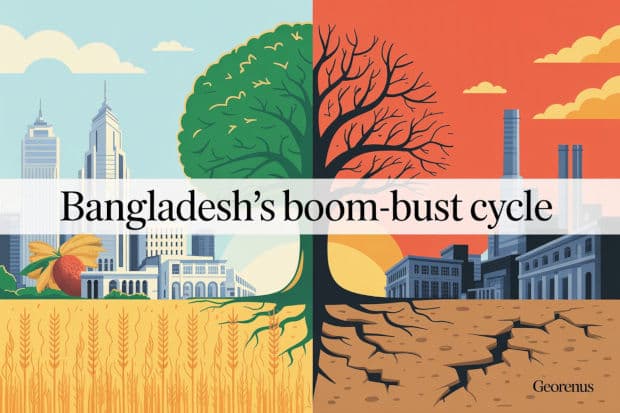
Picture a tree. From the outside it looks lush, vigorous, healthy. Every year new branches, new leaves, new flowers. The neighbors admire it -- "What a magnificent tree!" But beneath the soil, the roots are decaying. Nobody can see it, and nobody says it, because the canopy above demands all the attention. Then one day a storm arrives -- not a hurricane, just a moderate storm. The tree splinters with a sickening crack. Everyone is stunned. How could such a healthy tree fall so quickly?
The answer was always known. Nobody admitted it. The roots had been rotting for years. The storm did not kill the tree -- it only made the dying visible.
This article has a single, central thesis: Bangladesh's 2020-26 economic crisis was no accident, no mere consequence of external shocks. The seeds of the collapse were planted inside the 14-year boom phase itself. Every seed had a name -- non-performing loans, capacity payments, taka overvaluation, RMG over-concentration, fiscal weakness. Everyone saw them. Nobody named them. Until a moderate storm exposed everything at once.
According to the World Bank's April 2026 country update, Bangladesh's FY26 real GDP growth is projected at just 3.9% -- against a decade-long average of 6.5-7%. The non-performing loan ratio stands at 35.73%, private investment at a five-year low, private credit growth at a two-decade low. This is a textbook boom-bust cycle in its bust phase -- but the causes were not built in a single year. They accumulated quietly across 14 years of celebrated growth.
The article proceeds in seven movements: (1) Boom-Bust Cycle theory and Hyman Minsky's framework, (2) Bangladesh's 14-year boom and its glittering surface, (3) the eighteen structural weaknesses hidden beneath that surface, (4) how three storms -- COVID, Russia-Ukraine, and the July 2024 Uprising -- exposed the rot, (5) where Bangladesh stands now in seven dimensions of trough-phase reality, (6) how genuine the recovery signals actually are across four analytical layers, and (7) what risks lie ahead and what would constitute a genuine boom. This is not a summary. This is a complete economic post-mortem.
Boom-Bust Cycle Theory -- More Than Four Phases
Economists have wrestled for two centuries with a single question: why does an economy not grow in a straight line? Why must every few decades bring a crisis? The answers are not simple, but one idea has acquired the most credibility: the boom-bust cycle is an internal pattern of capitalism, not merely an outside disturbance. It is born from the dynamics of credit, expectations, and risk-taking themselves.
The Four Phases -- And What Really Happens Inside Each
Phase | Name | Economic Characteristics | Social Psychology |
1 | Expansion | GDP rising, investment rising, credit expanding, employment growing | Optimism, confidence, faith in the future |
2 | Peak | Asset bubbles, overvaluation, excessive risk-taking, credit excess | Euphoria -- 'this time is different', 'old rules don't apply' |
3 | Contraction | Defaults begin, asset prices crash, layoffs, credit freeze | Panic, mistrust, blame games |
4 | Trough | GDP at minimum, but leading indicators begin to turn | Despair, but rebuilding capacity awakens |
Hyman Minsky -- The Economist Who Wrote Bangladesh's Story 50 Years Early
Hyman Minsky was a relatively obscure American economist for most of his career. In the 1970s he proposed what he called the Financial Instability Hypothesis. Its core slogan: "Stability breeds instability." How does that work in practice?
When an economy performs well for a long time, businesses and banks gradually forget what risk feels like. They borrow more, lend more, accept thinner margins. Success breeds confidence, confidence breeds arrogance, arrogance breeds irrational risk-taking. At the end of this process arrives the so-called "Minsky moment" -- the instant when everyone simultaneously realizes the foundations of debt-fueled prosperity are hollow.
Minsky's Three Borrower Types | Characteristics | Bangladesh Examples |
Hedge Borrower | Can pay both principal and interest from operating income | Healthy small and medium-sized businesses |
Speculative Borrower | Can only pay interest; principal must be rolled over indefinitely | Many RMG factories, real estate developers |
Ponzi Borrower | Cannot even pay interest -- requires new loans to service old loans | Conglomerates such as S Alam Group, Beximco |
Minsky's central insight: an economy that drifts from Hedge to Speculative to Ponzi is drifting toward crisis. Bangladesh's banking system began that drift around 2010 and accelerated through the late 2010s. Nobody officially admitted it. Everyone in finance privately knew.
Schumpeter, Keynes, Minsky -- Three Lenses on the Cycle
Thinker | Core Idea | Relevance for Bangladesh |
Joseph Schumpeter | Creative Destruction -- the old must break for the new to be born | If the bust phase is well-managed, an opportunity for innovation |
John Maynard Keynes | Government intervention can dampen the cycle's intensity | Counter-cyclical fiscal policy -- but Bangladesh has no fiscal space |
Hyman Minsky | Stability itself sows the seeds of future instability | The literal 14-year story of Bangladesh |
Cycle Lengths -- Not All Cycles Are Equal
Cycle Type | Duration | Driver | Bangladesh Relevance |
Kitchin Cycle | 3-5 years | Inventory adjustments | Visible in RMG order books |
Juglar Cycle | 7-11 years | Fixed business investment | The 2009-2022 boom fits roughly here |
Kuznets Swing | 15-25 years | Demographic and infrastructure | Mega-project cycle since 2010 |
Kondratiev Wave | 45-60 years | Technological revolution | Bangladesh's RMG-led wave from 1980s |
The theory is now clear. The next question: what did Bangladesh's 14-year boom actually look like, and what was hidden inside the shine?
Bangladesh's Boom -- 14 Years of Glitter (2009-2022)
To understand the recovery problem, one must first appreciate how high Bangladesh climbed before the fall. The higher the climb, the more painful the descent -- and just as importantly, the higher the climb, the more structural weaknesses accumulate underneath. A ten-meter ladder may bruise you. A hundred-meter ladder kills.
Indicator | 2009 (approx.) | 2022 (Peak) | Change |
Per Capita GDP | ~$700 | ~$2,600 | Almost 4x |
GDP Growth (average) | ~5.5% | ~6.5-7% (sustained) | Continuity was the source of pride |
RMG Exports | ~$12 billion | ~$42 billion | 3.5x |
Remittances (annual) | ~$11 billion | ~$21 billion | Nearly doubled |
Foreign Reserves (peak) | ~$10 billion | ~$48 billion (Aug 2021) | Almost 5x |
Poverty Rate | ~31% | ~18% | Halved |
Mobile Subscribers | ~50 million | ~180 million+ | 3.6x |
Internet Subscribers | ~0.5 million | ~130 million | Explosion |
Note: Sources: Bangladesh Bureau of Statistics (BBS), Bangladesh Bank, World Bank, BTRC. Figures are approximate.
International Acclaim -- The 'Bangladesh Miracle'
During this period Bangladesh was repeatedly described as the next 'Asian Tiger.' World Bank reports cited the country as a 'development success story.' The Economist ran a cover essay titled 'The Bangladesh Paradox' -- how a country with weak institutions could nonetheless achieve such rapid growth. Foreign analysts marveled at the stability of the GDP graph.
Mega-projects made the story tangible. The Padma Bridge, the Karnaphuli Tunnel, the Rooppur Nuclear Power Plant, Dhaka Metro Rail, the Elevated Expressway -- each inauguration was a national festival. People would say, "We are on the road to Singapore." Foreign press echoed it. Domestic media amplified it. International institutions endorsed it. Everyone was, simultaneously, partly right and dangerously wrong.
Why Did Nobody See the Rot?
The question matters. Eighteen structural weaknesses accumulated for fourteen years. Yet alarm bells did not ring. Why? The reasons are tangled together:
- Political repression -- criticism could trigger Digital Security Act (DSA) cases
- Media self-censorship -- editors avoided narratives that contradicted the official 'development' story
- Complacency at international institutions -- the IMF and World Bank were satisfied looking at GDP graphs
- Economic success delivered partial gains to most stakeholders -- weakening the motivation to question
- Banking-sector data was opaque -- outsiders could not measure the true scale of NPLs
- The strength of remittances and RMG masked every other structural weakness
But beneath the glitter, eighteen deep structural weaknesses were quietly accumulating. The next three sections expose them, one layer at a time -- the banking and financial sector (Part 1), the fiscal and real sector (Part 2), and currency and governance (Part 3).
Seeds of Collapse Part 1 -- The Rot in Banking and Finance
The deepest structural weakness of Bangladesh's boom phase lived in the banking system. From the outside, branch counts were rising, deposits were growing, everything looked orderly. Inside, a systematic looting was under way. The rot accumulated in six distinct layers.
Weakness 1: Mountains of NPL Hidden Through Rescheduling
Bangladesh Bank's officially reported NPL ratio hovered at 8-10% throughout the boom. Yet IMF and World Bank analysts had warned for years that the true figure was 20% or more. The gap had a single explanation: loan rescheduling. Any defaulting loan could simply be re-papered as a fresh loan. The same loan was sometimes restructured three or four times. On paper, performing. In reality, dead. When Basel III standards were finally enforced in 2024, the reported NPL ratio leapt from 10% to 35.73%. It did not jump suddenly -- the rot had been there for a decade. Only the cover came off.
Weakness 2: Banking Licenses Distributed Politically
In 2012-2013, despite expert objections, the central bank handed out nine new commercial banking licenses simultaneously. The vast majority went to politically connected families. The S Alam Group at one point exercised effective control over seven banks (Islami Bank, Social Islami, First Security Islami, Global Islami, Union, NRBC and others). Multiple banks owned or controlled by the same family is a textbook conflict-of-interest problem -- and one that regulators ignored for over a decade.
Weakness 3: Looting One's Own Bank Through Shell Companies
The mechanism was simple but devastating, and it followed a five-step pattern that auditors have since reconstructed:
- Step 1: Acquire ownership or effective control of a bank
- Step 2: Create paper companies (shell companies) with no operating substance
- Step 3: Approve loans from your own bank to those shell companies
- Step 4: Show 'projects' on paper while siphoning the money abroad or into other ventures
- Step 5: When the loan defaults, reschedule it -- perpetual cover
CPD and TIB analyses estimate more than $50 billion was siphoned out of Bangladesh's banking system between 2010 and 2023 -- though precise figures remain unverifiable because the laundering itself was opaque. Global Financial Integrity (GFI) independently estimated annual illicit financial outflows from Bangladesh at $7-8 billion at the peak of the boom.
Weakness 4: Money Laundering and Capital Flight
Beyond loan-fueled laundering, trade misinvoicing was the largest single channel for capital flight. An exporter would invoice a $100 shipment as $70, leaving $30 in offshore accounts. An importer would invoice a $70 shipment as $100, parking the $30 difference abroad. GFI consistently rated Bangladesh among the world's worst for trade-misinvoicing leakage. Hundi networks -- informal cross-border money transfer -- ran in parallel, partly diverting remittances away from official channels and depriving the central bank of foreign exchange when it was most needed.
Weakness 5: A Cyclical Stock Market Scandal Pattern
The Dhaka Stock Exchange (DSE) suffered a catastrophic crash in 2010-11 in which retail investors lost tens of thousands of crore taka to coordinated manipulation. The Ibrahim Khaled inquiry committee identified those responsible. None were prosecuted. A second crash followed in 2018. After that, the DSE became, in effect, a half-dead market -- volumes fell, IPOs dried up, foreign portfolio investment retreated. Without a functioning capital market, every Bangladeshi corporation was forced to depend exclusively on bank loans -- which in turn worsened the NPL problem. One broken sector helped break another.
Weakness 6: The Absence of Bond and Money Markets
Mature economies finance long-term corporate projects through corporate bond markets and money markets. In Bangladesh both exist only nominally. A company building a 10-year project must raise short-term bank debt -- creating an asset-liability mismatch that is itself a structural source of fragility. Banking reform was promised year after year. Almost nothing materialized.
Reform Promise | Outcome |
Bank Companies Act amendment (2013) | Allowed up to 4 directors from one family -- the opposite of intended reform |
Tighter loan classification rules | Rescheduling continued without restraint |
Single borrower exposure limit | Repeatedly relaxed under industry pressure |
Bond market development | Stalled at the announcement stage |
DFI restructuring | On paper, not in practice |
NPL Recovery Tribunal | Ineffective; cases dragged on for years |
The rot in banking is now legible. But the problem was not confined to one sector. Identical decay had taken hold of the fiscal and real sectors. That is the next section.
Seeds of Collapse Part 2 -- The Rot in Fiscal and Real Sectors
Weakness 7: Mega-Projects Loaded With Foreign Debt
Mega-projects were the most visible artifact of the boom. The accounting tells a more sobering story.
Project | Approximate Cost | Financing Source | Economic Returns |
Padma Bridge | ~$3.6 billion | Domestic financing (controversial) | Transit benefit -- moderate ROI |
Rooppur Nuclear Power Plant | ~$12.65 billion | Russian loan ($11+ billion) | Power flows from 2027+; debt service starts now |
Dhaka Metro Rail (MRT-6) | ~$3.3 billion | JICA loan | Transit benefit -- good ROI |
Karnaphuli Tunnel | ~$1.1 billion | Chinese loan | Low utilization -- ROI questionable |
Elevated Expressway | ~$1.1 billion | PPP | Moderate ROI |
Matarbari Power Plant | ~$4.5 billion | JICA loan | Coal-based -- environmental questions |
These projects did contribute to GDP growth, particularly during construction. But the financing was overwhelmingly long-tenor foreign debt. Today's GDP today, tomorrow's debt service tomorrow. The World Bank had warned that several projects could not justify their cost-benefit ratios. Those warnings lost to the gravitational pull of inauguration ceremonies.
Weakness 8: The Capacity-Payment Trap in Energy
Quick Rental Power Plants were marketed in 2010 as a temporary fix to a power shortage. Fifteen years later they were still operating under the same toxic contractual logic: the government must pay 'capacity payments' whether or not the plant generates electricity. Power flowing or not, the rent must be paid.
CPD and other research estimates suggest Bangladesh paid more than $20-25 billion in capacity payments alone over the past decade -- much of it for power that was never delivered. The contract holders were largely politically connected conglomerates: S Alam Group, Orion Group, Summit Group, Beximco. The losses fell on the public; the gains accrued to a narrow elite.
Weakness 9: Hidden Subsidies and External-Shock Exposure
Energy prices were kept artificially low through subsidies on gas, electricity, diesel, fertilizer and food grains. Where did these subsidies come from? From government borrowing. Cheap gas today, larger debt service tomorrow. When global prices spiked in 2022, the subsidy bill became unmanageable. Prices were raised, all at once, and that price shock translated immediately into headline inflation. The hidden subsidy regime had simply delayed the inevitable -- and made the eventual adjustment more violent.
Weakness 10: Tax-to-GDP at 6.8% -- A Hollow Foundation
This is Bangladesh's deepest structural problem. According to CPD analysis, the tax-to-GDP ratio sits at just 6.8% -- the lowest in South Asia. By comparison: India ~11%, Vietnam ~15%, Indonesia ~12%, Thailand ~17%, OECD average ~34%.
Country | Tax-to-GDP Ratio (approximate) | Per-Capita Tax Capacity |
Bangladesh | 6.8% | Lowest in South Asia |
India | ~11% | 1.6x higher |
Vietnam | ~15% | 2.2x higher |
Indonesia | ~12% | 1.7x higher |
Thailand | ~17% | 2.5x higher |
OECD average | ~34% | 5x higher |
Low tax revenue means low public investment in education, health and infrastructure -- which means greater dependence on foreign borrowing. Even after fourteen years of growth, this ratio did not improve. Tax holidays for the wealthy and successive black-money whitening schemes deepened the structural problem instead of solving it. A country cannot become rich while running a tax system designed for a much poorer one.
Weakness 11: 85% Export Concentration in RMG -- One Bamboo Pole
Roughly 85% of Bangladesh's merchandise exports come from the ready-made garments sector, and roughly two-thirds of RMG exports go to the US and EU. That is a double concentration -- in product and market. Vietnam, Indonesia, India have all diversified exports across electronics, food processing, machinery and services. Bangladesh, by contrast, balances on a single sector. When the bamboo bends, the whole structure shakes.
Diversification was always possible -- leather, pharmaceuticals, IT services, jute, frozen food, ceramics. Each had real potential and none received serious policy attention. Why? Because the established RMG players (BGMEA leadership, the largest factory owners) were politically powerful and a new sector meant new competitors. Industrial policy in Bangladesh was effectively a defense of incumbents.
Weakness 12: Educated Unemployment and the Skills Mismatch
Roughly two million young Bangladeshis enter the labor market each year. In an RMG-dominated economy, the new jobs are almost all at the factory-worker level. There is little for university graduates. ILO data shows tertiary-education unemployment in Bangladesh exceeding 15%. Many graduates accept underemployment -- nominal jobs that waste both their skills and their wages. Real human capital sits idle while RMG factories cycle through low-cost labor. The aggregate growth statistic disguises this misallocation.
Weakness 13: Real Wage Stagnation -- The Hidden Truth Behind GDP Growth
Headline GDP grew at 7%, but the average worker's real wage did not keep pace. According to The Business Standard's analysis, nominal wage growth has lagged inflation for 26 consecutive months -- meaning purchasing power has been falling all along. The GDP graph trends upward; the household budget tightens. This is the textbook profile of 'jobless growth' or 'wageless growth.' It is also the social fuel that made the July 2024 uprising possible.
Banking, fiscal capacity, exports -- three pillars, all rotting. But the most dangerous weaknesses lay in currency management and governance. The next section opens that layer.
Seeds of Collapse Part 3 -- The Rot in Currency and Governance
Weakness 14: The Taka's Artificial Strength -- Burning Reserves to Hold a Peg
From 2017 to 2022, the taka was held artificially strong. The market-clearing exchange rate was probably 110-120 per US dollar; the official rate was kept at 85-87. How was this maintained? Bangladesh Bank sold dollars into the market every working day -- dollars drawn from the foreign reserves.
Two motives sat behind this policy. First, political: a weak taka makes imports expensive, raises consumer prices and erodes popularity. Second, structural: those engaged in capital flight benefited directly from a strong taka, since each taka converted into more dollars when sent abroad. The two motives reinforced each other. When reserves were nearly exhausted in 2022, the policy collapsed. The taka fell more than 40% in eighteen months.
Weakness 15: Reserve Overstatement -- The Embarrassment That Forced IMF Clarification
For years, Bangladesh Bank reported gross reserves as if they were usable. A meaningful chunk was committed to the Export Development Fund (EDF), the Long-term Financing Facility (LTFF) and similar instruments -- money that could not be used to defend the currency. In 2022-23, the IMF compelled Bangladesh to adopt BPM6 reporting standards. The result was humiliating: the headline $48 billion in reserves was actually $22-25 billion in usable terms. A 50% overstatement, sustained for years by accounting conventions everyone knew were misleading.
Weakness 16: The Lack of Bangladesh Bank Independence
Independent central banks are the foundation of macroeconomic stability. Bangladesh Bank was never one. The Governor was a political appointee. Monetary policy was effectively dictated by the Ministry of Finance. Regulations were relaxed under business-group pressure. The 2016 Reserve Heist -- in which $81 million was stolen from the Bangladesh Bank account at the New York Fed via SWIFT exploits -- was the most dramatic symptom of an institution that had not built operational integrity. Even after that humiliation, structural reform did not follow.
Weakness 17: The Expansion of Hundi and the Informal Economy
Because the taka was held artificially strong and a sizable gap had opened between official and curb-market exchange rates, the informal hundi network became overwhelmingly attractive to remitters. At the worst point in 2022-24, hundi-channel remittances rivaled official remittances in volume. Hundi flows do not enter official reserves -- but pay senders a better rate. The informal economy expanded beyond the measurement capabilities of the central bank, hollowing out the policy levers that normally support a currency.
Weakness 18: The Institutionalization of Crony Capitalism
Underlying every prior weakness was a single institutional pathology: the fusion of political power and economic privilege in the same hands. Under the Hasina administration, S Alam, Beximco, Orion, Summit, Bashundhara and Meghna -- with their political connections -- accumulated dominant positions across banking, energy, real estate and telecom. These were the largest defaulting borrowers, the largest beneficiaries of capacity payments, and the most prolific exporters of capital. The system was not failing by accident. It was performing exactly as those who designed it intended.
18 Structural Weaknesses -- Summary |
1. NPL hidden through rescheduling |
2. Banking licenses politically distributed |
3. Loan looting through shell companies |
4. Money laundering & capital flight ($7-8B/year per GFI) |
5. Cyclical stock market scandals |
6. Absent bond market & money market |
7. Mega-projects loaded with foreign debt |
8. Capacity-payment trap ($20-25B+ over a decade) |
9. Hidden subsidies and external-shock exposure |
10. Tax-to-GDP 6.8% -- lowest in South Asia |
11. 85% RMG export concentration |
12. Educated unemployment & skills mismatch |
13. Real wage stagnation (26 months below inflation) |
14. Taka's artificial strength burning reserves |
15. Reserve overstatement (gross vs net) |
16. Lack of Bangladesh Bank independence |
17. Hundi & informal economy expansion |
18. Institutionalized crony capitalism |
These 18 weaknesses were not isolated -- each strengthened the others. That is why a 'moderate' external storm could break the structure so quickly. Three storms hit Bangladesh between 2020 and 2026 -- COVID, the 2022 dollar shock, and the July 2024 uprising. Each storm exposed one layer of the rot. The next section follows that exposure storm by storm.
First Tremor -- COVID-19 (2020-21) and Its Long Shadow
Many people locate the start of Bangladesh's crisis in 2022. The actual starting point is March 2020, with COVID-19. COVID did not produce a visible collapse in Bangladesh -- but it did two consequential things: it accelerated the internal rot, and it built the bridge that made the next storm catastrophic.
RMG Hit -- $3+ Billion in Order Cancellations
By March-April 2020, Western retail had shut down. Walmart, H&M, Zara, Primark all canceled or postponed orders from Bangladesh. According to BGMEA, $3+ billion in RMG orders evaporated within weeks. Many factories could not pay wages. Some shut down. This was the first major warning of RMG over-concentration -- and policymakers chose not to remember it.
Migrant Worker Crisis -- Pressure on the Remittance Lifeline
Tens of thousands of migrant workers returned home as Gulf economies contracted. Falling oil prices led Saudi Arabia and the UAE to lay off Bangladeshi workers en masse. Initially, there was anxiety that remittances would collapse. In fact, 2020-21 saw remittances rise -- workers sent home larger amounts to cover their families' fixed expenses during uncertain times. But this was a one-time bump. The longer-term trend in Gulf labor markets had quietly turned against Bangladesh.
Recovery Debt -- The Sri Lanka Warning
To climb out of COVID, Bangladesh's government announced multiple stimulus packages -- for SMEs, agriculture, industry. Foreign and domestic borrowing rose sharply. Sri Lanka pursued the same logic and ended in a sovereign default. Bangladesh did not entirely follow Sri Lanka, but the sovereign debt-to-GDP ratio rose from 34% in 2020 to 39%+ by 2025. Each new dollar of stimulus debt narrowed the fiscal space available for the next storm.
Money Supply Expansion -- Seeding 2022's Inflation
Bangladesh Bank ran aggressive monetary stimulus during COVID -- low policy rates, refinance schemes, loan moratoria. M2 grew rapidly. That excess money supply, combined with the supply shock of 2022, translated directly into double-digit inflation. The lesson is straightforward: today's stimulus is tomorrow's inflation if structural productivity does not keep up.
COVID by itself did not crash Bangladesh. What COVID did was twofold: amplify existing weaknesses, and leave Bangladesh more exposed to the next shock. By February 2022, when Russia invaded Ukraine, Bangladesh was structurally more fragile than it had been in 2019.
Second Storm -- Russia-Ukraine, Dollar Crunch and Reserve Crisis (2022-23)
Russia invaded Ukraine in February 2022. Bangladesh has no direct connection to the war. Yet over the next eighteen months, the war's secondary effects punished Bangladesh's economy in ways almost no one had anticipated.
Commodity Shock -- Oil, Gas and Wheat at Once
Bangladesh imports all three. Within months of the war's start: Brent crude jumped from $75 to over $120, European LNG prices rose four to five-fold, wheat almost doubled. Bangladesh's annual import bill swelled by $20+ billion. There was no domestic substitute. Every taka of inflation was, in this sense, imported.
Fed Rate Hike -- The Dollar Tsunami
Simultaneously, the US Federal Reserve raised its policy rate from 0% to 5.5% to fight US inflation -- the fastest tightening in 40 years. The dollar strengthened globally; capital flowed out of emerging markets. For Bangladesh, this meant: each dollar of imports cost more taka, each dollar of foreign debt service cost more taka, each dollar held in reserve became more precious.
Reserve Drain -- $48B to $20B in 24 Months
Bangladesh Bank fought aggressively to defend the taka -- selling dollars day after day. Reserves peaked at $48 billion in August 2021. By the end of 2023 they had fallen to about $20 billion -- a roughly 60% drain in two years. At that point defending the peg was no longer possible. The taka fell from 85 to 110 in 2022, to 120 in 2023-24, and stands near 122 today. Cumulative depreciation: more than 40%.
IMF $4.7 Billion Bailout -- The 'We Surrender' Moment
In January 2023, Bangladesh signed a $4.7 billion bailout agreement with the IMF. The conditions cut directly into the heart of every structural weakness from the boom phase: subsidy reform, exchange-rate flexibility, banking transparency, NPL reclassification according to international standards, and revenue mobilization. The IMF was effectively saying: 'fix all the things you let rot during the boom.' That is the moment at which Bangladesh's policy elite quietly conceded the previous fourteen years had not been the success story they had advertised.
The 2022 storm exposed a second layer of rot -- currency and reserves. But a still larger storm was coming. It would be political as much as economic. It arrived in July 2024.
Third Storm -- The July 2024 Uprising and NPL Exposure
The July-August 2024 events were not merely a political transition. They were the detonation of fourteen years of accumulated economic and social pressure. And that detonation made every layer of rot -- previously hidden -- suddenly visible to the world.
Why the Uprising Was Inevitable
Five forces converged: rising inflation, youth unemployment, falling real wages, intensifying political repression and the immediate trigger of the quota movement. Together they transformed a student protest into a national uprising. The immediate economic damage from curfews and shutdowns has been estimated at $1.2+ billion -- factories closed, RMG orders canceled, investors retreating to wait-and-see. But that immediate damage was trivial. The deeper effects came later, after the dust settled.
The Unmasking of Hidden NPL -- The End of the 'Under the Carpet' Era
After August 2024, the interim government replaced the leadership of Bangladesh Bank. Governor Ahsan H Mansur adopted an explicit transparency policy. Basel III loan classification standards began to be enforced rigorously. And the buried numbers came up for air.
Bangladesh Bank Executive Director Arif Hossain Khan acknowledged in multiple interviews: "In the past, banks kept NPLs under the carpet. Irregular loans to influential clients were not recorded as NPL."
Period | Reported NPL Ratio | Comment |
June 2023 | ~10% | Official, pre-transparency |
June 2024 | ~12.2% | Final pre-transition reading |
December 2024 | ~20.2% | Basel III adoption begins |
March 2025 | ~24.6% | S Alam, Beximco defaults emerge |
June 2025 | ~34.6% | System-wide crisis acknowledged |
September 2025 | ~35.73% | 25-year high |
The 14-month rise from 10% to 35.73% was not an actual deterioration of credit quality at that pace. It was the gap between accounting reality and underlying reality finally closing. The NPLs had always been there. The new government simply removed the cover.
S Alam and the Other Conglomerates' Exposure
Audits commissioned by the interim government revealed staggering numbers. The S Alam Group alone had extracted more than BDT 1,50,000 crore (approximately $12+ billion) from various banks -- the bulk of it now classified as non-performing. Beximco, Orion, Summit and others appeared on the same lists. The interim government force-merged five Islamic banks into Sammilito Islami Bank PLC -- all five had been vehicles of S Alam control.
Trump Tariff (2025) -- The Fourth Shock
Donald Trump returned to the US presidency in January 2025. In April 2025, his administration announced reciprocal tariffs of 35-37% on Bangladeshi goods. According to Atlantic Council documentation, after months of negotiation the tariff was reduced to 20% in a July 2025 deal -- placing Bangladesh on parity with Vietnam. Even at 20%, however, the impact on already-thin RMG margins was severe. The fourth storm landed on a system that had absorbed three previous storms with no recovery in between.
The cumulative result of four storms (COVID, Russia-Ukraine, July 2024 uprising, Trump tariff): FY26 GDP at 3.9%, NPL at 35.73%, private investment at a five-year low. That position is the trough phase. There is, in a literal sense, almost no room left to fall further.
Where We Are Now -- The Seven-Dimensional Picture of Trough Phase
A trough is not just a theoretical concept. It strikes an economy along seven distinct dimensions: national output, banking and finance, external balance, government finance, household economics, investment, and the price level. To see Bangladesh's trough clearly, each dimension must be examined with its own data. This section does that, dimension by dimension.
Dimension 1: National Output -- A Sector-by-Sector Breakdown
According to the World Bank's April 2026 country update, Bangladesh's FY26 real GDP growth is projected at 3.9% -- the lowest reading since the COVID period. PRI's most recent analysis shows Q2 FY26 growth at just 3%. Disaggregating this aggregate by sector makes the picture sharper.
Sector | Share of GDP (%) | FY24 Growth | FY26 Growth (estimated) | Status |
Agriculture | ~11% | 3.3% | 2.6% | Slowing -- climate stress and fertilizer cost |
Industry | ~34% | 6.5% | 3.1% | Sharp slowdown -- RMG orders, energy |
Services | ~52% | 5.3% | 4.7% | Resilient but slowing |
Construction | ~7% | 4.8% | 1.9% | Mega-project pipeline winding down |
Manufacturing | ~24% | 6.6% | 2.8% | Hit by RMG dependence |
The industrial slowdown is the most dramatic -- 6.5% to 3.1%, almost halved. The bulk of that decline reflects the Trump tariff impact on RMG and the energy cost shock. Services have held up relatively well because remittance-funded household consumption has continued. Agriculture has been quietly broken for years -- climate change, input costs, and rising NPLs in agricultural lending are converging.
Dimension 2: Banking and Finance -- An ICU Patient
Indicator | Peak/Healthy Level | Trough Level (2025-26) | Source |
NPL Ratio | ~10% (reported) | 35.73% (actual) | Bangladesh Bank, Sept 2025 |
State-owned bank NPL | ~20% | 50%+ (post-merger) | BBF Digital |
Capital Adequacy Ratio | 12.5%+ (Basel) | system-wide ~4.5% | BBF Digital, IMF Article IV |
Provision Shortfall | Near zero | BDT 50,000+ crore | Bangladesh Bank QFSI report |
Private Credit Growth | 15-20% | 6% (20-year low) | The Daily Star |
Banks under AQR | Zero | 6 banks (18+ to follow) | World Bank Country Update |
According to BBF Digital reporting, system-wide bank capital ratio has fallen to 4.5% -- less than half of the 10% regulatory minimum. More than 12 commercial lenders show default ratios above 50%. Those institutions are technically insolvent -- operating only because of implicit government support.
The real-economy impact is direct: when banks are under-capitalized, they cannot extend new credit. Private credit growth at 6% means the economy's blood circulation has nearly stopped. Even healthy borrowers -- with no fault of their own -- cannot obtain working capital. Banking collapse, in this sense, becomes industrial collapse.
Dimension 3: External Balance -- Reserves, Exchange Rate, Current Account
Indicator | Peak (2021-22) | Bottom (2023) | Current (2025-26) | Assessment |
Foreign Reserves | $48 billion | $18.6 billion | $26.4 billion | Recovering, but 45% below peak |
Months of Imports Covered | ~7 months | ~3 months (warning level) | ~5 months | Adequate but thin buffer |
Taka/USD | ~85 | ~110 | ~122 (crawling peg) | Stabilized, but ~40% cumulative depreciation |
Current Account | Deficit (~$18B) | Deficit (~$6B) | Surplus (~$1B) | Improvement -- via import compression |
External Debt/GDP | ~17% | ~22% | ~25%+ | Worrying upward trajectory |
FY26 Foreign Debt Servicing | Manageable | Pressured | $4+ billion/year | Mega-project repayments now coming due |
There is an important nuance here. A current account surplus sounds positive, but in Bangladesh's case it is the result of import compression, not export expansion. People are buying less, factories are importing fewer raw materials, energy imports are down. The surplus emerges from contraction, not from growth. Economists call this a 'recessionary surplus' -- and it is not something to celebrate.
Dimension 4: Government Finance -- The Fiscal Squeeze
Indicator | Healthy Range | Bangladesh (FY26) | Source |
Tax-to-GDP | 15-20% | 6.8% | CPD |
Fiscal Deficit/GDP | 3-4% | ~4.6% | Bangladesh Budget |
Government Debt/GDP | 40-60% (manageable) | ~39% | Manageable, but rising |
Subsidy Burden | 1-2% of GDP | ~3%+ (energy, fertilizer) | MoF data |
Interest Payment/Revenue | <20% | ~35%+ | Concerning |
Bank Recapitalization Cost | Near zero | BDT 30,000+ crore | Public expense |
Tax-to-GDP at 6.8% is Bangladesh's deepest fiscal weakness -- the lowest in South Asia. Roughly 35%+ of all government revenue now goes to interest payments -- meaning the fiscal space available for education, health and infrastructure investment has nearly disappeared.
One genuinely positive signal: Q1 FY26 revenue collection rose 20% following the NBR reform -- the first real structural improvement since the political transition.
Dimension 5: The Household Economy -- Real Wages, Poverty, Employment
GDP, NPLs, reserves -- these numbers reach the newspapers. But the trough phase is actually felt in the kitchens of ordinary households. On this dimension, Bangladesh's situation is at its most severe.
Indicator | 2022 (Pre-Bust) | Current (2025-26) | Meaning |
Headline Inflation | ~6% | 8.29% (Nov 2025) | Past peak but still elevated |
Food Inflation | ~6-7% | ~10%+ | Devastating for low and middle income households |
Real Wage Growth | Positive | Negative for 26 consecutive months | Erosion of purchasing power |
Poverty Rate (PPRC) | ~18% | ~28% | 9.3 percentage point jump |
New Unemployed (PPRC) | ~0 | ~3 million | Job market in trough |
Underemployment | ~15% | ~22%+ | Working but skill/wage mismatched |
Per a recent PPRC survey, Bangladesh's poverty rate has jumped from 18% to 28% -- a 9.3 percentage point increase. That implies a major share of the past decade's poverty-reduction gains has been erased in this trough phase. Three million new unemployed have entered the system.
According to The Business Standard's analysis, wage growth has trailed inflation for 26 consecutive months -- even as nominal wages tick up, real purchasing power continues to fall. This is the largest single driver of social discontent and remains the most politically explosive macroeconomic statistic.
Dimension 6: The Investment Picture -- Private, FDI, Stock Market
Indicator | Peak (2018-22) | Trough (2025-26) | Status |
Private Investment/GDP | ~24% | 22.48% | 5-year low (CPD) |
FDI/GDP | ~1.7% (2013 peak) | ~0.5% | Lowest among comparable peers (IFC) |
FDI Growth (FY24-25) | Negative | +20% | Encouraging signal -- modest base |
DSE Market Cap/GDP | ~15% | ~8% | Equity market roughly halved |
Trade in Stocks | Active | Half-dead | Regular volume down 60%+ |
IPO Frequency | Moderate | Near zero | Companies losing interest in listing |
Private investment at a five-year low is the single most worrying indicator of trough phase. Every economy's future depends on today's investment. No investment today, no jobs tomorrow, no exports the day after. FDI growth at +20% in FY24-25 looks impressive in percentage terms -- but the base is so small that the absolute addition is not yet meaningful. Still, it is one of very few signals pointing in the right direction.
Dimension 7: Inflation and Money Supply
Indicator | Peak | Current | Meaning |
Headline CPI | 11.38% (Nov 2024) | 8.29% (Nov 2025) | Past peak -- 3+ point decline |
Food CPI | ~14% | ~10%+ | Still elevated |
Non-food CPI | ~9% | ~7% | Slowly moderating |
Policy Rate | 6-7% | 10% | Tight monetary stance |
Real Policy Rate | Negative for 5 years | Positive (Jan 2025+) | First positive real return in 5 years |
Money Supply (M2) Growth | 15-18% | ~7% | Rapid contraction |
Here are the clearest positive signals. The real policy rate is positive for the first time in five years -- making formal savings attractive again. The downside of monetary tightness is the direct cost to private credit growth, which has fallen as a side-effect of the same policy.
Where Bangladesh Stands in South Asia
Indicator | Bangladesh | India | Vietnam | Sri Lanka | Pakistan |
GDP Growth (2026) | 3.9% | 6.5% | 6.0% | 3.5% | 3.0% |
NPL Ratio | 35.7% | ~3.0% | ~3.4% | 12.6% | 7.6% |
Tax-to-GDP | 6.8% | 11% | 15% | 13% | 10% |
FDI/GDP | 0.5% | ~1.7% | ~4.5% | ~1.0% | ~0.6% |
Inflation | 8.3% | ~4% | ~3.5% | ~3% | ~4% |
External Debt/GDP | ~25% | ~19% | ~35% | ~60%+ | ~40%+ |
Note: Sources: World Bank, ADB, IMF, and respective national central banks 2025-26 projections. Figures approximate.
Note: Bangladesh's NPL ratio (35.7%) is far higher than any peer in the region -- even Sri Lanka, which formally defaulted, sits at 12.6%. That is why Bangladesh is now described in some IMF and World Bank documents as the country with the highest NPL ratio in the world.
Why This Is the Trough -- Three Technical Signals
Economists rely on three classical signals to identify a trough. In Bangladesh, all three are visible -- though faintly.
Signal | Theoretical Definition | Bangladesh Reading |
Signal 1: GDP Floor | GDP reaches its minimum without going negative | 3.9% -- positive but a decade low |
Signal 2: Leading Indicators Turn | Inflation, reserves, business confidence reverse | Inflation falling, reserves rising -- signals appearing |
Signal 3: Markets Price In Recovery | Equities and bond yields signal recovery early | DSE still dead -- this signal is absent |
The absence of Signal 3 matters. The market is not yet confident in recovery. We are at the trough, but uplift has not yet begun. PRI's economist captured the implication: "At this moment, retreating from reform would be an economically suicidal decision."
Trough Phase Psychology -- Why People Believe 'The Worst Is Over'
The most dangerous feature of a trough phase is that the fall has stopped, so people conclude the danger has passed. Government communications celebrate 'recovery.' Media highlight the positive numbers. Yet this is precisely the moment when the wrong choice can determine the next decade's trajectory.
According to a 2024 International Crisis Group (ICG) report, Bangladesh has avoided a 'Sri Lanka-style collapse' but has entered a 'long fragile transition.' That phrase captures trough phase precisely. From here, two paths diverge -- rapid reform-led recovery (the Korea pattern) or extended stagnation (the Brazil pattern).
Seven dimensions of trough are now mapped. The depth is clear. The next question: how genuine are the recovery signals that the government and media are highlighting? And which signals are still missing -- the ones without which no genuine recovery is possible?
Recovery Signals -- A Four-Layer Deep Analysis
To understand Bangladesh's recovery, three things must be done in sequence. First, recognize that recoveries come in different shapes -- and these shapes mean different things. Second, evaluate the signals across four analytical layers -- macro, real economy, market sentiment, and structural reform. Third, examine what is not recovering, because the gaps tell as much as the gains. This section walks through that analysis.
Recovery Typology -- V, U, L, K-Shaped
Economists classify post-crisis recoveries by their visual shape. Each shape encodes a different story.
Shape | Characteristics | Historical Example | Match with Bangladesh? |
V-shaped | Rapid fall, rapid recovery | USA 2020 COVID recovery | Poor fit -- structural problems too deep |
U-shaped | Slow fall, slow recovery, prolonged trough | USA 1979-82 Volcker era | Plausible if reform continues |
L-shaped | Fall followed by extended stagnation | Japan's Lost Decades | Real risk if populism prevails |
K-shaped | Some sectors recover, others continue to fall | USA post-2008 (inequality widened) | Some signals -- poverty rising while remittances rise |
No single shape is yet decisive for Bangladesh. The next two to three years of policy decisions will determine the answer. Current data points toward a U-shaped or K-shaped path. Avoiding L-shaped (Brazil/Japan) requires sustained reform momentum.
Stabilization vs. Recovery -- Two Different Things
This distinction is the most commonly confused in Bangladeshi public discourse. Officials say 'recovery is happening.' What is actually happening is 'stabilization.' Understanding the difference is essential.
Feature | Stabilization | Recovery |
Definition | Fall has stopped; indicators no longer worsening | Indicators returning to or exceeding pre-crisis levels |
Time horizon | Months to 1-2 years | 3-10 years |
Posture | Defensive | Offensive (advancing) |
Public sentiment | "Things are still bad" | "We are getting better" |
Bangladesh status | Yes -- inflation falling, reserves rising | No -- private investment, NPL, real wages still depressed |
ICG's assessment: Bangladesh has stabilized but is in a 'long fragile transition.' Being stuck in stabilization without progressing to recovery is itself a known trap -- Argentina has stabilized and re-stabilized for 20-30 years without ever truly recovering.
Layer 1: Macro Signals -- What Is Returning
Indicator | Bottom | Current | Recovery Quality | Sustainability |
Inflation Headline | 11.38% | 8.29% | Good -- 3+ point decline | Moderate -- supply shock fading |
Foreign Reserves | $18.6B | $26.4B | Good -- $7.8B recovered | Remittance-dependent |
Exchange Rate | Volatile, depreciating | Stable (crawling peg) | Good -- volatility reduced | Depends on next government's policy |
Remittance | Fluctuating | $3.17B/month (Jan 2026) | Outstanding -- third highest ever | Gulf stability dependent |
Current Account | Deficit $6B | Surplus $1B | Improvement -- but recessionary | Driven by import compression |
Macro signals look comparatively healthy. But there is a critical caveat: this recovery is largely driven by remittance and import compression. People are spending less, so the current account looks better. Migrant workers are sending more home, so reserves are rebuilding. This is not a 'healthy' recovery -- it is a 'forced' stabilization. It buys time. It does not, by itself, generate growth.
Layer 2: Real Economy -- What Remains in Deep Trouble
Indicator | Pre-Crisis | Current | Status |
Private Credit Growth | 15-20% | 6% | 20-year low -- no recovery |
Private Investment/GDP | ~24% | 22.48% | 5-year low -- recovery absent |
RMG Order Book | Strong | Mixed (Trump tariff effect) | Tariff easing, but margins squeezed |
Industry Growth | 6.5% | 3.1% | Half -- no recovery |
Manufacturing | 6.6% | 2.8% | Sharp slowdown |
Construction | 4.8% | 1.9% | Mega-project pipeline ending |
In the real economy, recovery signals are essentially absent. Macro stable, but real production, real investment, real credit -- all still in trough. This is the basis for what economists call a 'jobless recovery' -- where GDP growth appears in the headline numbers but no employment is generated.
Layer 3: Market Sentiment -- What the Markets Are Saying
Indicator | Status | Assessment |
DSE Index | Half-dead, low volume | Investor confidence absent |
Bond Yield Curve | Flat/distorted | Long-term outlook uncertain |
Bank Stock Performance | Underperforming | Banking crisis ongoing |
Real Estate | Slow | Demand weakened |
Business Confidence Survey (DCCI) | Below neutral | Critical of contractionary policy |
FDI Growth (FY24-25) | +20% | Single positive sentiment indicator |
Market signals tell two stories. DSE, real estate, banking equities -- all still weak. The one exception is FDI, which grew by 20%. Al Jazeera's reporting describes this as 'surprisingly positive' -- new foreign investors arriving in the middle of a political transition, despite the noise. It is the single most positive sentiment signal in the entire economy.
Layer 4: Structural Reform Signals -- Foundation Change
This is the most important layer. Macro stability without structural reform simply means the next crisis will arrive at the same coordinates.
Reform Area | Action Taken | Status | Assessment |
NBR Reform | Customs and Tax separated | Q1 FY26 revenue +20% | Real progress |
Bank Resolution Ordinance 2025 | Enacted May 2025 | Sammilito Islami Bank merger | Strong action |
Asset Quality Review (AQR) | 6 banks underway, 18+ to follow | Ongoing | Important |
Distressed Asset Management Act | Drafting | Not yet passed | Slow |
Exchange Rate Flexibility | Crawling peg active | Stable | Major improvement |
Bangladesh Bank Independence | Improved under interim government | Tested under new government | Uncertain |
Energy Capacity Payment Renegotiation | Discussion stage | No effective action | Failure |
Export Diversification | Plan exists | Implementation slow | Failure |
LDC Graduation Preparation | Inadequate readiness | 6 months remaining | Failure |
Real progress is visible in five areas -- NBR, Bank Resolution, AQR, Exchange Rate, Bangladesh Bank Independence. Four areas remain stuck or failed -- and these are the most worrying. Without energy capacity-payment renegotiation, the fiscal squeeze will persist. Without export diversification, LDC graduation in November 2026 will deliver another shock.
Who Is Driving the Recovery?
Whose work has produced this recovery? The government's? The banks'? Foreign investors'? The honest answer is uncomfortable.
Driver | Contribution | Sustainability |
Diaspora | $3B+ monthly remittance, FY26 third highest ever | Moderate -- Gulf stability dependent |
Interim Government Reform | NBR, Bank Resolution, AQR | Continuity uncertain under new government |
IMF Conditionality | $4.7B package, structural reform pressure | Conditional -- next tranche $800M held |
Trade Deal (Trump tariff 35-37% to 20%) | RMG margin recovery | Depends on US relations |
Import Compression | Current account improvement | Forced -- not sustainable |
The hardest truth: the largest drivers of this recovery did not come from inside Bangladesh -- they came from the diaspora and from external conditionality. Domestic investment, domestic production, domestic reform -- all three are weak. This is the deepest limit of Bangladesh's recovery.
Which Pattern Are We Following -- Korea, Brazil, or Argentina?
Pattern | Core Features | Match with Bangladesh |
South Korea (1997-2000) | Rapid reform, harsh banking restructuring, recovery in 3-4 years | Reform underway -- but slower |
Brazil (1980s Lost Decade) | Reform fatigue, populism, 10+ lost years | Populism risk present |
Argentina (recurring) | Cyclical crises, never genuinely recovers | Possible if reform stalls |
Sri Lanka (2022-) | IMF bailout, painful austerity | Similar IMF posture, less acute crisis |
Turkey (2018-23) | Heterodox monetary, then orthodox U-turn | Bangladesh has avoided Turkey's mistake |
Current data positions Bangladesh somewhere between Korea and Brazil. Rapid reform makes the Korea pattern achievable. A drift into populism makes the Brazil pattern likely. The decisions of the next two to three years will determine which path is taken.
The Limits of Recovery -- What Has Not Returned
- NPL ratio at 35.7% will need 5-10 years to fall to 10% -- there is no shortcut
- Banking sector capital ratio (4.5%) returning to regulatory minimum (10%) requires BDT 1,00,000+ crore in fresh capital
- Real wages still in negative growth -- purchasing power will take time to rebuild
- Poverty rate at 28% (PPRC) -- returning to 18% will require an economic boom of its own
- Tax-to-GDP rising from 6.8% to 15% -- a project measured in decades, not years
- Export diversification -- structural -- requires years of consistent reform
- FDI at 0.5% returning to 1.7% (the 2013 peak) requires political stability and the rebuilding of institutional trust
"In economics, things take longer to happen than you think they will, and then they happen faster than you thought they could." -- Rudi Dornbusch
Dornbusch's observation may be the single most relevant economic aphorism for Bangladesh today. Fourteen years of structural problems accumulated. No one believed an explosion would come. Then, in 2022-2024, everything broke at once. The recovery may follow the same pattern in reverse -- for years it will look like nothing is happening, and then suddenly things will start to work. Or, conversely, recovery may appear to take hold, and then collapse again on the next storm. The next two to three years of decisions will determine which it is.
What Lies Ahead -- Three Critical Risks and the Conditions for a Genuine Boom
Risk 1: Middle East Conflict
The World Bank has warned that tensions around the Strait of Hormuz are pushing oil and LNG prices higher. For Bangladesh, this triggers three simultaneous shocks: (1) the energy import bill rises again, (2) energy subsidy costs rise, (3) any prolonged Gulf instability puts at risk the ~43% of remittances that come from Gulf countries. An economy that survived the 2022 commodity shock cannot easily survive a repeat in 2026-27.
Risk 2: LDC Graduation (November 2026)
Six months remain. According to CPD analysis, LDC graduation will gradually withdraw the duty-free preferences that currently cover roughly 70% of Bangladesh's exports. EU GSP+ status, Canadian duty-free access, and several other arrangements all require fresh negotiation post-graduation. Without meaningful export diversification, absorbing this shock is nearly impossible.
Risk 3: New Government Populism
BNP has won the election and made significant promises -- a Family Card program, inflation-indexed wages, expanded social spending. Politically attractive, but fiscal space is essentially absent. The IMF has held back the next tranche of $800 million pending policy clarity from the new government. If populism erodes banking reform, exchange-rate flexibility, or fiscal discipline, Bangladesh could rebuild from scratch the very fragilities the bust has just exposed. This is precisely how Brazil's 1980s Lost Decade began.
What Would a Genuine Boom Require?
Condition | What's Needed | Current Status |
Banking Reform | NPL recovery, undercapitalized banks restructured, S Alam-style loans recovered | Bank Resolution Ordinance 2025 enacted; enforcement ongoing; outcome uncertain |
Fiscal Discipline | Tax-to-GDP to 15%, capacity payment renegotiation, subsidy reform | Q1 FY26 revenue +20%, but structural change slow |
Export Diversification | Beyond RMG: IT, pharma, leather, agro-processing | Plan exists; implementation inadequate; LDC graduation pressure |
Political Stability | Continuity and policy predictability | New government in place; populism risk |
Institutional Reform | Bangladesh Bank independence, judiciary, anti-corruption | Whether interim-era reforms continue is uncertain |
Energy Sector Reform | Capacity payment contracts renegotiated, renewable transition | Almost no progress; quiet pressure rising |
Without all six moving together, Bangladesh will remain stuck in stabilization. There will be no genuine boom. In the worst case, Bangladesh follows Brazil's Lost Decade. In the best case, it follows South Korea's path -- three to five years of harsh but successful reform, then a real recovery.
Conclusion -- The Roots Must Change, Not Just the Leaves
We began with the story of a tree. We end there too.
A tree standing on rotten roots cannot know it is rotten until the storm arrives. Bangladesh's 14-year boom phase was exactly such a tree -- green outside, with eighteen structural rots inside. Four storms (COVID, Russia-Ukraine, the July uprising, Trump tariffs) made the rots visible.
Bangladesh is now in the trough. It has stabilized. A tentative recovery has begun. But to reach a genuine boom, the roots must change -- not just the leaves. Banking reform, fiscal discipline, export diversification, institutional independence, energy sector reform -- without these five structural changes, the next boom will deposit Bangladesh into the same trap. Another fourteen years could be wasted exactly the way the last fourteen were.
History points to two paths. South Korea's rapid reform delivered recovery in three to five years. Brazil's Lost Decade absorbed more than ten years through the slow erosion of populism. Which path Bangladesh chooses will be determined by the policy decisions of the next two to three years -- decisions being made right now.
"Stability is destabilising. The longer the boom, the more fragile the system that emerges from it." -- Hyman Minsky
Minsky said this fifty years ago. Bangladesh's 14-year boom-bust cycle is now living proof of his theory. The remaining question is what lesson the next fifty years will carry. Will Bangladesh, once again, grow new leaves on rotten roots -- or will it, this time, undertake genuine reconstruction from the soil up?
Recommended for you

SWOT Analysis
A ‘SWOT’ analysis is essentially a planning process that helps an organization identify new directions it can pursue while overcoming its challenges. The acronym ‘SWOT’ stands for Strengths, Weaknesses, Opportunities, and Threats. Therefore, a SWOT analysis is an excellent strategy for evaluating these four aspects of any organization.
Business Models
Sharing Economy Model: How Businesses Make Money Without Owning Anything
Marketing
Digital Marketing: What It Is, Why It Matters, and How It Works

E-Commerce
E-Commerce: The Complete Guide to Online Business

Finance
Finance: What It Is, Why You Need It, and How It Works in Real Life
GeoPolitics
The U.S.-China Rivalry: What It Means for the World's Economy, Technology, and Military Balance
Investment
Investment: What It Is, Types, and Real Life Examples
Sales
What Is Sales and How Does It Work?

Accounting
Tax Planning and Strategies: A Comprehensive Guide

Agreement
General Agreement on Tariffs and Trade (GATT)