Inflation: Silent Tax or Economy's Necessary Fuel? — The Great Debate, Evidence, and Final Verdict
G
GeoRenus Editorial Team
1,055 views
Summary
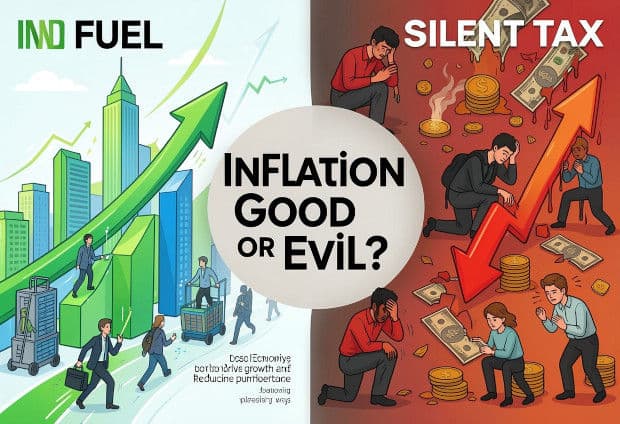
Is inflation a silent tax that steals your wealth without warning, or is it the necessary fuel that keeps a modern economy moving? Milton Friedman calls it theft. Paul Krugman calls it essential. This article puts both sides on trial — examining five prosecution arguments, five defense arguments, IMF data, Bangladesh's own economic history, and the positions of the world's greatest economists — to deliver a definitive verdict: moderate inflation (2-4%) is fuel, unmanaged inflation (8%+) is a tax, and the real problem is never inflation itself but the governance behind it.
Key Takeaways
- Inflation divides economists into two camps: 'silent tax' (Friedman, Hayek) vs 'necessary fuel' (Krugman, Bernanke, Yellen).
- Silent tax case: inflation destroys savings, punishes the poor hardest, lets governments erode debt at citizens' expense, and has triggered catastrophic hyperinflations.
- Necessary fuel case: moderate inflation drives spending, prevents the far worse deflationary spiral, keeps monetary policy effective, and lubricates labor markets.
- IMF data: 2-5% inflation correlates with the highest average GDP growth. Below 2% and above 10% both damage growth.
- Bangladesh: 5-6% inflation paired with 6-8% growth (2015-2019). At 9-10% inflation in 2023, growth slowed and the poor suffered acutely.
- Japan's Lost Decades: 30 years of near-zero inflation proved deflation is more economically destructive than moderate inflation.
- Final verdict: moderate (2-4%), well-managed inflation = necessary fuel. Excessive (8%+), uncontrolled inflation = silent tax on the poorest citizens.
- The core problem is never inflation itself — it is the quality of governance and institutions managing it.
Introduction: The Question That Divides Economists
For centuries, a battle has raged at the heart of economics — and it shows no signs of ending.
On one side stands Milton Friedman — the towering monetarist who declared that inflation is always and everywhere a monetary phenomenon, a product of reckless money-printing by governments, and ultimately a form of theft disguised as economic policy.
On the other side stands Paul Krugman — the Nobel laureate who argues that moderate inflation is a sign of a healthy, growing economy, and that the real enemy is not inflation but its opposite: deflation.
So who is right? Is inflation truly a silent tax that quietly picks your pocket every single day? Or is it the necessary fuel that keeps the economic engine running?
This article examines both sides with full force — arguments, counterarguments, historical evidence, real data — and delivers a final verdict. Format: Prosecution vs. Defense. Judge = data and history.
Let the trial begin.
Chapter 1: What Is Inflation — Common Ground Before the Debate
Before we enter the courtroom, let us establish what both sides agree on — what inflation actually is.
Inflation is the sustained, general increase in the price level of goods and services in an economy over time. In plain terms: the same amount of money buys less than it did before.
Inflation is measured primarily through the Consumer Price Index (CPI) — tracking how much the price of a fixed basket of goods changes month to month or year to year.
Inflation Rate = [(Current Year CPI - Previous Year CPI) / Previous Year CPI] x 100
Types of Inflation
Creeping Inflation: 1-3%. Most economists consider this normal and healthy.
Walking Inflation: 3-10%. Concerning but manageable with the right policy tools.
Galloping Inflation: 10-50%. Causes serious economic damage; purchasing power erodes rapidly.
Hyperinflation: 50%+ per month. Economy collapses. Currency becomes worthless paper.
Here is where the debate ignites — both sides agree on what inflation is, but they sit on opposite ends of the universe when asked whether it is good or bad.
| Type | Rate | Real-World Example | Economic Effect |
| Creeping | 1-3% | USA 1990s: ~2.5% | Normal, supports healthy growth |
| Walking | 3-10% | India 2023: ~5.7% | Worrying but controllable |
| Galloping | 10-50% | Bangladesh 2023: ~9.5% | Purchasing power erodes fast |
| Hyperinflation | 50%+/month | Zimbabwe 2008: 79.6 billion% | Economy completely destroyed |
Note: These figures are approximate. Actual numbers may vary slightly.
Chapter 2: The Prosecution — Inflation Is a Silent Tax
The prosecution rests its case on a single, powerful claim: inflation is a hidden tax imposed by governments and the banking system — one that drains citizens' wealth without their consent, without a vote, and without a receipt.
Argument 1: Inflation Destroys Savings
Imagine you have 100 taka in your pocket. At 10% inflation, after one year that 100 taka buys what 90 taka used to. After two years, it buys what 81 taka used to. After five years: 59 taka worth. After ten years: just 39 taka worth.
Your money is melting — like ice left on a hot pavement. Nobody robbed you. Nobody signed a tax notice. But your wealth is gone.
Now look at the real Bangladesh picture:
Bank savings deposit rate (typical): ~4-6%
Inflation (2023): ~9-10%
Real return = 5% - 10% = -5%. The person who saved money in the bank actually got poorer.
Every year you keep money in a savings account at below-inflation rates, you are paying an invisible tax. That is the silent tax in its purest, most mathematical form.
Argument 2: It Hits the Poor Hardest
The wealthy store their wealth in land, apartments, equities, and gold — assets whose prices rise with inflation. But poor households hold their wealth in cash and wages — exactly what inflation erodes.
According to BBS (Bangladesh Bureau of Statistics) estimates: the poorest 40% of Bangladeshi households spend over 60% of their income on food.
Food inflation in 2023 ran at approximately 12-13%. That means the poorest families experienced an effective inflation rate far higher than the official headline figure.
Inflation is a regressive tax — it punishes the poor more than the rich. At least income tax is progressive: higher earners pay more. Inflation works in reverse: lower earners bear the heaviest burden.
Argument 3: Governments Profit from Inflation
When a government borrows money, it borrows at a fixed nominal interest rate. When inflation rises, the real value of that debt falls. The government repays in cheaper money — effectively transferring wealth from creditors (citizens) to itself.
The more insidious mechanism: government prints new money → spends it → extra money enters the economy → prices rise → citizens pay through higher prices. All without a single vote in parliament.
'By a continuing process of inflation, governments can confiscate, secretly and unobserved, an important part of the wealth of their citizens.' — John Maynard Keynes
Argument 4: Banks and Borrowers Win, Savers Lose
Inside the banking system, inflation orchestrates a silent transfer of wealth — from savers to borrowers.
Bank loan rate: 12% interest
Inflation rate: 10%
Borrower's real cost of debt: just 2%
But the depositor earns: 5% interest - 10% inflation = -5% real return
The saver's wealth flows to the borrower — and the bank profits in the middle. This is not a conspiracy theory. It is arithmetic.
Argument 5: The Hyperinflation Slippery Slope
Those who say 'a little inflation is harmless' need to read their history. Every hyperinflation in recorded history began with what someone once called 'moderate' inflation.
Weimar Germany (1923): Monthly inflation hit 29,500%. A loaf of bread cost 200 billion marks.
Zimbabwe (2008): Annual inflation reached 79.6 billion%. The country printed 100 trillion dollar notes.
Venezuela (2018): Annual inflation hit 1.7 million%. Citizens could not afford basic food.
None of these countries believed they would end up there. The slippery slope is real — once inflation control is lost, regaining it is extraordinarily painful.
Who Stands on This Side?
Milton Friedman (Monetarist School): Inflation is always and everywhere a monetary phenomenon — the direct result of excessive money printing by governments.
Friedrich Hayek (Austrian School): Currency control must be taken from governments entirely — competing private currencies would self-regulate.
Ron Paul, Bitcoin maximalists, hard money advocates: Push for gold standards or cryptocurrency-based systems where money supply cannot be inflated at will.
'Inflation is taxation without legislation.' — Milton Friedman
| Years | Starting Amount | At 5% Inflation | At 10% Inflation | At 15% Inflation |
| 1 year | $100 | $95 | $90 | $85 |
| 5 years | $100 | $77 | $59 | $44 |
| 10 years | $100 | $60 | $39 | $20 |
| 20 years | $100 | $36 | $15 | $4 |
Note: These figures are approximate. Actual numbers may vary slightly.
Chapter 3: The Defense — Inflation Is Economy's Necessary Fuel
Now the defense takes the floor. Their claim is equally powerful: moderate inflation is not a tax — it is oxygen. Without it, economies suffocate, stagnate, and collapse in on themselves. The real danger is not inflation but its deadly mirror image: deflation.
Argument 1: Moderate Inflation Drives Spending and Investment
If prices rise 2-3% every year, rational people buy today rather than wait — because tomorrow everything will be slightly more expensive. This creates demand, and demand drives economic activity.
What happens at zero inflation? People think: 'Prices will stay the same or fall, so I'll buy later.' Result: spending falls → business revenues drop → layoffs → incomes shrink → recession.
Moderate inflation keeps the economy's wheels turning. It nudges people to spend and invest rather than sit on cash. Zero inflation, paradoxically, can paralyze an economy.
Argument 2: Deflation Is Far Worse Than Inflation
Japan's Lost Decades: From 1990 onwards, Japan spent 30+ years trapped in near-zero or negative inflation.
What happens in deflation:
Prices fall → people delay purchases (it will be cheaper tomorrow) → demand collapses → businesses suffer → layoffs → incomes fall → even less spending → prices fall further.
This is the 'Deflationary Spiral' — once it starts, it is extraordinarily difficult to escape. Japan spent over $10 trillion in stimulus and still has not fully broken free.
Ben Bernanke's famous 'Helicopter Money' speech was driven by terror of deflation — not inflation. Because escaping a deflationary trap is far harder than taming an inflationary surge.
Argument 3: Inflation Keeps Monetary Policy Effective
Central banks fight recessions by cutting interest rates. But rates cannot go below zero (in most conventional frameworks).
If inflation is 0% and rates are at 2%: only 2 percentage points of cutting room exists.
If inflation is 2% and rates are at 4%: 4 percentage points of room — double the firepower.
This is the 'Zero Lower Bound' problem. The Fed, ECB, Bank of England — every major central bank targets 2% inflation, not 0%. They need room to maneuver when the next crisis arrives.
Argument 4: Inflation Reduces the Real Debt Burden
Governments, businesses, and home buyers all borrow money. Inflation steadily erodes the real weight of that debt.
Example: You take out a 50 lakh taka home loan. At 10% annual inflation, in 7 years that debt's real value has fallen to roughly 25 lakh taka.
Your wages and income will rise with inflation, but your loan balance stays fixed. Over time, the debt becomes progressively easier to service. For borrowers — including governments carrying massive debt loads — inflation is a quiet blessing.
Argument 5: Inflation Lubricates the Labor Market
This is one of the most underrated arguments in the debate. Moderate inflation makes labor market adjustments smoother.
Cutting nominal wages is extremely hard — workers protest, productivity plummets, unions go on strike.
But with 3% inflation and 0% wage growth: real wages have effectively been cut 3% — without a single angry worker knowing!
This is 'Money Illusion' — workers see their nominal pay unchanged and accept the implicit adjustment. It prevents the labor conflicts and economic disruptions that come with explicit wage cuts. Economies adjust more smoothly with a little inflation lubricating the gears.
Who Stands on This Side?
Paul Krugman (Nobel laureate): Avoid deflation at all costs — a little inflation is a small price for economic stability.
Janet Yellen (former Fed Chair): The 2% inflation target is the ideal rate for sustainable economic health.
Ben Bernanke (former Fed Chair, Nobel laureate): Fighting deflation is the central bank's primary responsibility.
Most modern central bankers and Keynesian economists stand firmly on this side.
'A little inflation is a small price to pay for avoiding deflation.' — Summary of Paul Krugman's position
| Dimension | Deflation (0% or negative) | Moderate Inflation (2-3%) | High Inflation (10%+) |
| Consumer Spending | Delayed (cheaper tomorrow) | Encouraged (buy today) | Panicked (buy now before worse) |
| Business Investment | Frozen | Normal to enthusiastic | Highly uncertain |
| Debt Burden | Grows (in real terms) | Slowly shrinks | Rapidly shrinks |
| Wage Adjustment | Difficult, conflict-prone | Smooth (Money Illusion) | Chaotic demands |
| Monetary Policy Room | Trapped (Zero Lower Bound) | Effective | Requires aggressive tightening |
| Historical Example | Japan 1990-2020 | USA 1990s | Argentina 2023 |
Note: These figures are approximate. Actual numbers may vary slightly.
Chapter 4: What Does the Data Say? — Testing Both Arguments
Enough arguments. Let the judge — data — speak.
The IMF Evidence
IMF research (approximate findings): Countries maintaining inflation between 2-5% consistently recorded the highest average GDP growth rates.
Below 2% inflation: growth slows noticeably
Above 10% inflation: growth deteriorates significantly
Economists call this the 'Goldilocks Zone' — not too hot, not too cold. The empirical sweet spot for inflation is 2-4%.
Bangladesh Data
Bangladesh's own economic history supports this theory:
2015-2019: Inflation ~5-6%, GDP growth ~6-7%. These were the golden years.
2023: Inflation ~9-10%, GDP growth slowing. Inflation had crossed into damaging territory.
Years with very low inflation (<4%) also showed comparatively slower growth.
United States Data
1990s US Boom: ~2.5% inflation, 4%+ GDP growth. The textbook golden era.
2008-2015: Near-zero inflation, sluggish growth. Trillions in quantitative easing could not fully restart the engine.
2022: 9.1% inflation → aggressive Fed tightening → growth decelerated sharply. Too much inflation is also destructive.
The sweet spot: 2-3% inflation corresponds to the highest and most sustained growth rates in US history.
Japan's Lesson
Thirty years of near-zero or negative inflation = the Lost Decades. The world's third-largest economy stuck in slow motion.
Despite over $10 trillion in government stimulus, the deflationary mindset became generational. Japanese consumers delay purchases, save compulsively, and this behavior has passed from parents to children to grandchildren. A deflationary trap, once set, is extraordinarily hard to spring.
| Inflation Range | Avg GDP Growth | Countries Studied | Source |
| <1% | ~2.0% | 25+ | IMF (approximate) |
| 1-2% | ~2.8% | 30+ | IMF (approximate) |
| 2-5% | ~4.2% | 50+ | IMF (approximate) |
| 5-10% | ~3.5% | 40+ | IMF (approximate) |
| 10-20% | ~2.5% | 20+ | IMF (approximate) |
| >20% | ~1.0% or negative | 15+ | IMF (approximate) |
Note: These figures are approximate. Actual numbers may vary slightly.
| Year | Inflation % | GDP Growth % | Assessment |
| 2014 | ~7.3% | ~6.1% | Moderate inflation, solid growth |
| 2015 | ~6.4% | ~6.6% | Controlled, strengthening growth |
| 2016 | ~5.9% | ~7.1% | Ideal balance |
| 2017 | ~5.4% | ~7.3% | Golden years begin |
| 2018 | ~5.8% | ~7.9% | Peak growth performance |
| 2019 | ~5.5% | ~8.2% | Remarkable (pre-COVID) |
| 2020 | ~5.7% | ~3.4% | COVID shock |
| 2021 | ~5.6% | ~6.9% | COVID recovery |
| 2022 | ~7.7% | ~7.1% | Inflation rising |
| 2023 | ~9.5% | ~5.8% | High inflation, growth slowing |
Note: These figures are approximate. Actual numbers may vary slightly.
Chapter 5: Where Each Side's Argument Breaks Down
Honest judgment requires examining the flaws in both cases. Neither prosecution nor defense is without weakness.
Where the 'Silent Tax' Argument Breaks Down
1. Zero inflation is practically impossible: In a growing economy, some inflation is inevitable. Targeting zero risks triggering deflation — the very outcome the prosecution claims to oppose.
2. The gold standard repeatedly failed: The prosecution's preferred solution — returning to a gold standard — caused or deepened multiple crises in history, including the Great Depression.
3. Deflation is empirically worse: Japan's 30-year experience is not theoretical. Deflation destroys more economic value than moderate inflation by a wide margin.
4. Bitcoin is far too volatile: The alternative currency offered — cryptocurrency — swings 20%+ in a single day. That is not a stable medium of exchange.
5. Some inflation provides economic flexibility: It allows labor markets and debt markets to adjust smoothly in ways that rigid zero-inflation systems cannot.
Where the 'Necessary Fuel' Argument Breaks Down
1. 'Moderate' easily becomes 'high': The slippery slope is real — Argentina started with moderate inflation and arrived at 200%+. The line between manageable and catastrophic is thinner than central bankers admit.
2. Central banks lose control regularly: Theory says 'we will keep it controlled.' Reality brings political pressure, weak institutions, and external shocks that overwhelm the best intentions.
3. Even moderate rates hurt the poor: At 3-4% inflation, low-income households still suffer because their wages rarely keep pace. The burden falls disproportionately downward.
4. The 2% target is arbitrary: Why 2%? Why not 1% or 3%? The number rests more on historical convention than rigorous economic theory.
5. QE created asset bubbles, not broad prosperity: Quantitative easing inflated stock markets and real estate prices without raising consumer welfare — widening inequality rather than spreading growth.
Chapter 6: What the World's Greatest Economists Say
Where do the finest economic minds of the last century actually stand? Let the record speak.
Milton Friedman (Monetarist): Inflation is always a monetary phenomenon — governments are the culprit. His solution: a strict rule governing money supply growth, no discretion.
'Inflation is always and everywhere a monetary phenomenon.' — Milton Friedman
John Maynard Keynes: Both inflation and deflation are unjust, but deflation is the greater evil — it destroys employment and output on a massive scale.
'Inflation is unjust, deflation is inexpedient. Of the two, deflation is the worse.' — John Maynard Keynes
Paul Krugman (Nobel laureate, Neo-Keynesian): During the 2008 crisis, he argued the Fed should target 4% inflation to give monetary policy more room to fight the recession.
Friedrich Hayek (Austrian School): Inflation is a tool of government manipulation. His radical solution: privatize money entirely and let competing currencies find their natural equilibrium.
'I do not think it is an exaggeration to say history is largely a history of inflation, usually inflations engineered by governments.' — Friedrich Hayek
Raghuram Rajan (former RBI Governor): Inflation targeting works, but developing economies need flexibility — rigid adherence to a single target can cause unnecessary pain.
'Inflation targeting works, but do not be dogmatic — developing countries need some flexibility.' — Raghuram Rajan
| Economist | Position | Core Quote / Idea | School of Thought |
| Milton Friedman | Silent Tax | Inflation is always monetary | Monetarist |
| J. M. Keynes | Both bad, deflation worse | Deflation is the worse evil | Keynesian |
| Paul Krugman | Necessary Fuel | Small price to avoid deflation | Neo-Keynesian |
| Friedrich Hayek | Silent Tax | History = history of govt inflation | Austrian |
| Raghuram Rajan | Pragmatic Middle | Targeting works — be flexible | Pragmatist |
| Ben Bernanke | Necessary Fuel | Fight deflation at all costs | Neo-Keynesian |
Chapter 7: The Bangladesh Verdict — What Inflation Means for Us
Global theory is useful. But what does inflation actually mean for Bangladesh specifically?
The answer depends entirely on which era you are talking about:
At 9-10% inflation (2023): Unambiguously a silent tax. It destroyed the purchasing power of ordinary Bangladeshis — especially the urban poor.
At 5-6% inflation (2015-2019): A reasonably manageable fuel. The economy grew at 6-8% annually and living standards improved.
Bangladesh's real problem is not inflation itself — it is unmanaged inflation combined with widening inequality.
If inflation stayed at 4-5% and wages grew at 7-8%, everyone would benefit. But when inflation runs at 10% and wages grow at just 3%, that is a crisis with a human face.
The real villain is not inflation — the real villain is poor governance:
Excessive M2 (money supply) growth
Taka depreciation adding to import costs
Failure to address supply-side bottlenecks
A weak and poorly regulated banking sector
| Income Group | Food Spend % | Effective Inflation Felt | 2023 Real Income Change |
| Poorest 20% | ~65% | ~11-12% | ~-7% to -8% |
| Lower middle class | ~50% | ~10-11% | ~-5% to -6% |
| Middle class | ~35% | ~8-9% | ~-3% to -4% |
| Upper middle class | ~25% | ~7-8% | ~-1% to -2% |
| Wealthiest 20% | ~15% | ~6-7% | ~+2% to +5% (asset appreciation) |
Note: These figures are approximate. Actual numbers may vary slightly.
Chapter 8: Personal Do's and Don'ts During Inflation
Whatever the theory says, you are an individual living in an inflationary environment. Here is how to protect yourself — and what traps to avoid.
Do This
1. Invest in inflation-beating assets: Real estate, equities, gold — these asset classes historically appreciate alongside or faster than inflation.
2. Negotiate your wages actively: If inflation is running at 10% and your salary has not increased, you have effectively taken a 10% pay cut. Push back.
3. Take fixed-rate loans when possible: A fixed-rate mortgage means inflation actually helps you — the real value of your debt shrinks every year.
4. Reduce idle cash holdings: Every day excess cash sits in a low-yield account during high inflation, it loses value. Put it to work.
5. Diversify your portfolio: Do not concentrate all wealth in one asset class. Spread across equities, property, commodities, and bonds.
Do Not Do This
1. Do not hoard cash: Cash is the biggest loser in an inflationary environment. The longer you hold idle cash, the more purchasing power you surrender.
2. Do not look only at nominal returns: A bank offering 6% sounds attractive — but if inflation is 10%, your real return is -4%. Always calculate in real terms.
3. Avoid variable-rate loans during high inflation: When inflation spikes, central banks raise interest rates — and your variable-rate loan payments can jump suddenly.
4. Do not panic buy: Panic buying accelerates the very inflation you are trying to escape, depletes your savings faster, and rarely reflects genuine need.
Chapter 9: The Final Verdict — Silent Tax or Fuel?
The judge is ready to rule.
Both sides have argued brilliantly. But the data paints a clear picture:
Verdict 1: Moderate inflation (2-4%) is necessary fuel
The data consistently shows peak GDP growth at 2-4% inflation. It drives spending, prevents deflation, keeps monetary policy effective, and lubricates labor markets. This is not ideology — it is what the numbers say.
Verdict 2: Uncontrolled inflation (8%+) is a silent tax
At these levels, inflation strips wealth from the poor, enriches asset holders, allows governments to erode their debts at citizens' expense, and creates economic uncertainty that chills investment. The prosecution is right about this range.
Verdict 3: The answer is not binary — it depends on four factors:
1. The level: 2-4% = fuel. 8%+ = silent tax.
2. Who bears it: If the poor are disproportionately hurt, it functions as a regressive tax regardless of the rate.
3. Whether it is managed: Disciplined, well-governed inflation = fuel. Runaway, mismanaged inflation = tax.
4. Duration: Temporary spikes are tolerable. Sustained high inflation is destructive.
The Final Ruling:
Moderate, well-managed inflation = necessary economic fuel.
Excessive, unmanaged inflation = silent tax on the poorest.
The problem is never inflation itself — the problem is the governance of inflation.
| Scenario | Inflation Rate | Verdict | Reason | Historical Example |
| Controlled, moderate | 2-4% | Fuel | Drives growth, prevents deflation | USA 1990s, BD 2016-19 |
| Somewhat elevated, managed | 4-7% | Acceptable | Tolerable in developing economies | India 2015-19 |
| High, uncontrolled | 8-15% | Silent Tax | Purchasing power destroyed, poverty rises | BD 2023, Turkey 2022 |
| Very high | 15-50% | Severe Tax | Economic chaos and social strain | Argentina 2023 |
| Hyperinflation | 50%+/month | Catastrophe | Economy and society collapse | Zimbabwe 2008 |
| Deflation | <0% | Deadly Trap | Stagnation, unemployment, decades of pain | Japan 1990-2020 |
Final Thoughts: Like Fire — Controlled Is Wealth, Uncontrolled Is Destruction
Inflation is exactly like fire.
Controlled fire cooks your food, heats your home, powers your engines. Uncontrolled fire burns everything to ash.
Inflation works the same way. At 2-4%, it keeps the economic engine humming — encouraging investment, preventing deflationary spirals, giving central banks room to act when crises arrive. At 8-10% and beyond, it robs the poor of their bread, destroys savings built over decades, and widens the gap between those who own assets and those who do not.
Bangladesh's challenge is not to eliminate inflation — that is neither achievable nor desirable. The challenge is to control it. To hold it at 4-5%, ensure wages grow faster than prices for working people, protect the poorest through targeted subsidies, and build a Bangladesh Bank that is genuinely independent and genuinely capable.
'Inflation is like toothpaste. Once it is out, you can hardly get it back in again.' — Karl Otto Pohl, former Bundesbank President
'A little inflation is like a little pregnancy — it keeps on growing.' — Leon Henderson
The final word: whether inflation is good or bad does not have a single answer. It depends on the level, the management, and who pays the price. The right question is not 'should we have inflation?' The right question is 'who is in charge of keeping it honest?' Because inflation in good hands is fuel. Inflation in bad hands is a tax. And in the worst hands — it is a weapon.
Recommended for you
From Barter to Bitcoin: The Evolution of Money
Since the dawn of human civilization, people have engaged in trade through barter. However, around 5,000 years ago, humans gradually abandoned the barter system and began using metallic coins. These coins were made from copper, silver, and gold. Around 1260 AD, the first paper currency was introduced in China and eventually spread throughout the world. In the 1930s, the first credit cards were issued by commercial establishments, and by the 1950s, banks began issuing them as well.
Business
Red Ocean and Blue Ocean Strategy: Fight the Competition or Make It Irrelevant — The Complete Guide

Business
Understanding Gross Profit: The Foundation of Business Profitability
Books
The $100 Startup
Startup
How to Calculate Startup Valuation: Methods, Tools, and Examples
Accounting
Corporate Taxation and International Tax Challenges Explained
Accounting
Gross Profit: Definition, Formula, and Why It Matters
Accounting
Four Flavors of Accounting: Tax, Project, Financial, and Cost Accounting Explained
Agreement
Teesta Water Sharing Treaty
Banking
The History of Banking: From Ancient Times to the Digital Age