Malaysia's Economic Reforms: From Agrarian Roots to Industrial Powerhouse (Part 1)
G
GeoRenus Editorial Team
594 views
Summary
Malaysia's economic journey from a colonial agrarian economy to a modern industrial powerhouse is one of the most remarkable transformation stories in Southeast Asia. This first part explores how the New Economic Policy (NEP) of 1971 tackled poverty and racial economic disparity, how FELDA resettled over 112,000 families, and how bold industrialization moves like the Proton car project reshaped the nation. It also covers Malaysia's controversial but effective response to the 1997 Asian Financial Crisis and the ambitious Vision 2020 framework that guided the country's development trajectory.
Key Takeaways
- Malaysia's New Economic Policy (NEP), launched in 1971, had two core goals: eradicating poverty regardless of race and restructuring society to eliminate racial economic imbalances.
- Under the NEP, Malaysia's poverty rate dropped dramatically from 49.3% in 1970 to 16.5% by 1990, one of the fastest poverty reduction achievements in Southeast Asia.
- The FELDA land settlement program resettled over 112,000 families, transforming rural livelihoods and turning Malaysia into the world's largest palm oil producer.
- Malaysia's industrialization drive included launching the national car project Proton in 1983, establishing free trade zones, and attracting significant foreign direct investment to hubs like Penang.
- During the 1997 Asian Financial Crisis, the ringgit lost roughly 40% of its value, but Malaysia controversially rejected IMF bailout terms and imposed capital controls that proved effective.
- Malaysia achieved GDP growth rates of 6-8% annually through the 1970s-1980s, accelerating to 8-9% during the peak industrialization years of the late 1980s and early 1990s.
- Palm oil diversification was a strategic masterstroke, reducing dependence on volatile rubber and tin exports and creating a globally dominant agricultural export industry.
- Vision 2020, introduced by Prime Minister Mahathir Mohamad in 1991, set an ambitious goal for Malaysia to become a fully developed nation by 2020, driving investment in technology, infrastructure, and human capital.
Malaysia's Road to Transformation
Few countries in Southeast Asia have undergone a transformation as dramatic as Malaysia's. In just a few decades, this nation went from being a colonial agricultural economy heavily reliant on rubber and tin to becoming a diversified industrial powerhouse with a thriving manufacturing sector, a globally dominant palm oil industry, and ambitious plans to join the ranks of fully developed nations. But how did Malaysia pull it off? The answer lies in a combination of bold economic policies, strategic resource management, and a willingness to chart its own course, even when the rest of the world disagreed.
This is Part 1 of our two-part series on Malaysia's economic reforms. Here, we trace the journey from the country's agrarian roots through the transformative New Economic Policy, the rise of palm oil, the Proton national car dream, and the turbulent waters of the 1997 Asian Financial Crisis.
Pre-Reform Malaysia: A Colonial Agricultural Economy
Before the 1980s, Malaysia's economy was heavily shaped by its colonial past. Under British rule, the economy was structured around the extraction and export of rubber and tin, two commodities that made fortunes for colonial trading companies but left much of the local population in poverty. The British had also encouraged large-scale immigration of Chinese and Indian laborers, creating a multi-ethnic society with deep economic divisions.
By the time of independence in 1957, the economy was still overwhelmingly agrarian. The Bumiputra community (ethnic Malays and indigenous peoples, who made up the majority of the population) controlled only a tiny fraction of the nation's corporate wealth. Estimates suggest that Bumiputras owned just 2.4% of corporate equity in 1970, while foreign interests and non-Bumiputra communities held the rest. This stark inequality was not just an economic issue. It was a social tinderbox.
The explosion came on May 13, 1969, when racial riots erupted in Kuala Lumpur, killing hundreds and shaking the nation to its core. The government declared a state of emergency, and when the dust settled, it was clear that something fundamental had to change.
The New Economic Policy (NEP): 1971-1990
The New Economic Policy, launched in 1971, was Malaysia's answer to the crisis. It was ambitious, controversial, and ultimately transformative. The NEP was built around two core objectives that would guide the nation's economic policy for two decades.
Poverty Eradication: The Primary Mission
The first goal was straightforward but enormously challenging: eradicate poverty regardless of race. In 1970, nearly half of all Malaysian households lived below the poverty line. The government launched a comprehensive assault on poverty through subsidized agriculture programs, rural development initiatives, and expanded access to education and healthcare.
As Tun Abdul Razak, the architect of the NEP, put it: "National unity is the overriding objective of this country. A country that is divided by race and economic function cannot long endure."
Social Restructuring and Bumiputra Empowerment
The second goal was more contentious: restructuring Malaysian society to eliminate the identification of race with economic function. In practice, this meant increasing Bumiputra participation in the modern economy, particularly in corporate ownership, professional occupations, and higher education. Quotas were introduced for university admissions, government contracts, and corporate equity, with a target of 30% Bumiputra corporate ownership by 1990.
Poverty Reduction and Wealth Distribution
The centerpiece of the NEP's poverty reduction strategy was a massive investment in rural development. The government built roads, schools, clinics, and irrigation systems in previously neglected rural areas. But the most iconic program was FELDA (Federal Land Development Authority).
FELDA was a land settlement scheme that took landless families and resettled them on newly developed agricultural land. Each family received a plot of land, a house, and support to cultivate cash crops, primarily oil palm and rubber. By the time the program matured, FELDA had resettled over 112,000 families across more than 480 settlements, transforming rural livelihoods on a massive scale.
Investing in Human Capital
Malaysia understood early on that sustainable development required an educated workforce. The government dramatically expanded access to education, particularly for Bumiputra students. Scholarship programs like those run by MARA (Majlis Amanah Rakyat) sent thousands of Malay students to universities in the UK, US, Australia, and Japan. Technical and vocational training programs were scaled up to produce skilled workers for the growing manufacturing sector.
The results were striking. Bumiputra enrollment in universities rose from under 20% in the late 1960s to over 60% by the mid-1980s. A new generation of educated Malay professionals, engineers, and entrepreneurs began to emerge.
Building the Industrial Base
While rural development tackled poverty at the grassroots, the government simultaneously worked to industrialize the economy. Free Trade Zones (FTZs) were established to attract foreign direct investment (FDI), offering tax incentives, streamlined regulations, and access to a disciplined, low-cost workforce.
Penang became the flagship of this strategy. Multinational electronics companies like Intel, Motorola, and Hewlett-Packard set up manufacturing plants on the island, transforming it into the "Silicon Valley of the East". By the late 1980s, electronics had overtaken rubber and tin as Malaysia's top export earner.
NEP Outcomes: A Mixed but Powerful Legacy
By the time the NEP officially ended in 1990, the numbers told a compelling story. Malaysia's poverty rate had plummeted from 49.3% in 1970 to just 16.5% in 1990. GDP had grown at an average rate of 6-8% annually throughout the period. The manufacturing sector's share of GDP rose from 13.4% in 1970 to 27% by 1990. Bumiputra corporate ownership climbed from 2.4% to approximately 20%, still short of the 30% target but a dramatic improvement.
However, the NEP was not without its critics. Some argued that the race-based affirmative action policies created a culture of cronyism and rent-seeking, where politically connected Bumiputra businessmen benefited disproportionately while ordinary Malays saw more modest gains. Non-Bumiputra communities, particularly the Chinese business community, sometimes felt that the policies unfairly constrained their economic opportunities.
Despite these criticisms, most economists agree that the NEP achieved its primary objective. As the World Bank noted in a major study: "Malaysia's experience with the NEP represents one of the most successful examples of poverty reduction and social restructuring in the developing world."
The Palm Oil Revolution
One of Malaysia's most consequential economic moves was its strategic pivot from rubber and tin to palm oil. While oil palm had been cultivated in Malaysia since the early 1900s, it was the NEP-era FELDA settlements that turned it into a national economic engine.
The numbers are staggering. Malaysia's palm oil production grew from about 1.3 million tonnes in 1975 to over 6 million tonnes by 1990. By the mid-1980s, Malaysia had overtaken Nigeria to become the world's largest palm oil producer, a position it held for decades. The palm oil industry provided employment for hundreds of thousands of workers, generated billions in export revenue, and created an entire downstream processing industry.
This diversification was a strategic masterstroke. When global rubber prices crashed in the early 1980s and tin revenues collapsed after the 1985 tin crisis, Malaysia's economy was cushioned by its rapidly growing palm oil exports. The lesson was clear: economic diversification is not a luxury, it is a survival strategy.
Post-NEP Malaysia: Industrialization on Overdrive
As the NEP era drew to a close, Malaysia was already shifting into a higher gear. Under Prime Minister Mahathir Mohamad, who took office in 1981, the country embarked on an aggressive industrialization program that would transform it from a commodity exporter into a manufacturing hub.
Heavy Industry and the Proton Dream
Mahathir's most ambitious and controversial project was the national car, the Proton Saga. Launched in 1983 through a joint venture with Mitsubishi Motors, Proton was intended to be a symbol of Malaysian industrial capability and a catalyst for the development of a domestic automotive supply chain.
Mahathir himself championed the project passionately, declaring: "If we can make a car, we can make anything. The national car is not just about transportation. It is about building a nation's confidence in its own abilities."
Protected by high import tariffs on foreign cars, Proton dominated the domestic market for years. While critics questioned the economic efficiency of such protection, the project did help build a network of local auto parts suppliers and created thousands of jobs. During the peak years of the late 1980s and early 1990s, Malaysia's GDP grew at a blistering 8-9% annually, fueled by manufacturing exports, construction, and surging domestic consumption.
The 1997 Asian Financial Crisis
The boom came to a dramatic halt in mid-1997, when a financial crisis that began with the collapse of the Thai baht swept across Southeast Asia. Malaysia was hit hard. The ringgit lost approximately 40% of its value against the US dollar, the stock market plummeted, and billions of dollars in foreign capital fled the country.
While neighboring countries like Thailand, Indonesia, and South Korea accepted IMF bailout packages with strict austerity conditions, Mahathir chose a radically different path. In September 1998, Malaysia imposed capital controls, pegged the ringgit to the US dollar at 3.80, and refused IMF assistance. The decision was widely condemned by Western economists and financial institutions at the time.
Mahathir was blunt in his defense: "We are not going to let speculators destroy our economy. We will not accept the IMF's medicine when we know it will kill the patient."
In retrospect, Malaysia's unorthodox approach proved remarkably effective. The capital controls bought time for the banking system to stabilize, the economy began recovering by 1999-2000, and Malaysia emerged from the crisis with less social damage than its neighbors who followed IMF prescriptions. Even economists like Paul Krugman, who had initially been skeptical, later acknowledged that Malaysia's capital controls worked better than most had expected.
Infrastructure Development and Vision 2020
Even as it navigated the financial crisis, Malaysia never lost sight of its long-term development vision. In 1991, Mahathir unveiled Vision 2020 (Wawasan 2020), an ambitious national blueprint that aimed to make Malaysia a fully developed nation by the year 2020. The vision went beyond mere economic targets. It encompassed nine strategic challenges, including establishing a mature democratic society, building a scientific and progressive community, and fostering a caring and economically just society.
The National Development Policy Framework
To operationalize Vision 2020, the government rolled out the National Development Policy (NDP) in 1991, replacing the NEP. The NDP continued the emphasis on poverty reduction and Bumiputra development but placed greater weight on balanced growth, private sector-led development, and human resource development.
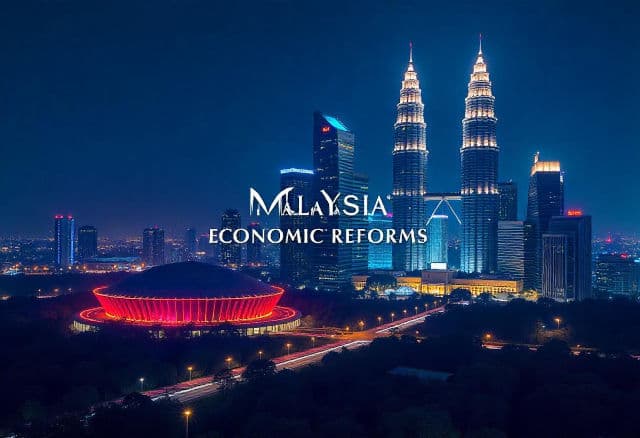
Malaysia invested heavily in infrastructure during this period. The Kuala Lumpur International Airport (KLIA), the Petronas Twin Towers (the world's tallest buildings from 1998 to 2004), the North-South Expressway, and the multimedia super corridor (MSC) were all products of this era. These projects were not just about concrete and steel. They were about signaling to the world that Malaysia was ready to compete on the global stage.
The technology and services sectors received particular attention. The MSC, modeled loosely on Silicon Valley, attracted major tech companies and spawned a growing domestic IT industry. By the early 2000s, the services sector had overtaken manufacturing as the largest contributor to GDP, reflecting Malaysia's successful transition toward a more knowledge-based economy.
Malaysia's story through these decades is one of relentless ambition, pragmatic policymaking, and a willingness to learn from both successes and setbacks. The foundations laid during the NEP era, the industrialization push, and the crisis recovery created a platform from which Malaysia would continue to build.
In Part 2, we continue the story by examining Malaysia's economic evolution after 2000, including the challenges of the middle-income trap, the shift toward a knowledge-based economy, the impact of political reform, and the nation's ongoing quest to achieve developed-nation status.
Recommended for you
Banking: What It Is, How Banks Work, and Everything You Need to Know
Most people use banks every single day — depositing salaries, withdrawing cash, transferring money, paying bills — without ever really thinking about how the whole system actually works. A bank is a licensed financial institution that accepts deposits from the public and uses those deposits to provide loans to individuals and businesses. Everything a bank does — from accepting your savings to issuing credit cards to printing cheques — falls under the broad category of banking. But banks are not just convenient places to store your money. They are the central nervous system of any economy — the institutions that keep money flowing productively through the system, connecting people who have surplus funds with people and businesses that need capital. And in Bangladesh, where Bangladesh Bank serves as the central authority overseeing the entire financial system, understanding how banking works is genuinely useful knowledge for anyone managing their personal finances, running a business, or simply trying to make smarter decisions with their money.
Business Models
Sharing Economy Model: How Businesses Make Money Without Owning Anything
E-Commerce
E-Commerce: The Complete Guide to Online Business

Investment
Investment: What It Is, Types, and Real Life Examples
Sales
What Is Sales and How Does It Work?

Accounting
Gross Profit: Definition, Formula, and Why It Matters
Accounting
Accounting for Startups: A Complete Guide to Getting It Right

Accounting
Financial Recording and Transactions: The Complete Guide

Agreement
General Agreement on Tariffs and Trade (GATT)

Agreement
Teesta Water Sharing Treaty