Consumer Price Index (CPI): What It Is, How It's Calculated, and Why It Matters
G
GeoRenus Editorial Team
579 views
Summary
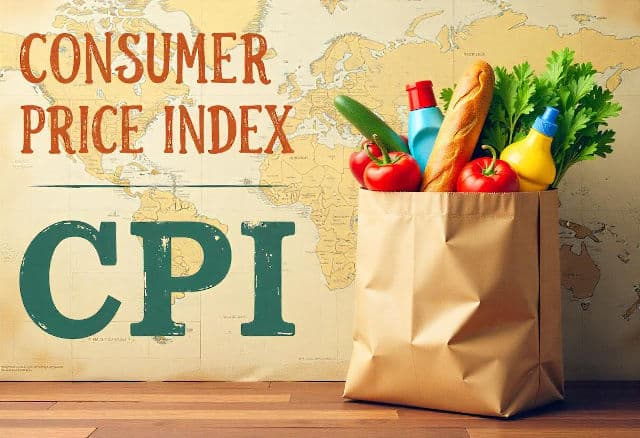
The Consumer Price Index (CPI) measures the average change in prices paid by consumers for a fixed basket of goods and services over time. It is the most widely used indicator of inflation. This guide explains what CPI is, walks through a step-by-step calculation example, covers the Laspeyres formula, and discusses the key limitations including substitution bias, quality changes, and regional variation.
Key Takeaways
- CPI measures the average change in prices paid by urban consumers for a fixed basket of goods and services over time.
- The US Bureau of Labor Statistics tracks approximately 80,000 items across 23,000 retail establishments to calculate CPI.
- CPI is calculated using the Laspeyres formula: CPI = (ΣPn × Qo) / (ΣPo × Qo) × 100.
- The CPI basket includes 200+ categories organized into eight major groups: food, housing, apparel, transportation, medical care, recreation, education, and other goods.
- Key limitations include substitution bias, difficulty capturing quality improvements, slow incorporation of new products, and regional variation.
- CPI is used to adjust Social Security payments, tax brackets, government contracts, and to guide Federal Reserve interest rate decisions.
- The inflation rate is calculated as the percentage change in CPI from one period to another.
What Is the Consumer Price Index (CPI)?
Have you ever noticed that a gallon of milk costs more today than it did five years ago? Or that your grocery bill keeps climbing even though you're buying the same items? The Consumer Price Index (CPI) is the tool economists use to measure exactly how much prices are changing over time.
The CPI measures the average change in prices paid by urban consumers for a fixed basket of goods and services over time. It's the most widely used indicator of inflation — when the CPI goes up, it means the cost of living is rising. When it goes down (rare), it signals deflation.
In the United States, the Bureau of Labor Statistics (BLS) calculates and publishes the CPI monthly, tracking prices for approximately 80,000 items across 23,000 retail establishments. In Bangladesh, the Bangladesh Bureau of Statistics (BBS) performs a similar function, publishing CPI data that guides government policy and economic planning.
Understanding CPI Through an Example
Let's make CPI concrete with a simplified example. Imagine a "basket" containing just three items that a typical household buys regularly:
- Rice: 10 kg per month
- Cooking Oil: 2 liters per month
- Eggs: 30 pieces per month
In the base year (say 2020), the total cost of this basket was $50. In the current year (2024), the same basket costs $62. The CPI would be:
CPI = (Cost of Basket in Current Year / Cost of Basket in Base Year) x 100
CPI = ($62 / $50) x 100 = 124
This means prices have risen by 24% since the base year. The inflation rate between the base year and the current year is 24%. That's the CPI in its simplest form.
How Is CPI Calculated?
In practice, CPI calculation is much more complex than the simple example above. Here are the key steps:
- Step 1 — Define the Basket: Statistical agencies conduct consumer expenditure surveys to determine what goods and services typical households buy and in what quantities. This becomes the "market basket."
- Step 2 — Collect Prices: Data collectors visit stores, websites, and service providers across the country to record current prices for every item in the basket.
- Step 3 — Assign Weights: Not all items affect consumers equally. Housing might represent 30% of spending while clothing is 3%. Each category gets a weight reflecting its share of total consumer spending.
- Step 4 — Calculate the Index: Using the Laspeyres formula: CPI = (Sum of Current Period Prices x Base Quantities) / (Sum of Base Period Prices x Base Quantities) x 100.
- Step 5 — Determine Inflation Rate: The percentage change in CPI from one period to another gives the inflation rate. For example, if CPI was 300 last year and 315 this year, inflation = (315-300)/300 x 100 = 5%.
CPI Calculation Formula
The standard CPI formula (Laspeyres Index) is:
CPI = (ΣPn × Qo) / (ΣPo × Qo) × 100
Where:
- Pn = Price in the current period
- Po = Price in the base period
- Qo = Quantity in the base period (the fixed basket)
For example, if the weighted cost of the basket in 2020 (base) was $1,745 and in 2024 it's $2,150:
CPI = (2150 / 1745) × 100 = 123.21
This means prices have risen 23.21% from the base year. The US CPI basket includes over 200 categories of goods and services organized into eight major groups: food, housing, apparel, transportation, medical care, recreation, education/communication, and other goods/services.
Limitations and Criticisms of CPI
While CPI is the most widely used inflation measure, it has several known limitations:
- Substitution Bias: CPI uses a fixed basket, but consumers switch to cheaper alternatives when prices rise. If beef prices spike, people buy more chicken — but CPI doesn't fully capture this substitution, potentially overstating inflation.
- Quality Changes: Products improve over time. A $1,000 smartphone today is far more powerful than a $1,000 smartphone from 2015. CPI struggles to separate genuine price increases from quality improvements.
- New Products: The fixed basket takes time to incorporate new products. Streaming services, electric vehicles, and smartphones weren't immediately reflected in CPI when they first appeared.
- Regional Variation: National CPI may not reflect local price conditions. Cost of living varies dramatically between cities — what's true for New York may not apply to rural Kansas.
- Outlet Substitution: When consumers shift from expensive stores to discount retailers or online shopping, CPI may miss these savings.
Despite these limitations, CPI remains indispensable. The Federal Reserve uses CPI (along with the PCE price index) to make interest rate decisions that affect trillions of dollars. Social Security payments, tax brackets, and government contracts are all adjusted based on CPI.
The Bottom Line
The Consumer Price Index is the most important measure of inflation and the cost of living. It tells us how much more (or less) consumers are paying for the same basket of goods over time. While it has its limitations — particularly around substitution bias and quality adjustments — CPI remains the gold standard for tracking inflation.
Whether you're a policymaker setting interest rates, a business adjusting prices, a worker negotiating a raise, or simply a consumer trying to understand why your grocery bill keeps growing, CPI is the number that matters. Understanding how it works gives you a clearer picture of the economic forces affecting your everyday life.
Recommended for you

Banking: What It Is, How Banks Work, and Everything You Need to Know
Most people use banks every single day — depositing salaries, withdrawing cash, transferring money, paying bills — without ever really thinking about how the whole system actually works. A bank is a licensed financial institution that accepts deposits from the public and uses those deposits to provide loans to individuals and businesses. Everything a bank does — from accepting your savings to issuing credit cards to printing cheques — falls under the broad category of banking. But banks are not just convenient places to store your money. They are the central nervous system of any economy — the institutions that keep money flowing productively through the system, connecting people who have surplus funds with people and businesses that need capital. And in Bangladesh, where Bangladesh Bank serves as the central authority overseeing the entire financial system, understanding how banking works is genuinely useful knowledge for anyone managing their personal finances, running a business, or simply trying to make smarter decisions with their money.
Business Models
Sharing Economy Model: How Businesses Make Money Without Owning Anything
E-Commerce
E-Commerce: The Complete Guide to Online Business

Investment
Investment: What It Is, Types, and Real Life Examples
Sales
What Is Sales and How Does It Work?

Accounting
Gross Profit: Definition, Formula, and Why It Matters
Accounting
Accounting for Startups: A Complete Guide to Getting It Right

Accounting
Financial Recording and Transactions: The Complete Guide

Agreement
General Agreement on Tariffs and Trade (GATT)

Agreement
Teesta Water Sharing Treaty