Law of Demand: Definition, Exceptions, Examples, and Why It Matters
G
GeoRenus Editorial Team
801 views
GeoRenus Editorial Team
The law of demand states that when the price of a good rises, the quantity demanded falls — and vice versa — assuming all other factors remain constant. This guide covers the law of demand in detail, including its definition, the key exceptions (Giffen goods, Veblen goods, speculative markets, and more), real-world examples, and its practical importance for business pricing strategies and government policy making.
As Professor Alfred Marshall stated, "Other things being equal, the amount demanded increases with a fall in price, and diminishes with a rise in price." This single sentence captures one of the most fundamental principles in all of economics.
The law of demand is beautifully simple: when the price of a good or service goes up, the quantity demanded goes down — and when the price goes down, the quantity demanded goes up, all else being equal.
Think about it from your own experience. If your favorite coffee shop raised its latte price from $4 to $8, you'd probably buy fewer lattes — maybe switching to regular coffee or brewing at home. Conversely, if they slashed the price to $2, you might buy one every day instead of just twice a week.
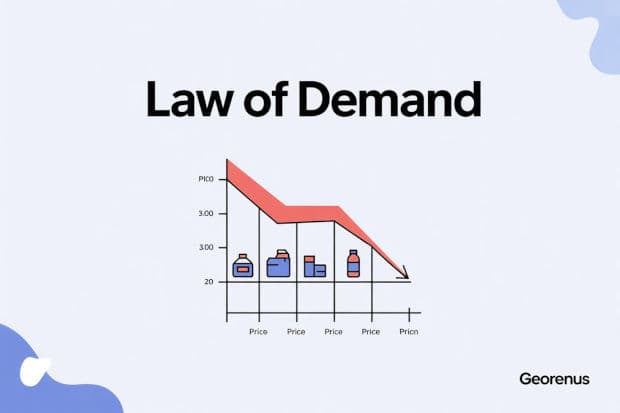
This inverse relationship between price and quantity demanded is not just common sense — it's backed by rigorous economic theory and countless empirical studies. The demand curve, which plots price against quantity demanded, slopes downward from left to right, visually representing this fundamental law.
The key phrase here is "all else being equal" (ceteris paribus). The law assumes that factors like income, preferences, prices of related goods, and expectations remain constant. When these other factors change, the entire demand curve shifts — but the law itself still holds along any given demand curve.
While the law of demand holds true in most situations, there are notable exceptions where the inverse price-quantity relationship breaks down:
If a consumer's income increases significantly, they may buy more of a product even if its price rises. For example, someone who gets a major raise might upgrade to premium groceries regardless of price increases. This violates the ceteris paribus condition since income isn't being held constant.
Fashion trends, health awareness, or cultural shifts can override price sensitivity. If a particular food is suddenly promoted as a superfood, demand may rise even as prices increase. Similarly, if a product falls out of fashion, demand drops regardless of price cuts.
If the price of a substitute good changes dramatically, it can distort the expected demand relationship. For example, if the price of Pepsi doubles, demand for Coca-Cola might increase even if Coke's price also goes up — because Coke is still relatively cheaper than its substitute.
When a product has no close substitutes — like essential medications or utilities — consumers must buy it regardless of price changes. Insulin, for example, has extremely inelastic demand because diabetic patients cannot simply stop buying it when prices rise.
If consumers expect prices to rise further in the future, they may buy more now even at higher prices — stockpiling before the expected increase. This is common during inflationary periods. During the early COVID-19 pandemic, consumers panic-bought goods like toilet paper and hand sanitizer despite rising prices, driven by expectations of future scarcity.
Giffen goods are the classic textbook exception to the law of demand. Named after Scottish economist Sir Robert Giffen, these are inferior goods where a price increase actually leads to increased demand. This happens because the income effect (consumers feel poorer and buy more of the cheap staple) outweighs the substitution effect.
The classic example involves bread or rice in poor communities. When the price of bread rises, poor families can no longer afford meat, so they buy even more bread to fill their stomachs — a seemingly paradoxical but economically explainable behavior.
Named after economist Thorstein Veblen, Veblen goods are luxury items where higher prices actually increase demand because the high price is part of the appeal. Think Rolex watches, Louis Vuitton bags, or Rolls-Royce cars. People buy these products partly because they're expensive — the price signals status and exclusivity. If a Rolex suddenly cost $50, it would lose its prestige appeal.
In stock markets and real estate, rising prices can attract more buyers (rather than fewer) because investors chase momentum. During the 2021 stock market rally, many investors bought stocks at all-time highs, driven by FOMO (Fear of Missing Out) rather than rational price analysis. This behavior creates bubbles that eventually burst.
The law of demand isn't just an abstract concept — it has real-world applications that affect businesses and governments every day.
Companies use the law of demand to make critical pricing decisions. Understanding how sensitive customers are to price changes (price elasticity of demand) helps businesses determine optimal pricing strategies. A company selling luxury goods knows its customers are less price-sensitive, while a discount retailer knows its customers are highly price-conscious.
For example, airlines use dynamic pricing based on demand patterns — prices are higher during peak travel seasons and lower during off-peak periods. This strategy maximizes revenue by aligning prices with the demand curve.
Governments apply the law of demand when designing tax policy and regulation. Sin taxes on cigarettes and alcohol are deliberately designed to raise prices and reduce consumption — a direct application of the law of demand. Similarly, subsidies on essential goods like food or fuel are designed to lower effective prices and increase access.
Price controls — such as rent ceilings and minimum wages — are also informed by demand analysis. Understanding how these interventions affect quantity demanded is essential for effective policy design.
The law of demand is one of the pillars of economic theory. Its simple premise — that people buy less when prices rise and more when prices fall — underlies nearly every aspect of market economics, from pricing strategies to government policy.
While exceptions like Giffen goods, Veblen goods, and speculative markets exist, they are just that — exceptions. For the vast majority of goods and services in the vast majority of situations, the law of demand holds firm. Understanding it is essential for anyone who wants to make sense of how markets work, why prices change, and how economic decisions are made.

In 1944, as the world was still engulfed in the devastation of World War II, the global economy had collapsed and people’s living standards had plummeted. In an effort to stabilize the international economy and address pressing global financial issues, the Allied nations convened a historic summit. Nearly 730 delegates from 44 countries gathered at the Mount Washington Hotel in Bretton Woods, New Hampshire, for the United Nations Monetary and Financial Conference. The outcome of this summit was the landmark Bretton Woods Agreement, which gave birth to the Bretton Woods System.