Law of Supply: Definition, How It Works, Exceptions, and Real-World Examples
G
GeoRenus Editorial Team
606 views
Summary
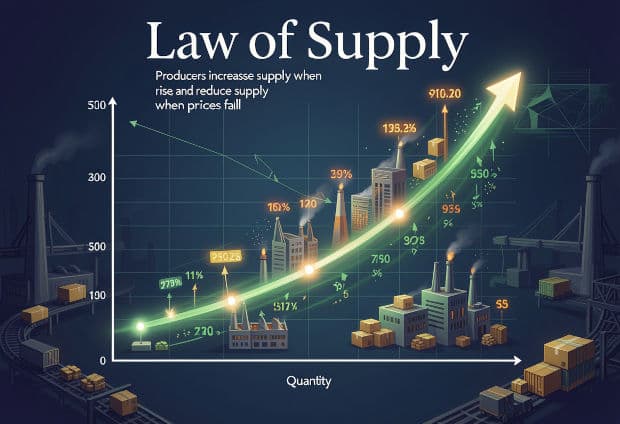
The law of supply states that as the price of a good increases, the quantity supplied also increases, and vice versa — holding all other factors constant. This guide explains the law of supply, its relationship to market pricing, the key exceptions (perishable goods, natural disasters, production capacity limits, labor market anomalies), and how businesses, investors, and governments use supply analysis for decision-making.
Key Takeaways
- The law of supply states that higher prices incentivize producers to supply more, and lower prices lead to reduced supply — a positive (direct) relationship.
- The supply curve slopes upward from left to right, reflecting the positive relationship between price and quantity supplied.
- Key exceptions include perishable goods, nature-dependent products, rare/limited goods, and production capacity constraints.
- The backward-bending labor supply curve shows that very high wages can actually reduce labor supply as workers prefer leisure.
- Natural disasters and economic recessions can disrupt the normal supply relationship regardless of price levels.
- OPEC countries adjust oil production based on global prices — a real-world application of the law of supply.
- Together with the law of demand, the law of supply determines market equilibrium — the price where quantity supplied equals quantity demanded.
Understanding the Law of Supply
If the law of demand explains the buyer's side of the market, the law of supply explains the seller's side. Together, they form the foundation of how markets work.
The law of supply states that, all else being equal, as the price of a good or service increases, the quantity supplied by producers also increases — and as the price decreases, the quantity supplied decreases. It makes intuitive sense: when producers can charge more for a product, they have greater incentive (and higher profit margins) to produce more of it.
As Alfred Marshall explained, "The supply curve slopes upward because, at higher prices, existing firms are willing to produce more, and new firms may enter the market attracted by the higher profits."
The relationship between price and supply is direct (positive) — they move in the same direction. This is the opposite of demand, where the relationship is inverse. The supply curve on a graph slopes upward from left to right, reflecting this positive relationship.
For example, if the price of wheat rises from $5 to $10 per bushel, farmers will plant more wheat because the higher price makes it more profitable. Conversely, if wheat prices crash to $2 per bushel, many farmers will switch to more profitable crops or reduce their planting.
Exceptions and Limitations of the Law of Supply
Like the law of demand, the law of supply doesn't hold universally. Several real-world conditions can cause supply to behave differently than the theory predicts:
1. Essential and Perishable Goods
For highly perishable goods like fresh fish, flowers, or milk, sellers may actually reduce prices (and increase supply to the market) rather than let the products spoil. A fisherman who catches 500 pounds of fish must sell it quickly regardless of the price — the supply is determined by the catch, not the market price.
2. Nature-Dependent Goods
Agricultural products are heavily influenced by weather, seasons, and natural conditions. Even if crop prices double, a farmer can't instantly produce more wheat — it takes an entire growing season. Droughts, floods, and pests can reduce supply regardless of how high prices climb. Supply of these goods is inherently limited by nature's timeline.
3. Limited or Rare Goods
Some goods have fixed or naturally limited supply that can't be increased regardless of price. Vintage wine, original artwork, and rare collectibles have perfectly inelastic supply — no matter how much buyers are willing to pay, you can't produce more of a 1945 Château Mouton-Rothschild.
4. Production Cost Constraints
If production costs rise faster than product prices, suppliers may actually reduce output despite higher market prices. For instance, if raw material costs spike, manufacturers may find it unprofitable to increase production even at higher selling prices.
5. Natural Disasters
Earthquakes, hurricanes, pandemics, and wars can devastate supply chains, making it impossible to increase supply regardless of price signals. The 2021 global semiconductor shortage caused by pandemic disruptions reduced car production by an estimated 7.7 million units worldwide (AlixPartners), despite strong demand and high prices.
6. Production Capacity Limits
Every factory, farm, and business has a maximum production capacity. Once a firm is operating at full capacity, higher prices won't immediately result in more output. Expanding capacity requires time and capital investment — new factories take years to build.
7. Labor Market Constraints
In the labor market, the law of supply can work differently. Beyond a certain wage level, workers may actually prefer leisure over work — the "backward-bending" labor supply curve shows that very high wages can reduce labor supply as workers choose more free time over additional income.
8. Economic Recession
During recessions, businesses may cut production even if prices remain stable, due to falling demand expectations, credit constraints, and risk aversion. The 2008 financial crisis saw many manufacturers reduce output dramatically despite relatively stable product prices — they feared that demand would collapse.
9. Seasonal Goods
Supply of seasonal products (mangoes in summer, winter coats in fall) follows natural cycles rather than price signals. You can't produce mangoes in December regardless of how much consumers are willing to pay.
10. Storage and Preservation Issues
For goods with significant storage costs or limited shelf life, maintaining or increasing supply in response to higher prices may not be economically feasible. The cost of warehousing, refrigeration, and potential spoilage can offset the benefits of waiting for higher prices.
Who Uses the Law of Supply and Why?
Profit Maximization
Businesses use the law of supply to make production decisions that maximize profitability. When market prices for their products rise, firms ramp up production to capitalize on higher margins. Understanding the supply curve helps businesses determine the optimal quantity to produce at any given price level.
For example, oil-producing countries in OPEC adjust their production levels based on global oil prices — increasing output when prices are high and cutting production when prices drop to protect their revenue.
Supply Chain Management and Growth
Businesses and investors use supply analysis to identify market opportunities. If demand for a product is rising but supply is constrained (creating a supply gap), that signals a business opportunity. Understanding supply dynamics helps investors evaluate market conditions and helps policymakers design effective regulatory frameworks.
For governments, supply analysis informs agricultural policy, energy policy, and trade negotiations. If domestic supply of a critical good is insufficient, the government may adjust tariffs, provide subsidies, or negotiate trade agreements to address the shortfall.
The Bottom Line
The law of supply is a fundamental economic principle that explains producer behavior: higher prices incentivize greater production, and lower prices discourage it. Together with the law of demand, it determines market equilibrium — the price at which the quantity supplied equals the quantity demanded.
While numerous real-world exceptions exist — from natural disasters and production constraints to backward-bending labor curves and perishable goods — the law of supply remains a powerful tool for understanding how markets function. Whether you're a farmer deciding what to plant, an investor evaluating a market, or a policymaker designing trade policy, the law of supply provides essential insights into the economics of production.
Recommended for you

Banking: What It Is, How Banks Work, and Everything You Need to Know
Most people use banks every single day — depositing salaries, withdrawing cash, transferring money, paying bills — without ever really thinking about how the whole system actually works. A bank is a licensed financial institution that accepts deposits from the public and uses those deposits to provide loans to individuals and businesses. Everything a bank does — from accepting your savings to issuing credit cards to printing cheques — falls under the broad category of banking. But banks are not just convenient places to store your money. They are the central nervous system of any economy — the institutions that keep money flowing productively through the system, connecting people who have surplus funds with people and businesses that need capital. And in Bangladesh, where Bangladesh Bank serves as the central authority overseeing the entire financial system, understanding how banking works is genuinely useful knowledge for anyone managing their personal finances, running a business, or simply trying to make smarter decisions with their money.
Business Models
Sharing Economy Model: How Businesses Make Money Without Owning Anything
E-Commerce
E-Commerce: The Complete Guide to Online Business

Investment
Investment: What It Is, Types, and Real Life Examples
Sales
What Is Sales and How Does It Work?
Accounting
Gross Profit: Definition, Formula, and Why It Matters
Accounting
Accounting for Startups: A Complete Guide to Getting It Right

Accounting
Financial Recording and Transactions: The Complete Guide

Agreement
General Agreement on Tariffs and Trade (GATT)

Agreement
Teesta Water Sharing Treaty