Macroeconomics vs Microeconomics -- The Complete Guide to Understanding Both Sides of the Economy
G
GeoRenus Editorial Team
790 views
GeoRenus Editorial Team
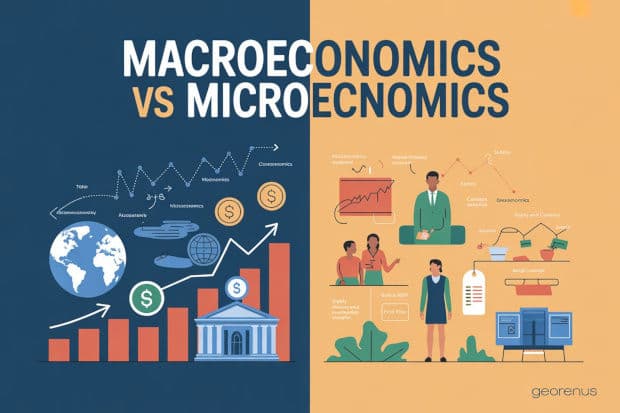
Macroeconomics studies the entire economy — GDP, inflation, unemployment, monetary policy. Microeconomics studies individual decisions — a single consumer, a single business, a single market. Macro is the big picture, Micro is the close-up. When rice prices rise at your local shop, that is micro. When the central bank raises interest rates affecting the entire country, that is macro. This guide covers definitions, key differences, how they connect, real examples, and why understanding both is essential.
Imagine walking into your neighborhood grocery store and noticing that a kilogram of rice now costs fifteen percent more than it did three months ago. You pause. You think: did the local farmer raise his price? Did the shop owner get greedy? Did the truck driver demand higher wages? These are all reasonable questions — and every single one of them lives inside the world of Microeconomics.
But now zoom out. That same price rise is happening in shops across every city in the country. Rice imports have become expensive because the dollar has strengthened against the local currency. The central bank raised interest rates to control inflation, which pulled capital out of agriculture. A monsoon failure in a neighboring country disrupted the regional supply chain. Suddenly you are no longer looking at one shop — you are looking at the entire economy. That is Macroeconomics.
Economics has two great lenses: Micro — the close-up shot — and Macro — the wide-angle view. Neither is complete without the other.
This guide walks you through both disciplines from the ground up. You will learn what each one studies, how they differ, where they overlap, which economists shaped them, and most importantly — why every informed citizen, every business owner, and every student of finance needs to understand both sides of the economic coin.
Microeconomics is the branch of economics that studies the decision-making behavior of individual actors — a single consumer choosing between two products, a single firm setting its price, a single market finding its equilibrium. The word 'micro' comes from the Greek 'mikros', meaning small. But do not let the name fool you: the forces microeconomics describes drive everything from a street vendor's pricing strategy to a billion-dollar corporation's market entry decision.
At its heart, microeconomics asks: given limited resources, how do people and businesses make choices? How do prices emerge from millions of individual buying and selling decisions? What happens when a government sets a price ceiling on medicine or a price floor on wages? These questions sound simple, but their answers shape industries, livelihoods, and policy debates around the world.
Supply and Demand: The foundational model. When demand for a good rises and supply stays the same, price increases. When supply floods the market, price falls. Every market — from housing to smartphones — dances to this rhythm.
Elasticity: How sensitive buyers and sellers are to price changes. Insulin demand is inelastic — diabetics will buy it at almost any price. Luxury handbag demand is elastic — a ten percent price hike sends many shoppers away.
Consumer Surplus and Producer Surplus: The extra value buyers get above what they paid, and the extra revenue sellers earn above their minimum acceptable price. These surpluses measure the total welfare a market creates.
Market Structure: Whether a market is perfectly competitive, monopolistic, oligopolistic, or a monopoly determines how much power any single firm has over price and output.
Externalities: Costs or benefits that spill over onto people outside a transaction. A factory polluting a river imposes an external cost on the community. A neighbor planting a flower garden creates an external benefit for everyone who walks by.
Concept | Definition | Real-World Example |
Supply & Demand | Price emerges from buyer/seller interaction | Rice price rises after flood destroys crops |
Price Elasticity | Sensitivity of quantity demanded to price change | Petrol demand barely drops when price rises 10% |
Consumer Surplus | Value buyers gain above the price they pay | Buying a phone worth $500 for only $380 |
Producer Surplus | Revenue sellers earn above their minimum price | Selling tomatoes at $2 when $1 was acceptable |
Market Structure | Degree of competition in a market | Telecom duopoly vs. farmer's produce market |
Externality | Cost or benefit on uninvolved third parties | Factory smoke affecting nearby residents |
Game Theory | Strategic decision-making between rivals | Two airlines pricing the same route |
Opportunity Cost | Value of the next best alternative foregone | Studying instead of working earns a degree but costs a year's income |
Macroeconomics studies the economy as a whole — the aggregate behavior of millions of households, thousands of firms, and hundreds of government institutions acting simultaneously. The word 'macro' comes from the Greek 'makros', meaning large. Macroeconomics asks the big questions: Why do economies grow in some decades and shrink in others? What causes mass unemployment? Why does money sometimes lose its value rapidly? And what tools do governments and central banks have to respond?
The discipline was essentially born during the Great Depression of the 1930s, when classical economic theory failed to explain why tens of millions of people remained unemployed even as markets supposedly self-corrected. John Maynard Keynes stepped into that void with a radical argument: sometimes governments must spend aggressively to rescue an economy that has fallen into a demand trap. That insight launched macroeconomics as a formal field.
Gross Domestic Product (GDP): The total monetary value of all goods and services produced in a country within a year. GDP is the most widely used measure of economic size and growth. When GDP grows, the economy is expanding. When it shrinks for two consecutive quarters, economists call it a recession.
Inflation: The rate at which the general price level rises over time. Moderate inflation — around two percent — is considered healthy. Hyperinflation, like Zimbabwe's 89.7 sextillion percent in 2008, destroys savings overnight. Deflation — falling prices — sounds good but often signals dangerous economic weakness.
Unemployment: The percentage of the labor force actively seeking work but unable to find it. Economists distinguish between frictional unemployment (people switching jobs), structural unemployment (skills mismatch), and cyclical unemployment (caused by economic downturns). The natural rate of unemployment is typically around four to five percent in healthy economies.
Monetary and Fiscal Policy: The two main tools governments and central banks use to steer the economy. Monetary policy — controlled by central banks — manages interest rates and money supply. Fiscal policy — controlled by governments — manages taxes and public spending.
Macro Indicator | What It Measures | 2024 Global Snapshot |
GDP Growth Rate | Speed of economic expansion or contraction | World GDP grew ~3.1% in 2024 (IMF estimate) |
Inflation Rate | How fast prices rise across the economy | US CPI: ~3.4%; Bangladesh: ~9.7% (2024) |
Unemployment Rate | Share of labor force without jobs | US: ~3.9%; Global average: ~5.1% |
Interest Rate | Central bank's benchmark borrowing cost | US Fed Funds Rate peaked at 5.25-5.5% in 2024 |
Current Account Balance | Net trade + income flows with the world | US deficit ~$900B; China surplus ~$300B (2024) |
Government Debt to GDP | Public debt relative to economic output | Japan ~260%; US ~120%; Bangladesh ~40% |
Exchange Rate | Value of domestic currency vs. foreign | BDT/USD averaged ~110 in 2024 |
Students often struggle to keep micro and macro straight — and that is understandable, because the two fields share many of the same tools and often reach into each other's territory. But the distinction is real and important. Here is the clearest way to think about it: if your question involves one actor or one market, it is probably micro. If your question involves the entire economy, a national trend, or government policy at scale, it is probably macro.
Think of it this way. A cardiologist studies individual hearts — valves, arteries, blood pressure in one patient. An epidemiologist studies disease patterns across populations — infection rates, mortality trends, national health system capacity. Both are doctors. Both use biology. But their units of analysis are completely different. Micro is the cardiologist. Macro is the epidemiologist.
Dimension | Microeconomics | Macroeconomics |
Scope | Individual actors and single markets | Entire national or global economy |
Unit of Analysis | One consumer, one firm, one market | All consumers, all firms, all markets combined |
Key Variables | Price, quantity, cost, profit, utility | GDP, inflation, unemployment, interest rates |
Policy Focus | Market regulation, antitrust, consumer protection | Monetary policy, fiscal stimulus, trade policy |
Time Horizon | Short to medium term | Medium to long term |
Origin | Classical economics (Adam Smith, 1776) | Keynesian revolution (Keynes, 1936) |
Demand Concept | Individual demand curve | Aggregate demand curve |
Supply Concept | Firm-level supply curve | Aggregate supply curve |
Price Theory | Relative prices between goods | General price level (inflation/deflation) |
Employment Focus | Wage rates in specific industries | National unemployment rate |
Government Role | Enforce contracts, prevent monopoly | Stabilize economy, manage cycles |
Examples of Questions | Why did Netflix raise subscription price? | Why did the US economy enter recession in 2008? |
The most powerful way to internalize micro versus macro is to take a single real-world event and examine it through both lenses simultaneously. You will be surprised how often both perspectives are at play — and how incomplete the picture is without either one.
Your local shop raises the price of rice by fifteen percent. Through a micro lens, you analyze the specific supply-demand dynamics of that market: perhaps the local wholesaler increased the markup, or a regional drought reduced local supply. Through a macro lens, you look broader: the taka depreciated against the dollar, making rice imports more expensive; the central bank tightened credit, making agricultural loans costlier; global commodity prices shifted. Both lenses are true simultaneously. The micro tells you what happened in that shop. The macro tells you why it happened across the entire country.
A software engineer in Dhaka cannot find work despite having excellent skills. Micro analysis: perhaps her specific skill set — legacy COBOL programming — is no longer demanded by local firms. She faces structural unemployment at the individual level, and the solution is retraining. Macro analysis: perhaps a global tech sector downturn has caused mass layoffs worldwide, and Bangladesh's outsourcing sector contracted by thirty percent. The solution there requires government stimulus, export promotion policy, or central bank intervention. Same person, same problem — two completely different diagnoses and prescriptions.
An entrepreneur is deciding whether to open a restaurant in Chittagong. Micro thinking guides most of her decisions: location selection, menu pricing, competition from nearby restaurants, supplier negotiations, staff wages. But macro conditions set the stage: if the economy is in recession and consumer confidence is low, even the best-run restaurant will struggle. If inflation is high, her ingredient costs will keep rising unpredictably. If interest rates are high, her business loan will be expensive. Ignoring macro while running a micro business is like sailing without checking the weather forecast.
Situation | Micro Perspective | Macro Perspective |
Rice price rises 15% | Local supplier markup; regional crop failure | Currency depreciation; central bank rate hike |
Engineer cannot find work | Her skills are outdated (structural unemployment) | Tech sector recession; export contraction |
Restaurant profits fall | Nearby competitor opened; menu not competitive | Consumer confidence low; inflation cutting disposable income |
Smartphone sales drop | Company raised price above consumer willingness to pay | Economic recession reduces discretionary spending |
Bank reduces loan approvals | Specific borrower has poor credit score | Central bank raised interest rate to control inflation |
Farmers switch to different crop | New crop is more profitable per acre | Government subsidy policy changed agricultural incentives |
Here is a subtle truth that many introductory courses miss: micro and macro are not separate sciences. They are two views of the same underlying reality. The economy is, after all, just the sum of millions of individual decisions. When every household in a country simultaneously decides to save more and spend less — a classic micro-level behavior — the aggregate result is a collapse in national demand, a macro phenomenon called the 'paradox of thrift.' The micro action produces a macro outcome that no individual intended or predicted.
"The curious task of economics is to demonstrate to men how little they really know about what they imagine they can design." — Friedrich Hayek
Conversely, macro policies create micro effects. When the central bank raises interest rates, that is a macro decision. But it immediately affects the micro reality of every small business owner trying to get a loan, every family trying to buy a home, every student trying to finance an education. The macro and micro are in constant dialogue — policymakers who forget this connection routinely produce unintended consequences.
Modern economics increasingly blurs the line. Behavioral economics — pioneered by Daniel Kahneman and Richard Thaler — applies micro-level psychological insights to explain macro phenomena like financial bubbles and market crashes. Development economics uses macro data to design micro interventions for individual communities. The fields talk to each other constantly.
Connection Type | Micro Cause | Macro Effect |
Paradox of Thrift | Each household saves more individually | National consumption falls; GDP contracts |
Wage-Price Spiral | Workers demand higher wages from their employers | Nationwide labor costs rise; inflation accelerates |
Investment Boom | Each firm sees profitable opportunity and invests | National capital stock grows; long-run GDP rises |
Bank Run | Each depositor fears bank failure and withdraws | Banking system collapse; credit crunch nationwide |
Fiscal Multiplier | Government spends on one infrastructure project | Creates income for workers who spend again; GDP multiplies |
Import Substitution | Individual firms switch to local suppliers | Current account deficit narrows at national level |
Economics did not arrive fully formed. It was built — argument by argument, crisis by crisis — by brilliant thinkers who often disagreed fiercely with each other. Understanding who they are and what they stood for gives you a richer context for why the field is divided the way it is.
Adam Smith (1723–1790): The father of modern economics. His 1776 masterwork, The Wealth of Nations, introduced the concept of the invisible hand — the idea that individuals pursuing their own self-interest in competitive markets unintentionally generate the best outcomes for society. Smith is primarily a microeconomist, though his work spans both fields.
John Maynard Keynes (1883–1946): The architect of modern macroeconomics. His 1936 General Theory of Employment, Interest and Money argued that economies can get stuck in low-output, high-unemployment equilibria, and that government spending is sometimes the only way out. The entire field of macro policy still operates in the shadow of his ideas.
Milton Friedman (1912–2006): The great intellectual rival of Keynesianism. Friedman led the monetarist school, arguing that controlling the money supply — not government spending — is the key to macroeconomic stability. His famous quote: 'Inflation is always and everywhere a monetary phenomenon.' His work on consumer theory also made major micro contributions.
N. Gregory Mankiw (born 1958): Author of the world's most widely used economics textbook, Mankiw has made modern economics accessible to generations of students. He served as Chairman of the Council of Economic Advisers under President George W. Bush and remains one of the most influential voices bridging micro and macro in practical policy.
Economist | Era | Primary Field | Key Contribution |
Adam Smith | 1723–1790 | Micro (foundational) | Invisible hand; division of labor; market self-regulation |
Alfred Marshall | 1842–1924 | Micro | Supply and demand curves; elasticity; consumer surplus |
John Maynard Keynes | 1883–1946 | Macro | Aggregate demand; government fiscal stimulus; liquidity trap |
Milton Friedman | 1912–2006 | Macro/Monetary | Monetarism; natural rate of unemployment; permanent income hypothesis |
Paul Samuelson | 1915–2009 | Both | Mathematical formalization of both micro and macro economics |
Eugene Fama | born 1939 | Micro (finance) | Efficient market hypothesis; asset pricing theory |
Joseph Stiglitz | born 1943 | Both | Information asymmetry in markets; critique of austerity policies |
N. Gregory Mankiw | born 1958 | Both | Modern synthesis textbooks; New Keynesian economics |
You might be thinking: I am not an economist or a policymaker — why does any of this matter to me? The answer is that economic forces shape every major financial decision of your life. Understanding both micro and macro gives you a framework to think clearly when everything around you seems chaotic.
Consider inflation. A pure micro thinker might notice that their grocery bill has risen and respond by switching to cheaper brands — a sensible micro adjustment. But without macro awareness, they might miss that inflation is eroding the real value of their savings account simultaneously, that interest rates will likely rise in response, and that their variable-rate home loan is about to become significantly more expensive. The micro adjustment was correct but insufficient.
Or consider starting a business. Every successful entrepreneur must think in both registers simultaneously. Micro thinking drives day-to-day operations: pricing, hiring, supplier negotiations, marketing. Macro thinking drives strategic timing: when to launch, when to expand, when to hold cash in reserve. Companies that ignore macro conditions — launching expensive expansions at the peak of a credit bubble, for instance — often do not survive the correction that follows.
The bottom line: Micro without macro is like driving with your eyes only on the road directly ahead of you, never checking the weather, the traffic reports, or the map. Macro without micro is like flying a plane using only national traffic data — you know the altitude and heading but cannot land safely without understanding the specific runway in front of you.
Use both lenses before making major financial decisions.
Whether you are negotiating a salary, launching a business, or investing your savings, run both the micro analysis (your specific situation, your specific market) and the macro analysis (the broader economic environment, interest rate trends, inflation outlook). The two together give you a far more complete picture than either alone.
Track at least three macro indicators regularly.
You do not need to be an economist, but every financially literate person should have a working awareness of their country's inflation rate, the central bank's interest rate direction, and GDP growth trend. These three indicators will tell you whether the economic tide is coming in or going out — before you feel it in your wallet.
Understand that micro decisions aggregate into macro outcomes.
Your individual spending, saving, and investment decisions are not isolated. They are part of a national pattern. When millions of people make the same micro choice — to delay consumption during uncertainty — the aggregate macro effect can be a recession. This awareness makes you a more thoughtful economic actor.
Don't confuse micro price changes with macro inflation.
If the price of your favorite restaurant's biryani rises, that is a micro price change. It might reflect higher ingredient costs, or simply the owner raising margins. It is NOT automatically evidence of economy-wide inflation. Inflation refers to a broad, sustained rise in the general price level — not individual price movements.
Don't assume macro solutions solve micro problems.
A government stimulus package might boost national GDP — a macro win. But if you are a small business in a declining industry due to technological disruption, aggregate GDP growth will not automatically save your firm. You still need a micro-level response: pivot your business model, retrain your staff, find a new niche.
Don't ignore macro signals when making long-term investments.
Many investors lose money not because they chose the wrong individual stock (micro error) but because they invested at the wrong stage of the economic cycle (macro error). Buying real estate at the peak of a credit bubble, or holding growth stocks while the central bank is aggressively raising rates, are macro timing mistakes that no amount of micro analysis can fully protect against.
Both disciplines have genuine strengths and genuine limitations. Being aware of those limits is what separates a sophisticated economic thinker from someone who applies every tool indiscriminately. Here is an honest assessment of what each field does well and where it falls short.
Field | Pros | Cons |
Microeconomics | Precise and testable; explains specific market behaviors clearly | Can miss forest for trees; ignores systemic and aggregate effects |
Microeconomics | Directly actionable for businesses and individuals | Assumes rational actors; real humans are often irrational |
Microeconomics | Strong mathematical foundation (supply/demand curves, utility functions) | Models often require simplifying assumptions that rarely hold perfectly |
Macroeconomics | Explains economy-wide phenomena: recessions, inflation, unemployment | Predictions are often unreliable due to complexity and political interference |
Macroeconomics | Provides tools for policy intervention at national scale | Policy transmission is slow and uncertain; lags can cause overshooting |
Macroeconomics | Enables international comparisons and long-term growth analysis | Aggregate data can mask severe inequality and distributional problems |
Let us ground this discussion in real numbers. The global economy in 2024-2025 has been shaped by a distinctive combination of forces: post-pandemic supply chain normalization, aggressive central bank tightening cycles, artificial intelligence-driven productivity questions, and geopolitical fragmentation reshaping trade. Both micro and macro analysts have had plenty to study.
Indicator | Metric | 2024-2025 Data | Lens |
Global GDP Growth | Annual % | ~3.1-3.2% (IMF, 2024) | Macro |
US Inflation (CPI) | Year-on-year % | ~2.9% (early 2025, cooling from 9.1% peak in 2022) | Macro |
Bangladesh Inflation | Year-on-year % | ~9-10% (2024) | Macro |
Global Unemployment | % of labor force | ~5.0% (ILO, 2024) | Macro |
Amazon Net Profit Margin | % of revenue | ~8.5% (2024) | Micro |
Global Smartphone ASP | Average selling price | ~$335 USD (2024, IDC) | Micro |
US Federal Funds Rate | Central bank benchmark rate | 5.25-5.5% (2024 peak); easing cycle started late 2024 | Macro |
Global e-Commerce Market | Market size | ~$6.3 trillion USD (2024) | Micro/Macro |
US Corporate Profit Margins | Average S&P 500 net margin | ~11-12% (2024) | Micro |
China GDP Growth | Annual % | ~4.9% (2024) | Macro |
Note: All figures are estimates based on available data through early 2025. Macro figures sourced from IMF, World Bank, and central bank publications. Micro figures from corporate reports and industry research.
Remember that bag of rice at the beginning of this guide — the one that suddenly cost fifteen percent more? Now you have the full toolkit to understand it. The local shop owner raised the price (micro pricing decision). The wholesaler passed on higher import costs (micro supply chain). But behind those micro moves lay macro realities: currency depreciation, central bank rate hikes, global commodity cycles, and agricultural credit constraints.
The price of rice is never just about rice. It is a node in a vast network of individual decisions and systemic forces simultaneously. Microeconomics gives you the tools to trace what happened at each node. Macroeconomics gives you the tools to understand why the entire network shifted. You need both maps to navigate.
As you read the news, follow markets, run a business, or plan your personal finances, practice switching between the two lenses deliberately. Ask yourself: is this a micro question or a macro question? Often the honest answer will be: both. And that will make you a sharper thinker than most.
"Economics is the science of choices — individual and collective, small and large, present and future. Master both scales, and few economic puzzles will remain mysterious."
The economy is a story told simultaneously at two scales. Micro is every character's personal journey. Macro is the arc of the whole civilization. Understanding both is not just academic — it is the literacy of the modern world.

In 1944, as the world was still engulfed in the devastation of World War II, the global economy had collapsed and people’s living standards had plummeted. In an effort to stabilize the international economy and address pressing global financial issues, the Allied nations convened a historic summit. Nearly 730 delegates from 44 countries gathered at the Mount Washington Hotel in Bretton Woods, New Hampshire, for the United Nations Monetary and Financial Conference. The outcome of this summit was the landmark Bretton Woods Agreement, which gave birth to the Bretton Woods System.