The War Economy: The System Where War Becomes the Most Profitable Business
G
GeoRenus Editorial Team
651 views
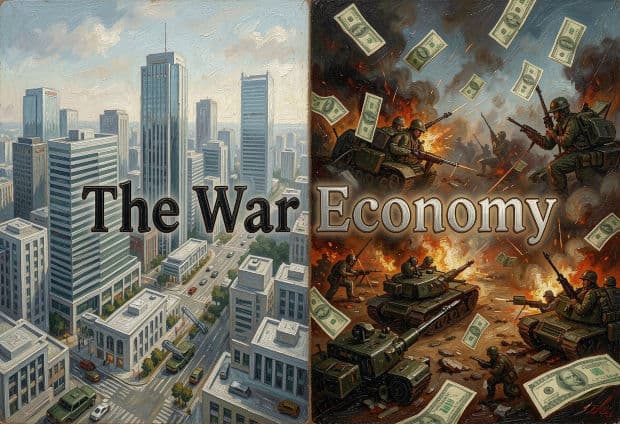
Summary
War means destruction — that's what we're taught from childhood. But history tells a different story. For certain countries, certain industries, and certain people, war means enormous profit. This system is called the 'war economy.' From two world wars to today's Ukraine-Russia conflict, every major war has been driven by this invisible economic machinery. This article explores how the war economy was born, how it works, and how modern empires sustain themselves through it.
Key Takeaways
- A war economy centralizes a nation's production, labor, and resources for military purposes — but its deeper meaning is a system where war itself becomes an industry.
- WWII's war economy pulled America out of the Great Depression — unemployment dropped from 14.6% to 1.2%.
- The Military-Industrial Complex is a triangular power structure of government, military, and arms companies that directly profits from keeping wars going.
- The US spends over $900 billion annually on defense — more than the next 10 countries combined.
- Post-war reconstruction contracts, control of oil and minerals, and new market access are the three prizes that make war economically attractive.
- Within one year of the Ukraine war starting, the top five US defense companies saw their share prices rise by an average of 35%.
The Warning That Started It All
It was 1961. President Dwight Eisenhower — the Supreme Commander of Allied Forces in World War II, America's most trusted military leader — was delivering his farewell address.
But instead of celebrating military glory, he issued a warning.
"We must guard against the acquisition of unwarranted influence by the military-industrial complex. The potential for the disastrous rise of misplaced power exists and will persist." — President Eisenhower, 1961
A military leader himself was saying the system was dangerous. Because he'd seen from the inside how war stops being just a political decision — and becomes a financial one. This article is the story of that system.
What Is a War Economy — And Why Does It Exist?
The term "war economy" carries two distinct meanings.
The first meaning is wartime economic management.
When a country goes to war, its entire economy pivots to serve the military. Car factories stop making cars and start making tanks. Textile mills stop making clothes and start making uniforms. Food production, transportation, fuel — everything comes under government control.
The second — and far more important — meaning is a system where war itself becomes an industry.
Arms manufacturing, military contracting, intelligence technology — these industries literally cannot survive without war. Their survival depends on conflict continuing. This is what Eisenhower warned about.
Three Historical Reasons This System Was Born
Reason 1: The Industrial Revolution turned war into a factory product.
Before industrialization, wars were fought with swords, spears, and horses. No factories needed. But after the Industrial Revolution, guns, cannons, and warships required steel mills, coal mines, and massive production lines. War became an industry — and like any industry, it needs demand for its products.
Reason 2: World War I proved that war is profitable.
American companies made staggering profits during WWI. DuPont earned 10x its pre-war profits selling explosives. The Nye Committee investigation later proved that certain companies and banks had actively worked to prolong the war. The public called them the "Merchants of Death."
Reason 3: The Great Depression proved war economies can cure recessions.
According to the US Bureau of Labor Statistics, unemployment was 14.6% in 1940. By 1944, it had fallen to just 1.2%. War ended the Depression. This lesson burned itself into policymakers' minds: military spending keeps the economy strong.
World War II — The Laboratory of Modern War Economics
America Turned Its Entire Economy Into a Weapons Factory
In 1939, the US Army had just 175,000 soldiers — smaller than Portugal's. After Pearl Harbor in 1941, Roosevelt made an unprecedented decision: convert the entire American economy to war production.
Ford Motor Company stopped making cars and started building B-24 bombers — one every 63 minutes. General Motors made tank engines. Chrysler made tanks. Even piano factories built glider aircraft.
According to the US Office of War Information, between 1940 and 1945, America produced 300,000 aircraft, 100,000 tanks, 400,000 artillery pieces, and 47 million rounds of ammunition.
The war also transformed society. With millions of men deployed, women flooded into factories. "Rosie the Riveter" became the war's most iconic poster. Women's share of the workforce jumped from 27% to 37%.
The Financial Result: How America Became the World's Richest Nation
By 1945, America's GDP had nearly doubled during the war. Unemployment was practically zero. Meanwhile, Europe lay in ruins. According to IMF historical data, in 1945, America alone produced approximately 50% of the entire world's GDP. Half of everything made on Earth came from one country. The foundation of this unprecedented wealth? The war economy.
The Military-Industrial Complex — The Machine That Turns War Into Business
The Triangle of Power
Corner 1: The Military
Generals and admirals always want bigger budgets, newer weapons, better equipment. Their careers depend on building the most capable force possible. And after retirement, many generals walk straight into high-paying positions at defense companies — the famous "Revolving Door."
Corner 2: The Arms Industry
Lockheed Martin, Boeing, Raytheon, Northrop Grumman, General Dynamics — these companies derive almost all their revenue from government defense contracts. According to SIPRI, the top 100 arms companies globally sold $597 billion worth of weapons in 2022. American companies accounted for 51%.
Corner 3: Politicians
Members of Congress approve defense budgets — but these same politicians receive massive campaign donations from defense companies. According to the Center for Responsive Politics, the defense industry donated approximately $44 million to political campaigns in 2022.
The cycle is self-reinforcing: politicians approve bigger budgets, companies profit, profits fund politician campaigns, politicians approve even bigger budgets.
Step by Step: How a War Becomes Corporate Profit
Step 1 — A threat is created or amplified.
In 2002, the US government declared Iraq had "weapons of mass destruction." This was later proven false. But it was enough to prepare the public for war.
Step 2 — The defense budget explodes.
The US defense budget was $316 billion in 2001. By 2008, it had doubled to $616 billion — in just seven years.
Step 3 — Arms companies win contracts.
The Commission on Wartime Contracting reported that contractor spending in Iraq and Afghanistan totaled approximately $200 billion.
Step 4 — Reconstruction contracts follow destruction.
Halliburton — whose CEO was Dick Cheney before he became Vice President — won Iraq reconstruction contracts worth approximately $39 billion. The same Cheney who was the war's biggest advocate.
Step 5 — Stock prices soar.
After 9/11, Lockheed Martin's stock rose 300% in two years. Every major war triggers a defense stock rally. The shareholders — institutional investors, pension funds, university endowments — quietly profit while soldiers die.
How Empires Sustain Themselves Through War Economics
Every great empire in history followed the same formula: use military power to seize resources, use those resources to maintain military power. The modern version has five steps.
Step 1 — Military presence secures trade routes.
The US maintains over 750 military bases in more than 80 countries. These bases aren't just for fighting wars — they're positioned near critical trade chokepoints: the Strait of Malacca, the Strait of Hormuz, the Suez Canal. This ensures global trade flows on American terms.
Step 2 — Arms sales buy alliances.
In 2023, US arms exports hit a record $238 billion. But the real value isn't just revenue. Countries that use American weapons become dependent on the US for spare parts, training, and upgrades — creating long-term strategic dependency.
Step 3 — Weak post-war governments serve foreign interests.
Iraq, Afghanistan, Libya — after each war, strong central governments were replaced by weak, fractured states whose oil and mineral wealth became easily accessible to Western corporations.
Step 4 — Reconstruction contracts capture markets.
After 2003, ExxonMobil, BP, and Shell entered Iraq's oil industry — access that was impossible under Saddam. War opened the market.
The Ukraine War — A Case Study in Proxy War Profits
A proxy war is fighting on someone else's land, with someone else's soldiers. Your troops don't die, but your weapons sell, and your rival weakens. Ukraine is the largest modern example.
According to the US Department of Defense, from February 2022 through early 2024, America provided Ukraine with approximately $46 billion in military aid. But this isn't cash handed to Ukraine — America buys weapons from its own defense companies and ships them to the front lines. American taxpayer money flows directly to American corporations.
Lockheed Martin CEO James Taiclet said in 2022: "The Ukraine conflict has given us the justification to increase production capacity."
According to Reuters, within the first year of the Ukraine war, the top five US defense companies saw their share prices rise by an average of 35%.
People are dying in Ukraine. Profits are being made in American boardrooms.
The Dark Side — Who Wins, Who Loses
Who profits? Arms company shareholders. Military contractors. Retired generals on defense company boards. Politicians receiving campaign donations.
Who suffers? Soldiers who lose their lives. Civilians caught in war zones. Taxpayers funding the machine. Developing nations destabilized by conflict.
Brown University's "Cost of War" project estimates that America's post-9/11 wars cost more than $8 trillion. Over 900,000 people died. More than 37 million were displaced.
What could $8 trillion have accomplished? It could have cancelled all American student debt. Funded decades of global climate change mitigation. Dramatically reduced world poverty. Instead, it went to arms companies, contractors, and military operations.
SIPRI reports that global military spending in 2023 reached $2.2 trillion. Much of this comes from developing nations that desperately need healthcare and education investment instead.
Today's War Economy in Numbers
The US defense budget for 2024 was $886 billion — more than the next 10 countries combined.
2023 Military Spending Comparison (SIPRI):
United States: $916 billion
China: $296 billion
Russia: $109 billion
India: $83 billion
Saudi Arabia: $75 billion
United Kingdom: $74 billion
Germany: $66 billion
Top Arms Companies (SIPRI 2022):
Lockheed Martin: $66 billion | Raytheon: $67 billion | Boeing (defense): $66 billion | Northrop Grumman: $36 billion | General Dynamics: $39 billion
These companies derive 70-90% of their revenue from government defense contracts. Without war — or the threat of war — their business model collapses.
Will the War Economy Last Forever?
Challenge 1: Economic exhaustion.
US national debt stands at $34 trillion. The post-9/11 wars alone cost $8 trillion. "War fatigue" is growing — America's withdrawal from Afghanistan was a clear symptom.
Challenge 2: The changing nature of warfare.
Drones, cyber warfare, and AI are transforming combat. A drone strike costs thousands of dollars; a fighter jet costs hundreds of millions. This disrupts the traditional arms industry model.
Challenge 3: The climate crisis.
Climate change requires massive investment in clean energy — every dollar spent on weapons is a dollar not spent on survival. There's a fundamental tension between the war economy and planetary survival.
Challenge 4: The multipolar world.
In a unipolar world, one empire can wage war at will. But with China and Russia rising, adversaries are stronger. Even proxy wars like Ukraine are proving extraordinarily costly.
"Forever War" — A Business Model
The Military-Industrial Complex doesn't want wars that end. It wants wars that continue. A finished war means declining arms demand, falling profits, stock drops, and layoffs. But an ongoing war means constant orders for new weapons, replacement parts, expanded intelligence budgets.
America spent 20 years in Afghanistan and never "won." But during those 20 years, defense companies earned trillions. The question becomes unavoidable: was the failure to win... by design?
Final Thoughts
Eisenhower's 1961 warning is more relevant today than ever. The Military-Industrial Complex is no longer confined to America. China, Russia, India — every major power now has its own war economy.
And these war economies feed each other. When America builds more weapons, China builds more. When China builds more, India buys more. This arms race doesn't just increase the risk of conflict — it diverts the world's limited resources toward machines designed to kill people.
The money the world spends on military budgets every year dwarfs what it would take to end global hunger, provide universal education, and build healthcare systems in the poorest nations.
But that money goes to weapons. Because weapons generate profit. Ending hunger doesn't generate the same kind of immediate return.
"Every gun that is made, every warship launched, every rocket fired signifies a theft from those who hunger and are not fed." — President Eisenhower, 1953
The war economy will persist as long as war remains profitable. And that is precisely how the system was designed.
Recommended for you

The Bretton Woods Agreement: A Turning Point in Global Economic History
In 1944, as the world was still engulfed in the devastation of World War II, the global economy had collapsed and people’s living standards had plummeted. In an effort to stabilize the international economy and address pressing global financial issues, the Allied nations convened a historic summit. Nearly 730 delegates from 44 countries gathered at the Mount Washington Hotel in Bretton Woods, New Hampshire, for the United Nations Monetary and Financial Conference. The outcome of this summit was the landmark Bretton Woods Agreement, which gave birth to the Bretton Woods System.
Money
Money: What It Is, How It Works, and Its Complete History
Business
What is Equity? A Comprehensive Guide to Ownership, Value, and ROE

Books
The $100 Startup
Economics
Economics: What It Is, Why It Matters, and How It Shapes Our Lives
Agreement
North American Free Trade Agreement (NAFTA)
Analysis
PESTLE Analysis in depth

Analysis
VPEC-T Analysis: Definition, Components, and How to Use It

Analysis
Business Analysis Tools: A Complete Guide to the Best Tools

Banking
Banking 101 - Understanding Banking Products and Services