How FIFA Runs Its Business: The $7.5 Billion Ecosystem, 5 Revenue Sources, 7 Stakeholders
G
GeoRenus Editorial Team
829 views
Summary
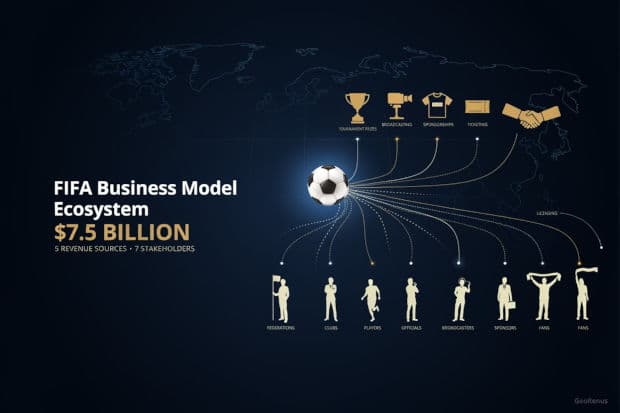
FIFA is the monopoly regulator of world football. Founded in Paris in 1904 by seven European nations. Headquartered in Zurich. Legally a Swiss non-profit association. 211 member federations, more than the UN. Six confederations. Revenue of $7.5 billion in the 2019-2022 cycle, projected $11 billion for 2023-2026. Five revenue sources: broadcasting 55%, sponsorship 20%, ticketing 15%, licensing 5%, other 5%. Seven stakeholders: federations, confederations, players/clubs, sponsors, broadcasters, host countries, fans. Governance: Congress (211 votes), Council (37 members), President Infantino. The 2015 $2 billion bribery scandal and Infantino's reforms. FIFA vs UEFA vs clubs, the modern conflict. Bangladesh's BFF receives $1.5-2M annually through the FIFA Forward Programme.
Key Takeaways
- FIFA founded in Paris in 1904, headquartered in Zurich, a Swiss non-profit association. First World Cup 1930, first TV broadcast 1954.
- 211 member federations (more than the UN's 193). Six confederations. Bangladesh sits in AFC.
- $7.5B revenue in the 2019-2022 cycle. $11B projected for 2023-2026. Reserves ~$4B.
- Five revenue sources. Broadcasting 55% ($4.1B), sponsorship 20% ($1.5B), ticketing 15% ($1.1B), licensing 5% ($400M), other 5%.
- Seven FIFA Partners: Adidas, Coca-Cola, Wanda, Hyundai-Kia, Visa, Qatar Airways, Saudi Aramco (added 2024).
- World Cup delivers 90% of revenue. Qatar 2022 net $1.1B. 2026 American World Cup: 48 teams, 104 matches, $11B projected.
- Seven stakeholder groups: member federations, confederations, players and clubs ($209M club compensation in 2022), sponsors, broadcasters, host countries, fans.
- Governance: Congress (211 votes), Council (37 members), President (Infantino, $5M salary, 12-year cap).
- 2015 FBI raid at Zurich's Baur au Lac Hotel. $2B+ in bribery. Blatter resigned. Infantino reforms. 2034 Saudi decision revives suspicions.
- Bangladesh BFF receives $1.5-2M/year through FIFA Forward Programme. T Sports paid $10M for 2022 World Cup broadcasting. $15M projected for 2026.
Introduction: From the Night of the Final to FIFA's Business
July 19, 2026. East Rutherford, New York. MetLife Stadium. All 82,500 seats packed. The World Cup final. Argentina versus Spain. Two generations met on the pitch. On one side, 39-year-old Lionel Messi, likely playing his last-ever World Cup final. On the other, 19-year-old Lamine Yamal, the face of Spain's new generation. In the end it was the younger generation that had the last laugh, beating Messi's Argentina to crown Spain the new world champions.
Outside the stadium thousands of fans without tickets. But they hadn't gone home. Blue-and-white Argentine jerseys from South America. Red Spanish jerseys from Europe. In Bangladesh it was 1 AM. In Dhaka, Chittagong, Khulna, Sylhet, tea stalls were open. People sat in front of televisions. Nobody had slept all night.
This one match was watched, on television and streaming, by around 2 billion people, or so FIFA projects. If it holds, that's 500 million more than the 2022 Qatar final. The most-watched sporting event in history. Behind that one match, however, sits a four-year financial machine. Its name is FIFA.
In the 2023-2026 cycle FIFA's projected revenue is around $11 billion. Up 45% from the $7.5 billion of the 2019-2022 cycle. There is a story behind every dollar of that revenue. Broadcasting rights, sponsorships, ticket sales, licensing. Each with its own market. Its own buyers. Its own history.
The match is over, the title decided. But a simple question remains. How much did FIFA earn from this tournament? Where does the money go? Who makes the decisions in this business? Champions Spain walked away with $42 million in prize money, but where does that number come from? And what about the grant that Bangladesh Football Federation gets every year, where does that come from?
Many people think of FIFA as just a football body. Non-profit on paper. A small office in Zurich, Switzerland. A president who makes some decisions. The rest is left to referees and national teams. That view is half true. Because FIFA is also the largest single sports business on Earth. Reserves of nearly $4 billion. 211 member countries. 900 staff. A history of $2 billion worth of bribery scandals. And the centre of several continental power struggles.
This article is an attempt to break that business apart. Not just the numbers, but the structure behind them. Who earns how. Who takes a share. Who makes the calls. What happened in the 2015 corruption scandal. Why European clubs are turning against FIFA. What exactly Bangladesh Football Federation's relationship with FIFA looks like. And where this business is heading in the next ten years.
In one sentence, FIFA is the monopoly regulator of world football. Founded in Paris in 1904. Headquartered in Zurich. Legally a Swiss non-profit association. But commercially, a giant. A pyramid of 211 member federations and six confederations. The main engine is the four-year World Cup, which brings in roughly 90% of revenue. Broadcasting rights are the largest single source, followed by sponsorship, ticketing, and licensing. This article walks through the entire ecosystem.
The article opens with history. It then walks through the five sources of revenue, the economics of the World Cup, the seven stakeholder groups, the governance structure, the 2015 scandal, the conflicts with UEFA and clubs, the Bangladesh connection, and the future. Read together, FIFA no longer looks like just a football body. It looks like one of the more remarkable business models in the world. A machine that converts human passion directly into revenue.
What FIFA Actually Is: A 120-Year Institution
FIFA's full name is Fédération Internationale de Football Association. French. In English, that reads as "International Football Association Federation." The French name itself hints at where FIFA was born. Not in England. In Paris.
1904: Founded in Paris
Football itself belongs to England. The Football Association was founded in London in 1863. The world's first modern football body. But England did not want to lead internationally. The British view was that international rules would mean bending their own.
So the rest of Europe organised itself. May 21, 1904. A small office at Rue Saint-Honoré in Paris. Representatives from seven countries. France, Belgium, Denmark, the Netherlands, Spain, Sweden, Switzerland. The first president was Robert Guérin. A French journalist. The budget was 50 francs. Staff, zero.
For the first ten years FIFA played almost no role. Football at that stage was mainly a continental affair. England played at the Olympics. The idea of a full international tournament was still new.
1930: The First World Cup
FIFA's real rise started in 1930. The first World Cup, held in Uruguay. 13 teams. In the final, Uruguay beat Argentina. From that tournament, FIFA had a place on the world stage. But the early World Cups were still financially modest. Europe and South America ran the show. There was no television.
The 1954 World Cup in Switzerland brought the first television broadcast. Black and white. In Europe. That one moment changed FIFA's trajectory. Because television meant advertising. Advertising meant sponsorship. Sponsorship eventually meant billion-dollar business.
The Current Structure: A Pyramid
Today's FIFA is a pyramid. At the top sits FIFA itself. Headquartered on Zurich's Hitzigweg. 900 staff. Annual operating budget around $250 million.
Below sit six continental confederations. First, UEFA, meaning Europe. 55 members. The wealthiest. Annual revenue over €4 billion. It runs the Euros, the Champions League, and the Europa League.
Second, CONMEBOL, meaning South America. Only 10 members. But historically the winningest confederation. Brazil has 5 World Cup titles, Argentina 3, Uruguay 2. It runs the Copa América.
Third, AFC, the Asian Football Confederation. 47 members. Bangladesh sits inside this one. Headquartered in Kuala Lumpur. It runs the Asian Cup and the AFC Champions League. Japan, South Korea, Iran, and Australia (which moved from OFC in 2006) all sit here.
Fourth, CAF, the Confederation of African Football. 54 members. Africa Cup of Nations. Egypt, Cameroon, Nigeria, and Senegal are the main powers.
Fifth, CONCACAF. North America, Central America, and the Caribbean. 41 members. Mexico and the United States are the main powers.
Sixth, OFC, Oceania. 14 members. The smallest. No real major nation, because Australia moved to Asia.
Add it all together and you have 211 national federations. FIFA has more member countries than the UN. The UN has 193. Football's number is higher because England, Scotland, Wales, and Northern Ireland each have their own federation. Palestine, Taiwan, Kosovo, and Gibraltar are all members too.
Legal Character: Why a Swiss Non-Profit
FIFA is legally a Swiss association. That is, a non-profit. This status has held since 1904. Why Switzerland? Because Swiss law is straightforward. Minimal audit. Low tax. High autonomy.
This non-profit status is a gold mine for FIFA. Because there are no shareholders. So no dividends have to be paid. The tax rate sits close to zero. Almost all revenue can be retained internally, or spent on football development.
Non-profit does not mean poor, however. At the end of 2023 FIFA held reserves of roughly $4 billion. Those reserves sit invested. Mostly in government bonds, high-grade corporate bonds, and some equity. Annual investment income runs $100-200 million.
Critics ask why a non-profit needs to hold $4 billion in reserves. FIFA's answer is that if any future World Cup runs into trouble (Covid was the reference), the tournament can still be delivered. But that explanation doesn't satisfy everyone. Since the 2015 scandal the reserve size has attracted more scrutiny.
In plain terms: FIFA was founded in Paris in 1904 by representatives of seven countries. The first World Cup was in 1930. Television arrived in 1954. Headquartered in Zurich. A Swiss non-profit. 211 members (more than the UN's 193). Six confederations. Reserves near $4 billion.
Where FIFA's Money Comes From: Five Sources
Understanding FIFA's revenue requires understanding FIFA's accounting cycle. FIFA does not report on a corporate year. It reports on a four-year cycle. And the centre of that cycle is the World Cup. The 2019-2022 cycle centred on the Qatar World Cup. The 2023-2026 cycle centres on the American World Cup.
On that basis, total revenue in the 2019-2022 cycle came to $7.5 billion. The prior cycle, 2015-2018 (Russia World Cup), delivered $6.4 billion. A roughly 15% jump per cycle. The 2023-2026 cycle projects $11 billion. That is another 45% jump. Because the American World Cup fields 48 teams and 104 matches.
Source | 2019-2022 Revenue | Share |
Broadcasting rights | $4.1 billion | 55% |
Sponsorship and marketing | $1.5 billion | 20% |
Ticketing and hospitality | $1.1 billion | 15% |
Licensing | $400 million | 5% |
Other (investments, FIFA+) | $400 million | 5% |
Total | $7.5 billion | 100% |
(1) Broadcasting Rights: The King
Broadcasting is FIFA's largest revenue source. 55% share. Here's the key thing. To show the World Cup, any TV channel or streaming platform must purchase rights from FIFA. Those rights are usually sold in packages that cover two World Cups. Meaning 2018 and 2022 together. Or 2026 and 2030 together.
The biggest market is the United States. Fox Corporation paid $425 million for the 2018 and 2022 World Cups. Those rights originally sat with ESPN. Fox took them from ESPN in 2011. For 2026-2030 Fox has paid roughly $470 million. About 11% more than the first deal.
In Spanish-speaking America, Univision. Mexico, South America, and the Spanish-speaking part of Europe sit outside this deal. The 2018-2022 cycle came to $300 million. It's growing.
In the Middle East and North Africa, beIN Sports. A Qatari channel. The 2018-2022 cycle delivered $350 million. Qatar's hosting of 2022 shaped that deal. For 2026 the market is bidding again. Saudi's SSC is the main competitor.
In the UK, BBC and ITV split rights. The rules are different there. Public broadcasters must show the World Cup free-to-air. The 2018-2022 package came to £200 million.
China has CCTV as the exclusive holder. The price is confidential. Market analysts estimate around $300 million. Why so much? China has 1.4 billion football fans.
In Bangladesh the story is different. Small market. In 2022 T Sports and Nagorik TV together bought rights. The price came to roughly $8-10 million. For 2026 FIFA will push the price higher. Because the team count is 48 and the match count is 104.
Across 200+ countries, the 2019-2022 cycle delivered $4.1 billion in broadcasting. The 2026 cycle targets $5.5 billion.
(2) Sponsorship and Marketing: The Second Largest
Sponsorship means companies pay FIFA to attach their brand to the World Cup. The market has three tiers, each with its own price point and privileges.
The top tier is FIFA Partner. Only seven companies can hold this status. Four-year contracts. Around $100-150 million each. In exchange, brand presence at every FIFA tournament. In the World Cup, the best logo placements in stadiums.
The 2026 FIFA Partners are seven. Adidas, with FIFA since 1970. Supplies the World Cup ball. Coca-Cola, since 1974. Present in almost every trophy shot. Wanda Group, a Chinese conglomerate. Joined in 2016. Hyundai-Kia, the Korean automotive group. Since 1999. Visa, since 2007. Exclusive card payment. Qatar Airways, since 2017. Tied to the Qatar World Cup. Saudi Aramco, added in 2024. Linked to the 2034 Saudi World Cup.
The second tier is World Cup Sponsor. For one specific World Cup. Cost $20-50 million. For 2026 the list includes McDonald's, Budweiser (AB InBev), Lenovo (Chinese), Alibaba, BYJU's. Most of these are strong in one country or region.
The third tier is Regional Supporter. Cost $5-20 million. The right to use the brand in one region only. For example, a beer brand in Latin America. Or a telecom in Asia.
Across all three tiers, the 2019-2022 cycle delivered $1.5 billion. For 2026 the projection is $2 billion. Because Saudi Aramco has joined and new Asian companies are coming in.
(3) Ticketing and Hospitality
Ticket sales for World Cup matches. In Qatar 2022, more than 3 million tickets sold. Average price $200. Straight ticket revenue came to $600 million. The cheapest group-stage ticket was $11 (for locals). The most expensive final ticket was $1,600.
The real margins sit in hospitality packages. These are sold by Match Hospitality, a joint venture between FIFA and Infront Sports. Packages run $5,000 to $50,000 per match. Included: VIP boxes, food, drinks, expert commentary. In 2022 hospitality alone brought in $400 million.
Across the 2019-2022 cycle, ticketing and hospitality delivered $1.1 billion. For 2026, with 104 matches across 16 cities, the projection is $1.7 billion.
(4) Licensing
Use of the World Cup trophy image. Mascots. Video games. This is licensing revenue. Small but important.
The biggest was the video game deal. EA Sports (now Electronic Arts) made the FIFA video game from 1993. Paid FIFA $150 million a year. In 2023 the deal ended. EA wanted more autonomy. FIFA wanted more money. EA renamed its game to EA Football. FIFA is now hunting for new licensees. Three or four smaller games have launched under the FIFA name in 2025, but none has matched EA.
Other licensing includes World Cup trophy replicas, mascot merchandise, books. The 2019-2022 cycle delivered $400 million across all licensing.
(5) Other
Investment income on $4 billion of reserves at 2-3% comes to $100-150 million a year.
There is also FIFA+, launched in 2022. A streaming platform. Free. Revenue is still small. But the expectation is growth.
Together, roughly $400 million across the cycle.
In plain terms: FIFA's five revenue sources. Broadcasting rights at 55% ($4.1B, split across Fox / beIN / CCTV / T Sports and others), sponsorship at 20% ($1.5B, seven FIFA Partners), ticketing at 15% ($1.1B), licensing at 5% ($400M, shrinking since the EA breakup), and other at 5%. Total $7.5 billion in one cycle.
The World Cup: The Engine of 90% of Revenue
There is a hidden truth about FIFA's revenue. Around 90% of it comes from one one-month tournament every four years. The World Cup. The remaining 10% comes from the Women's World Cup, age-group tournaments, the FIFA Confederations Cup (now defunct), membership fees, and so on.
That fact raises a question. Is FIFA a sports body, or is it a four-year event manager? Critics answer the second. FIFA is, in effect, one enormous event whose main job is running the World Cup every four years and generating $7.5 billion around it.
The Qatar World Cup: A Financial Breakdown
Qatar 2022 was the most expensive World Cup in history. The Qatari government spent roughly $220 billion. Most of that was infrastructure. Seven new stadiums. A brand-new city (Lusail). A metro line. Airport expansion. Hotels.
But FIFA's own P&L is separate. In Qatar, FIFA's total revenue came to $7.5 billion. The cost breakdown is below.
Line item | Amount |
Total revenue | $7.5 billion |
Prize money (32 teams) | $440 million |
Club compensation | $209 million |
Allocation to member federations | $1 billion |
Allocation to confederations | $200 million |
Operating costs | $1 billion |
FIFA net revenue | $1.1 billion |
The prize money detail. Champion Argentina received $42 million. Runner-up France, $30 million. Third-placed Croatia, $27 million. Fourth-placed Morocco, $25 million. The four quarter-finalists $17 million each. The eight round-of-16 teams $13 million each. The 16 group-stage exits $9 million each.
That means if Bangladesh had reached the World Cup, even just the group stage would have brought in $9 million. That is more than Bangladesh's annual football budget.
Club compensation is a newer idea. Introduced in 2010. Big European clubs had argued they pay player salaries all year, then lose players to World Cup injuries. Clubs bore the loss. So FIFA in 2022 paid clubs $209 million. Roughly $10,000 per player per day. Messi played for PSG. PSG collected daily compensation for Messi.
Allocation to member federations came to $1 billion. That averaged out to $5 million each for the 211 federations. BFF received its share.
After all costs, FIFA's net revenue was $1.1 billion. That was added to reserves.
2026: The Biggest World Cup in History
The 2026 World Cup is the biggest in history. Because FIFA made one large decision. To expand from 32 teams to 48.
Why the expansion? The official reason, giving smaller nations a chance. Cabo Verde, Uzbekistan, New Zealand, that kind of country will have a better shot at reaching the World Cup. More teams from Africa and Asia will qualify.
The actual reason, revenue growth. More teams means more matches. More matches means more broadcasting rights, more ticket sales, more sponsorship. Going from 64 to 104 matches is a 63% increase.
Three host countries. The US (11 cities), Mexico (3), Canada (2). 16 cities total. A 32-day tournament. Projected revenue $11 billion. That's 45% more than Qatar.
But the expansion is controversial. Major European clubs argue that players will play even more. 70+ matches a year. More injuries. Lower quality. President Infantino counters that the World Cup is becoming democratised.
2034 Saudi Arabia: The Most Controversial Decision
The 2034 World Cup was awarded to Saudi Arabia in December 2024. This is FIFA's most controversial decision.
Why controversial? First, the bidding process. Saudi Arabia was the only bidder. No competition. Other countries did not bid. Because FIFA had ruled 2034 would go to Asia or Oceania. Australia was the most likely challenger from Asia. But they didn't bid. Why not? An internal understanding with FIFA is the assumption.
Second, human rights. Women's rights in Saudi Arabia are restricted. Workers' rights, especially for migrants, are weak. Across the 2010-2020 decade, an estimated 6,500 migrant workers died in Qatar. Not all in stadium construction, and from a range of causes. But that toll is tied to the broader World Cup building boom. Saudi risks are higher. LGBT rights are effectively non-existent. Human rights groups are protesting.
Third, sportswashing. Saudi Arabia has been pouring billions into world football over the past decade. The arrivals of Ronaldo, Neymar, Benzema. The Saudi Pro League. Newcastle United acquired (Saudi PIF). LIV Golf. Saudi Aramco a FIFA Partner. The World Cup gives Saudi Arabia a chance to soften its international image.
FIFA still gave the tournament to Saudi. Because the financial upside is uncapped. Saudi investment is essentially bottomless. Government backing is there. Infantino's personal ties with Saudi Crown Prince Mohammed bin Salman are well known.
In plain terms: The World Cup delivers 90% of FIFA's revenue. Qatar 2022 brought $7.5B in revenue and $1.1B in net profit. Prize money was $440M, club compensation $209M. The 2026 American World Cup fields 48 teams, 104 matches, and projects $11B. Saudi 2034 remains controversial on human rights and sportswashing.
Who slices up the $7.5 billion pie? The answer shows FIFA's power structure. Broadly, seven kinds of stakeholders. Their shares are unequal. Some get direct payouts as a percentage. Others just enjoy indirect benefits.
(1) Member Federations: Direct Allocation
The largest single stakeholder is the member federation set. 211 of them. Each with an equal vote. But unequal economic clout.
Through the FIFA Forward Programme, each federation receives roughly $8 million every four years. It is not a loan. It's a grant. But it comes with conditions. The money must go into pitches, training, women's football, youth development. Not luxury spending.
Bangladesh Football Federation receives this. Roughly $1.5-2 million a year. A total of $8 million over four years. That grant makes up a significant share of BFF's annual budget.
But there is a problem. Smaller federations don't always track the money properly. The 2015 scandal revealed that many small members of the Caribbean Football Union pocketed these grants. In return for votes in FIFA presidential elections.
(2) Confederations: Mid-Tier
The six confederations receive $200-400 million each per cycle. UEFA is the largest, at around $400 million. But UEFA's own revenue is larger than FIFA's. €4 billion a year. Mostly from the Champions League and Euros. So the FIFA allocation isn't critical for UEFA. It matters much more to the smaller confederations.
The AFC receives about $200 million per World Cup cycle. That money runs the Asian Cup, the AFC Champions League, and Asian youth tournaments. A lot of Bangladesh's own matches sit on top of AFC budgets.
CAF (Africa) and CONCACAF (North America) each receive around $200 million. CONMEBOL (South America) gets less. OFC (Oceania) is smallest, below $100 million.
(3) Players and Clubs: A Complex Stakeholder
Players are FIFA's most important asset. They are why fans show up. But FIFA does not pay players directly. National federations do. Prize money goes to the federation. The federation distributes to players.
The players' body is FIFPro. It represents about 65,000 professional players. It negotiates directly with FIFA. On schedule, pay, safety, health. In 2023 FIFPro sued FIFA over calendar congestion.
Clubs are also FIFA stakeholders. Because club players go to the World Cup. Clubs pay salaries year-round. During the World Cup they don't get their players. If a player returns injured, the club takes the loss. The solution is the FIFA Club Benefits Programme. In 2022 FIFA paid clubs $209 million. In 2026 the expectation is $350 million.
(4) Sponsors
Sponsor relationships are two-way. Sponsors pay FIFA money. FIFA promotes their brand globally. This relationship stretches decades. Adidas since 1970. Coca-Cola since 1974.
But sponsorship has problems. Some sponsors walked after the 2015 corruption scandal. Sony left. Emirates did not renew. In 2017 FIFA struggled to find second-tier sponsors. Qatar Airways came in. In 2024 Saudi Aramco joined. Modern Western companies increasingly hesitate on human rights concerns.
(5) Broadcasters
Around the world, 200+ television channels and streaming platforms buy World Cup rights. Fox, beIN, BBC, CCTV, Star Sports, T Sports. The relationship is two-way. Broadcasters pay, FIFA delivers content.
The recent trend is the rise of streaming. Amazon Prime, Apple TV, Disney+, Netflix, all competing against traditional broadcast. By 2030 the World Cup might be streamed live rather than broadcast.
(6) Host Countries
Host countries build billions of dollars of infrastructure. Qatar in 2022 spent $220 billion. Russia in 2018 spent $15 billion. Brazil in 2014 spent $15 billion. South Africa in 2010 spent $4 billion.
But the ticket and broadcasting profits go to FIFA. Host countries get tourism, jobs, prestige. All indirect. The direct P&L is usually negative.
Research shows Brazil in 2014 spent $13 billion and recovered $6 billion. A $7 billion loss. Russia in 2018 broke roughly even. Qatar in 2022 spent $220 billion mostly on broader infrastructure, and recovered $20-30 billion.
So why do countries want to host? Not direct money. Soft power. Global visibility. Diplomatic upside.
(7) Fans: The Real Asset
Last, and largest. Around 5 billion football fans globally. The 2022 Qatar final was watched by 1.5 billion people. The most-watched sporting match in history. Across the tournament, 5 billion viewer-hours.
Fans don't demand anything direct from FIFA. Just good football. Free or affordable to watch. Yet fans are FIFA's real asset. Because fans are why sponsors exist, why broadcasters exist, why the entire billion-dollar business exists.
In plain terms: FIFA's seven stakeholders. Member federations (211, each getting $8M per cycle), confederations (UEFA $400M, others $200M), players and clubs ($209M in 2022 club compensation), sponsors, broadcasters, host countries (often net-negative directly), fans (5 billion, the real asset).
Governance: How Power Actually Flows
Who decides on $7.5 billion? The answer sits in FIFA's governance. Three tiers. Congress, Council, President.
The FIFA Congress: The Parliament
At the top is the FIFA Congress. FIFA's parliament, essentially. Each member federation gets one vote. 211 votes. Bangladesh's vote, France's vote, China's vote, all equal. This one-country-one-vote rule is the core of FIFA politics.
Why does it matter? Because controlling the votes of small countries is the path to the FIFA presidency. Europe has 55 votes. Africa has 54, Asia 47, CONCACAF 41, together 142. Much larger than Europe's block. So presidential races usually require building alliances with smaller nations.
Congress meets once a year. Presidential elections happen every four years. Budgets pass. Policies get approved. Since 2017, World Cup hosts are also selected by Congress.
The FIFA Council: The Cabinet
Below Congress sits the FIFA Council. It used to be called the Executive Committee, or ExCo. Renamed Council in the 2016 reforms.
37 members. President, 8 vice presidents (from the confederations), and 28 members (confederation representatives). The Council makes all major decisions. Where the World Cup goes. Rule changes. Big budget allocations. It meets monthly.
Historically the Council has seen most of FIFA's corruption. In 2015, nine ExCo members were arrested. After the reforms, mandatory female membership was introduced. At least six women.
The President: The Most Powerful Person
The FIFA president is the most powerful individual in world football. Why? Not just FIFA itself, but indirectly six confederations, 211 national federations, tens of thousands of clubs, hundreds of thousands of players, billions of fans, all sit downstream.
Four-year term. Three-term limit. Meaning 12 years maximum. That limit came in with the 2016 reforms. Before then, no cap. Sepp Blatter served 17 years (1998-2015). João Havelange served 24 (1974-1998).
The current president is Gianni Infantino. Swiss-Italian. A lawyer. Former UEFA general secretary. Elected in February 2016 after Blatter's fall. Started his third term in 2023. He serves until 2027.
How much does he earn? The number is confidential. But a 2022 FIFA report disclosed 4.3 million Swiss francs. Roughly $5 million. That covers base salary, bonus, pension, travel. FIFA Council members' salaries have also been disclosed. Around $250,000 a year plus per-meeting bonuses.
The General Secretary: The Day-to-Day CEO
The president is a political role. Day-to-day work is run by the General Secretary. In the corporate world, the equivalent of a CEO. The administrative head of the 900-strong staff.
Currently, Fatma Samoura. A Senegalese woman. Since 2016. The first female General Secretary in FIFA history. UN background. Long service in refugee agencies. Infantino picked her for gender balance and African representation.
Samoura announced her resignation in 2023. The actual reason is unclear. But there are rumours of disagreements with Infantino over the Council's commercial decisions. A successor selection process is in progress.
In plain terms: FIFA's three-tier governance. Congress (211 votes, one per member), Council (37 members, meets monthly), President (Infantino, $5M salary, 12-year cap). The General Secretary (Samoura, resigning in 2023) runs day-to-day operations.
The 2015 Scandal: FIFA-Gate
FIFA's history splits into two eras. Before 2015. After 2015. Because on the morning of May 27, 2015, an event shook every layer of the organisation.
May 27, 2015: The Baur au Lac Hotel
That morning was the day before the FIFA Congress. Zurich's Baur au Lac Hotel. Five-star. FIFA officials all staying there. World Cup host selection, presidential election, budget talks, all on the agenda.
At 6 AM Swiss police entered the hotel. With FBI support. Seven FIFA officials arrested. Mostly from CONCACAF and CONMEBOL. They were having breakfast at the time.
Why the raid? The US Department of Justice had been running a long investigation. Jack Warner, former FIFA vice president, from Trinidad. Chuck Blazer, former ExCo member. Both had bribery and corruption charges of $2 billion levelled against them.
The Charges
The charges were serious. First, bribes for World Cup host selection. Buying ExCo votes for the 2010 and 2014 World Cups. South Africa was accused of paying $10 million in bribes for 2010. Brazil for 2014, similar.
Second, bribes for the 2022 Qatar World Cup. This one is the most contested. Qatar won the vote in December 2010. Beating Japan, South Korea, Australia, and the US. Many suspected Qatar had funnelled billions to ExCo members. Le Monde in 2020 published evidence.
Third, kickbacks on broadcasting rights. Officials took money into personal accounts from broadcasters. Latin American broadcasting rights especially. Fox Sports executives were also caught up in this.
Fourth, bribes on Latin American football tournaments. $150 million into personal pockets on CONMEBOL and CONCACAF broadcasting deals.
The Fall of Sepp Blatter
Sepp Blatter was FIFA's president at the time. Since 1998. So 17 years. The May 27 arrests were a shock. He himself was not arrested. But half the Council was under indictment.
Two days later, on May 29, Blatter was re-elected at the FIFA Congress. Winning on Asian, African, and Caribbean votes. Europe voted against him. But small-country votes carried the day.
Four days later, on June 2, Blatter suddenly announced his resignation. What had happened? The truth isn't public. Rumour has it that the FBI had threatened to release more names. Blatter resigned to save himself.
Later investigations found Blatter himself had taken 2 million Swiss francs in an unauthorised payment from UEFA president Michel Platini. Platini called it consulting fees. There was no contract. No paperwork. FIFA's Ethics Committee banned both for 8 years. Later reduced to 6.
Infantino and Reform
In February 2016 came the FIFA Congress. Presidential election. Five candidates. Gianni Infantino (Swiss). Prince Ali (Jordan). Sheikh Salman (Bahrain). Jérôme Champagne (French). Tokyo Sexwale (South African).
In the first round no candidate reached 50%. In the second, Infantino won. 115 votes. Sheikh Salman took 88. Europe, North America, and some African countries backed Infantino.
Infantino announced reforms immediately. Several major changes.
First, ExCo was renamed FIFA Council. More members (24 to 37). Mandatory female representation from each confederation. Total at least six women.
Second, presidential term limits. Three terms of four years. 12 years maximum. Blatter's 17 no longer possible.
Third, salary disclosure. President, Council members, all salaries disclosed. Mandatory annual audit.
Fourth, an independent Ethics Committee. Vetting FIFA officials. Investigative powers.
Fifth, World Cup host selection by the full Congress. Previously the 24-member ExCo voted. Now all 211 federations.
These reforms have been praised. But critics say they are strong on paper, weak in practice. In 2023 the Ethics Committee shut down its own investigation into Infantino. And the 2034 Saudi decision raises the same questions again. The process wasn't transparent.
In plain terms: May 27, 2015 FBI raid on the Baur au Lac Hotel in Zurich. 7 officials arrested. $2B+ in bribery charges. Vote-buying for the 2022 Qatar World Cup, broadcasting rights kickbacks. Blatter resigned. Infantino won the 2016 election. Reforms: renamed Council, 12-year limit, salary disclosure, independent Ethics. But the 2034 Saudi decision has revived old suspicions.
FIFA vs UEFA vs Clubs: The Modern Fight
FIFA's biggest challenge today isn't scandal. It's a power fight. Three sides. FIFA itself. UEFA as the continental confederation. And Europe's major clubs.
Conflict 1: FIFA vs European Clubs
The major European clubs, Real Madrid, Barcelona, Manchester City, Bayern Munich, Juventus, Liverpool, PSG, all these. They play 70-80% of their season's matches themselves. They pay player salaries all year. But during World Cup windows the players go to national duty. Clubs bear the loss. Especially if a player gets injured.
Example. In 2023 Brazilian striker Vinicius Jr. was Real Madrid's. Roughly €10 million a year salary. Playing for Brazil at the Copa América, he tore his hamstring. Real Madrid didn't have him for three months. But the salary kept getting paid. Loss around €2.5 million.
The Club Benefits Programme has softened this. But clubs argue $200 million a year isn't enough. If you add up all international windows across a year, the true loss is closer to $500 million.
There is also the calendar complaint. Clubs argue FIFA keeps tightening the match calendar. 70+ matches a year. Player fatigue. Burnout. In 2023 FIFPro sued FIFA in Belgian court.
Conflict 2: FIFA vs UEFA
UEFA is FIFA's largest and wealthiest confederation. But the tension has been rising.
The first big conflict came in 2021 when Infantino proposed holding the World Cup every two years. His argument was that every four years meant many people would miss a World Cup within a generation. Every two years would grow the market.
UEFA fought back hard. Because the Euros are every four years. So is the World Cup. Together that gives you a major tournament every two years. FIFA's proposal meant one every year. Which would drown out the Euros. And drain UEFA's revenue.
CONMEBOL joined UEFA. So did FIFPro and Europe's major clubs. Everyone against it. In 2022 Infantino quietly withdrew the proposal. UEFA's power was proven.
The second conflict came in presidential politics. In 2019 UEFA president Aleksander Čeferin considered running against Infantino. Three weeks of drama. Eventually pulled out. But the tension deepened.
Conflict 3: The Super League
One April 2021 night, 12 of Europe's biggest clubs announced a new league. The European Super League. Founding members were Real Madrid, Barcelona, Juventus, Manchester United, Liverpool, Chelsea, Arsenal, Manchester City, Tottenham, AC Milan, Inter Milan, Atlético Madrid.
The goal was to replace UEFA's Champions League. The clubs argued Champions League earnings were low. Each club gets around €50 million a year. Super League projected €300 million.
But fans revolted. English fans took to the streets. So did German fans. Prime Minister Boris Johnson, French President Macron, all opposed. Within 48 hours nine clubs pulled out. Only Real Madrid, Barcelona, and Juventus stayed in.
But the story wasn't over. Real Madrid sued UEFA in EU court. Arguing that UEFA was running a monopoly. Violating EU competition law. In 2023 the EU court ruled in Real Madrid's favour. UEFA cannot block the Super League.
The project is still alive. Preparations for a 2027-28 launch. New structure, more teams, more flexibility. Whether it actually launches remains uncertain.
FIFA's Response: Expanded Club World Cup
In the middle of all this, FIFA played a card. Expanding the Club World Cup.
The old Club World Cup was small. Just 7 teams. Once a year. Continental champions went. UEFA Champions League winner, CONMEBOL Copa Libertadores winner, Asia, Africa, CONCACAF, OFC champions. Then the final was the FIFA Club World Cup. Small crowds. Small revenue.
But in 2025 Infantino announced a new format. 32 teams. Once every four years. In the US in June-July 2025. A total $1 billion prize pool. The champion takes $125 million.
The expansion was bait for major European clubs. $125 million is hard to refuse. Manchester City, Real Madrid, Chelsea, Bayern, all in.
But FIFPro protested. A 32-team Club World Cup in 2025 means 7 more matches for club players. That pushes players over 75 matches a year. Fatigue peaks.
In plain terms: Three fights. FIFA vs European clubs (player load and compensation), FIFA vs UEFA (two-year World Cup withdrawn in 2022), clubs vs UEFA (Super League 2021, EU court ruling 2023). FIFA's response: expanded Club World Cup with 32 teams and $1B prize. Players' union in court.
Bangladesh and the BFF: Bottom of the Pyramid
Bangladesh sits far down FIFA's pyramid. In the FIFA world rankings, Bangladesh is 184 (July 2026). Even in Asia, low. Never qualified for a men's World Cup. Last appearance at the Asian Cup was in 1980. 46 years ago.
Yet Bangladesh's relationship with FIFA is long. Because Bangladesh is one of the 211 members. Equal vote. Economically small link, but present.
BFF: Bangladesh Football Federation
BFF was founded in 1972. Right after independence. The first president was M. Kamruzzaman. FIFA membership came in 1974. AFC membership in 1976. An independent country's football journey began.
The headquarters sit in Motijheel's BAFUFE Bhaban. Around 40 staff. The president is elected. The council has 72 members. District football associations, clubs, and football universities all send delegates.
From 2008 to 2024 the president was Kazi Mohammad Salahuddin. Four terms, 16 years. Long tenure attracted many accusations. Authoritarianism. Financial opacity. In the 2024 election Salahuddin lost. The new president is Tabith Awal. A businessman.
FIFA Forward Programme
Through the FIFA Forward Programme, BFF receives roughly $8 million every four years. Meaning $1.5-2 million a year. That grant is a significant share of BFF's annual budget.
The spending must land in four areas. First, national team operations. Matches, training, travel, coaching. Second, youth development. Age-group teams (U-17, U-20, U-23). Academies. Third, women's football. This one gets special emphasis. Because BFF's women's team qualified for the 2022 Asian Cup. And won the 2022 SAFF Championship. Funding is being increased. Fourth, infrastructure. Pitches. Training centres. The BAFUFE Technical Centre at Kamalapur was set up in 2016 with this money.
But there are complaints. BFF's accounting is not fully transparent. FIFA warned once in 2023 that future disbursements would be paused unless reporting improved. BFF made some reforms, but the issue hasn't been fully resolved.
World Cup Broadcasting Rights
The story of World Cup broadcasting in Bangladesh is worth tracing. From 1994 to 2006 rights were with BTV (Bangladesh Television). Government channel. Shown free-to-air.
In 2010 and 2014, Machranga TV and Channel i split the rights. Private channels. Ad-supported. Price around $3 million per cycle.
2018 was different. No Bangladeshi channel bought rights. FIFA had raised prices. Bangladeshi channels realised they couldn't recover the cost through advertising, so they walked. Bangladeshi football fans in 2018 watched the World Cup on India's Sony Ten channel. Via DTH or cable.
In 2022 Qatar broadcasting returned to Bangladesh. T Sports and Nagorik TV bought rights together. Price around $8-10 million. Bashundhara Group and PRAN-RFL helped as sponsors to make the math work.
For 2026 FIFA wants even more. Because it's 48 teams and 104 matches. Projected around $15 million. If Bangladeshi channels don't buy, the country will watch again through Indian channels.
Sponsorship and Bangladesh
No Bangladeshi company qualifies as a FIFA Partner. Because the minimum contract is $100 million. No single Bangladeshi company has that kind of budget. And even if one did, the ROI for a FIFA Partner slot would be limited.
But Bangladeshi brands participate in local sponsorship. During the 2022 Qatar World Cup on T Sports, big local sponsors included Walton, PRAN, Bashundhara, bKash, Nagad, and Fresh. Each contributed Tk 2-10 crore.
The Future of Bangladeshi Football
Where is Bangladeshi football heading? The optimistic view has two possibilities.
First, progress in women's football. Sabina Khatun, Krishna Rani Sarker, Sanjida Akter, these players are close to World Cup qualification. In the Asian qualifying round for the 2027 Brazil World Cup, Bangladesh sits in a strong position.
Second, youth investment. Bangla-Cellular Football League, Dhaka Premier League, Bashundhara Kings, Sheikh Russel, these clubs are building young players. Qualifying for the 2034 men's World Cup is possible if this investment continues.
In plain terms: BFF founded in 1972, FIFA member since 1974. Receives $1.5-2M annually through the FIFA Forward Programme. Spending directed to four areas (national team, youth, women, infrastructure). World Cup broadcasting T Sports at $10M in 2022. Projected $15M for 2026. No Bangladeshi FIFA Partner (minimum $100M). Growth possibilities in women's football and youth investment.
The Future and Closing
Where is FIFA heading? What the past decade has shown is that the next one will be equally turbulent. Several trends are clear.
Trend 1: A Bigger World Cup
The 2026 American World Cup fields 48 teams. The 2030 tournament has six co-hosts (Portugal-Spain-Morocco-Argentina-Uruguay-Paraguay). Then 2034 in Saudi Arabia. Each successive World Cup is larger.
Where does it end? Infantino has floated the idea of a 64-team World Cup by 2038. But players' groups oppose it. Because the physical burden on players becomes unmanageable.
Trend 2: FIFA's Push Into Club Football
For most of its history FIFA has stayed away from club football. Now it is stepping in. The 32-team 2025 Club World Cup. Proposals to make it annual. That puts FIFA in direct competition with UEFA and Europe's clubs. Because the Champions League is UEFA's. The Club World Cup is FIFA's. They fight for the same players and calendar space.
Trend 3: The Rise of Women's Football
The Women's World Cup was in France in 2019, then Australia-New Zealand in 2023. Brazil hosts in 2027. Revenue is climbing fast. $250 million in 2019. $570 million in 2023. Projected $1 billion in 2027.
Women's football is unlocking new audiences. Women and girls. FIFA is stepping up investment. Prize money in the 2023 Women's World Cup came to $150 million. Still three times below the men's number. But growing.
Trend 4: Digital and FIFA+
FIFA+ launched in 2022. A streaming platform. Free. 40 million active users a year. Smaller tournaments, women's football, age-group matches all sit on FIFA+.
In future FIFA+ will grow. Some World Cup matches could stream directly on FIFA+. Competing with ESPN or Sky.
Trend 5: The Saudi Effect
Saudi Aramco became a FIFA Partner in 2024. 2034 World Cup is Saudi's. Billions being invested in the Saudi Pro League. Neymar, Ronaldo, Benzema. Saudi PIF bought Newcastle United. Saudi's rise in world football is accelerating.
By 2030 Saudi's influence will be the largest among FIFA Partners. Politically too.
Trend 6: Fan Fatigue
All the expansion is tiring fans. Too many matches. Too much pressure on players. Falling quality. European fan forums are complaining continuously.
One example. At the start of the 2022 Qatar World Cup European fans nearly boycotted over human rights. The German team covered their mouths in the first match in protest. Boycotts are more likely for the 2034 Saudi World Cup.
Fan revolt could turn out to be FIFA's biggest challenge. Because without fans there is no broadcasting. Without broadcasting there is no money.
Closing
Stepping back from all this, one central truth emerges. This $7.5 billion machine runs on one thing. Human passion. A rickshaw puller in Dhaka spends a portion of his Tk 200 fare on tea and watches a match. A Brazilian child dreams in the jersey of his favourite player. A Saudi prince invests in football from a VIP box. All three passions are the same. Only the expression is different.
Turning that passion into broadcasting rights, sponsorship, ticketing, and licensing, four layers of revenue, is FIFA's real business model. More passion, more money. More money, a bigger World Cup. A bigger World Cup, more passion. A cycle.
But the cycle has a limit. When there are so many matches that fans get tired. When there are so many scandals that trust erodes. When the World Cup becomes so commercial that the beauty of the game fades. That is when the cycle starts to break.
FIFA is at that bend. A $7.5 billion business today. In 20 years, either $20 billion or, if passion fades, back down to $5 billion. Time will tell.
"FIFA is a $7.5 billion machine. But this machine runs on human passion. From a Bangladeshi rickshaw puller to a Saudi prince. Turning that passion into broadcasting rights, sponsorship, ticketing, and licensing is FIFA's real business model. If the passion fades, FIFA is nothing."
References
Article Sources
- FIFA — Annual Financial Report 2023
- FIFA — 2019-2022 Financial Cycle Report
- FIFA Statutes 2024 edition
- FIFA Forward Programme Documentation
- SportsPro Media — FIFA Broadcasting Rights Analysis 2025
- New York Times — 2015 FIFA Corruption Investigation Coverage
- Financial Times — FIFA Business Model Analysis 2024
- Bangladesh Football Federation Annual Report 2024
- AFC Asian Football Confederation Financial Overview
- David Conn — "The Fall of the House of FIFA" (book)
- Ken Bensinger — "Red Card: How the U.S. Blew the Whistle on the World's Biggest Sports Scandal"
Facts and Figures
- FIFA 2019-2022 cycle revenue: $7.5B
- FIFA 2023-2026 expected revenue: $11B
- FIFA revenue split: 55% broadcasting, 20% sponsorship, 15% ticketing, 5% licensing, 5% other
- FIFA member federations: 211 (more than UN's 193)
- FIFA confederations: 6
- FIFA reserves (2023): ~$4B
- FIFA employees: ~900 (HQ Zurich)
- 2022 Qatar World Cup net revenue for FIFA: $1.1B
- 2022 Qatar World Cup prize money: $440M
- 2022 champion Argentina prize: $42M
- 2026 World Cup: 48 teams, 104 matches, 3 host countries, 16 host cities
- FIFA President Infantino salary (2022): ~$5M
- FIFA Forward Programme: ~$8M per federation per 4-year cycle
- Bangladesh Football Federation annual FIFA grant: ~$1.5-2M
- 2015 FIFA scandal indictments: $2B+ in bribery
- 2022 World Cup final viewership: 1.5B people
- 2022 Qatar total infrastructure spending: $220B
- FIFA Partners (2026): Adidas, Coca-Cola, Wanda, Hyundai-Kia, Visa, Qatar Airways, Saudi Aramco
Case Studies
- 1904 FIFA founding in Paris — start of global football governance
- 1930 first World Cup Uruguay — 13 teams
- 1954 first TV broadcast — Switzerland World Cup
- 2010 Club Benefits Programme — first payments to clubs
- 2015 FIFA corruption arrests — Zurich Baur au Lac hotel raid
- Sepp Blatter resignation — end of 17-year presidency
- 2016 Infantino elected — reform era begins
- 2021 European Super League — clubs vs UEFA/FIFA
- 2021 Biennial World Cup proposal — withdrawn after UEFA opposition
- 2022 Qatar World Cup — most expensive at $220B
- 2023 EU court ruling on Super League — UEFA cannot block
- 2024 Saudi Aramco FIFA Partner — controversial addition
- 2025 expanded Club World Cup — $1B prize pool
- 2034 Saudi Arabia World Cup award — most controversial
- FIFA vs EA — end of iconic video game partnership (2023)
Recommended for you
Banking: What It Is, How Banks Work, and Everything You Need to Know
Most people use banks every single day — depositing salaries, withdrawing cash, transferring money, paying bills — without ever really thinking about how the whole system actually works. A bank is a licensed financial institution that accepts deposits from the public and uses those deposits to provide loans to individuals and businesses. Everything a bank does — from accepting your savings to issuing credit cards to printing cheques — falls under the broad category of banking. But banks are not just convenient places to store your money. They are the central nervous system of any economy — the institutions that keep money flowing productively through the system, connecting people who have surplus funds with people and businesses that need capital. And in Bangladesh, where Bangladesh Bank serves as the central authority overseeing the entire financial system, understanding how banking works is genuinely useful knowledge for anyone managing their personal finances, running a business, or simply trying to make smarter decisions with their money.
Business Law
Business Law: What It Is, Why It Matters, and Types You Must Know

Organization
What Is the International Monetary Fund (IMF)?
Sales
What Is Sales and How Does It Work?
Accounting
Corporate Taxation and International Tax Challenges Explained
Accounting
Taxation for Individuals and Businesses: A Complete Overview

Accounting
Income Tax, Concept and Calculation

Agreement
North American Free Trade Agreement (NAFTA)
Analysis
Business Analysis: What It Is, Why It Matters, and How to Do It

Analysis
CATWOE Analysis: Definition, Framework, and Examples