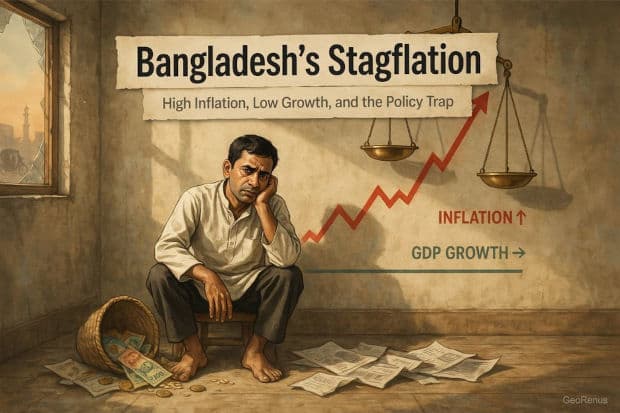
Bangladesh's Stagflation -- High Inflation, Low Growth, and the Policy Trap
G
GeoRenus Editorial Team
1,183 views
Summary
Bangladesh entered a rare and dangerous economic state during 2022-2026 — high inflation (10%+), low GDP growth and taka depreciation all together. This condition is called stagflation — the same condition that brought the US economy down in the 1970s. Normal monetary policy does not work against it, because raising rates to tame inflation further chokes growth. This article explains where Bangladesh's stagflation came from, why it is so dangerous, and how a country can escape it.
Key Takeaways
- Bangladesh is not in full textbook stagflation (official unemployment is still below 4%), but it is in "Incipient Stagflation" -- high inflation, low growth, and hidden underemployment present at the same time.
- The IMF projects FY26 inflation at 9.2% and GDP at 3.9%; PPRC's latest survey shows poverty rising from 18% to 28%; real wage growth has been negative for 26 consecutive months.
- More than 70% of Bangladesh's inflation is supply-side (energy, taka depreciation, supply chain) -- monetary policy alone cannot solve it.
- The Policy Trap is real: pushing the policy rate to 10% has only partially curbed inflation, while private credit growth has collapsed to 6% -- a 20-year low -- and private investment is at a five-year low.
- Historical comparisons: USA escaped via the Volcker shock in 4-5 years; Brazil endured a 10+ year lost decade; Argentina has been cyclically trapped for 40+ years; Bangladesh's path is still undetermined.
- The way out is a four-pillar integrated reform: supply-side reform, fiscal discipline, political stability, and export diversification -- all four in parallel.
- Bangladesh Bank has avoided Turkey's heterodox mistake, but monetary tightening alone is not enough -- immediate supply-side action is required.
Introduction -- The Doctor's Dilemma, One Patient with Two Diseases
Imagine a patient walks into a hospital with two simultaneous diseases. The first disease requires a hot medicine; the second requires a cold one. Administering both at the same time is impossible because each cancels the other. The doctor hesitates: which disease should be treated first? Whichever one is addressed, the other will worsen. In economics, this scenario has a precise name: the "Policy Trap."
Bangladesh is sitting inside exactly such a trap today. High inflation calls for raising interest rates. Low growth and shrinking investment call for cutting them. Bangladesh Bank has chosen the first prescription and pushed the policy rate to 10 percent. Yet inflation has not fully eased, while private credit growth has collapsed to a 20-year low and private investment has shrunk to its weakest level in half a decade.
Economists have a single word for this condition: stagflation -- a contraction of "stagnation" and "inflation." The term was coined in 1965 by Iain Macleod, then the United Kingdom's Conservative spokesman on economic affairs, to describe an economy suffering both diseases at once. Since then, stagflation has been treated as the worst macroeconomic condition in the textbook because the standard policy levers stop working.
According to the IMF's latest Article IV consultation, Bangladesh's inflation is projected at 9.2 percent and GDP growth at 3.9 percent for FY26. The Asian Development Bank's own projection places inflation around 9 percent. When inflation exceeds growth -- and stays there -- the most important textbook signature of stagflation is satisfied.
But a full textbook stagflation diagnosis requires a third condition: high unemployment. Bangladesh's official unemployment rate is still below 4 percent. So is Bangladesh in stagflation, or not? The honest answer is "Incipient Stagflation" -- a country standing at the doorstep of the disease. Already inside it through real wages, hidden underemployment, and poverty. Not yet inside it through the official labour-force lens.
This article, written from the perspective of an economic researcher, will examine: (1) what stagflation is and why it terrifies economists, (2) how far Bangladesh meets the three classical conditions, (3) why the demand-pull versus cost-push distinction is decisive, (4) the anatomy of the Policy Trap, (5) why monetary policy is failing, (6) historical parallels from the USA, Brazil, Turkey and Argentina, (7) a four-pillar path out, and (8) the actionable do's and don'ts for every stakeholder.
Stagflation Theory -- The Worst Economic Disease in History
To understand why stagflation is uniquely dangerous, one must first appreciate that economies have two classical enemies: inflation and recession. Both are damaging, but in different ways. Inflation erodes purchasing power. Recession destroys jobs. Each has its own well-developed treatment. Stagflation throws both at the economy at once -- and the treatments work against each other.
The Birth of a Word -- From 1965 to the 1970s
In 1965, Iain Macleod stood up in the House of Commons and declared: "We now have the worst of both worlds -- not just inflation on the one side or stagnation on the other, but both of them together. We have a sort of 'stagflation' situation." The term entered the economic vocabulary that day. But it became a global obsession in the 1970s, when the OPEC oil embargo trapped the United States, the United Kingdom, and Western Europe simultaneously in a deep stagflationary slump.
The Three Textbook Conditions
Condition | Threshold | Economic Manifestation | Impact on People's Lives |
1. High Inflation | Typically 5-7%+ sustained | Prices rising rapidly across the basket | Purchasing power eroding, real wages falling |
2. Stagnant Growth | Half of potential or less | GDP slowing, investment weak | Few new jobs being created |
3. High Unemployment | Above the structural rate | Layoffs rising, hiring frozen | Job-loss fear, household stress |
Why Stagflation Is So Feared
Three structural reasons make stagflation the "worst" of macroeconomic conditions in the eyes of mainstream economists.
- Standard policy tools fail -- raising rates to fight inflation kills growth further; cutting rates to revive growth reignites inflation
- The Phillips Curve breaks down -- the foundational inflation-unemployment trade-off no longer behaves as expected
- It is politically lethal -- voters experience inflation and unemployment simultaneously, and almost no government has survived it
Historically, almost every stagflation-stricken government has fallen: the United States (Nixon's resignation amid crisis, Carter's defeat by Reagan), the United Kingdom (Callaghan replaced by Thatcher), Italy, and Spain. In Bangladesh, stagflationary pressure was one of the structural drivers behind the 2024 mass uprising that toppled the previous government.
The Phillips Curve -- The Theory That Cracked Under Stagflation
In 1958, the New Zealand economist A.W. Phillips published a paper showing an inverse statistical relationship between inflation and unemployment: when one rose, the other tended to fall. This "Phillips Curve" became the bedrock of Keynesian demand management. Policymakers believed they could choose a point on the curve and trade a little inflation for a little less unemployment.
The 1970s shattered this idea. Milton Friedman and Edmund Phelps, in independent papers in 1968, argued that the Phillips Curve only holds in the short run. Once inflation expectations adjust, the curve shifts upward and the trade-off vanishes. Stagflation was the empirical proof. This intellectual rupture gave rise to Monetarism, Rational Expectations, and Real Business Cycle theory -- arguably the most important paradigm shift in macroeconomics since Keynes himself.
Three Conditions Tested -- Full Stagflation or Incipient?
Let us now test each of the three classical conditions against Bangladesh's actual data. For every condition, we will examine the technical threshold, Bangladesh's current position, and the interpretation.
Condition 1: High Inflation -- Fully Satisfied (Yes)
Period | Headline Inflation | Food Inflation | Non-Food Inflation | Source |
FY22 (avg) | ~6% | ~6.5% | ~5.5% | BBS |
FY23 (avg) | ~9% | ~9.5% | ~8.5% | BBS |
FY24 (avg) | ~9.7% | ~11% | ~8% | BBS |
Nov 2024 (peak) | 11.38% | ~14% | ~9% | BBS, The Daily Star |
Nov 2025 | 8.29% | ~10% | ~7% | BBS |
FY26 (projection) | ~9.2% | Elevated | Slow decline | IMF, ADB |
According to the IMF's latest Article IV consultation, Bangladesh's inflation is expected to remain at 9.2 percent in FY26 -- higher than earlier projections. The ADB has issued a similar 9 percent forecast. Both institutions agree that inflation will not return to Bangladesh Bank's 5.5 percent medium-term target any time soon.
By any reasonable threshold, Bangladesh has been in high inflation territory for three consecutive years. This is no longer cyclical; it has become structural. Condition 1 is fully satisfied.
Condition 2: Stagnant Growth -- Fully Satisfied (Yes)
Measuring potential growth is a complex exercise, but most analysts agree that Bangladesh needs a sustained 7-8 percent GDP expansion to absorb its growing labour force and continue poverty reduction. Anything below that implies the economy is failing to keep pace with demographic pressure.
FY | GDP Growth | Potential | Gap | Status |
FY22 | 7.1% | 7-8% | Negligible | On track |
FY23 | 5.8% | 7-8% | Below potential | Slowdown begins |
FY24 | 5.8% | 7-8% | Below potential | Continued slowdown |
FY25 (BBS) | 3.97% | 7-8% | Roughly half of potential | Major shortfall |
FY26 (WB projection) | 3.9% | 7-8% | Roughly half of potential | Confirmed stagnation |
FY25 and FY26 together represent two consecutive years at half of potential growth. The Policy Research Institute's latest quarterly analysis places FY26 Q2 growth at barely 3 percent -- the weakest post-COVID quarter on record. Condition 2 is fully satisfied.
Condition 3: High Unemployment -- Contested (Warning)
This is where the debate over Bangladesh's stagflation becomes interesting. The official unemployment rate is still below 4 percent. In strict technical terms, that is "low" unemployment. So how can stagflation be present?
The answer lies in three independent pieces of evidence that contradict the official headline.
Indicator | Official Number | Reality | Source |
Official Unemployment | ~4% | Misleading due to ILO definition | BBS, BBLFS |
Real Wage Growth | Positive (nominal) | Negative for 26 straight months (below inflation) | The Business Standard |
Poverty Rate | ~18% (2022) | ~28% (2025 PPRC survey) | PPRC, The Financial Express |
New Unemployed | Limited official data | 3 million newly unemployed | PPRC latest survey |
Underemployment | Not officially tracked | ~22%+ | ILO Bangladesh estimate |
Tertiary Educated Unemployment | 6-7% | 15%+ on ILO measure | ILO Bangladesh |
Under the ILO's Bangladesh Labour Force Survey methodology, anyone who worked at least one hour during the reference week is classified as "employed." A graduate without a real job who helps at a local tea stall for two hours a day is officially "employed." That is why the headline rate so badly understates the true labour-market distress.
Verdict: Incipient Stagflation
Condition | Requirement | Bangladesh's Position | Verdict |
High Inflation | 5%+ sustained | 8-9% sustained for 3+ years | Fully satisfied |
Stagnant Growth | Half of potential | 3.9% vs 7-8% potential | Fully satisfied |
High Unemployment | Above structural rate | Officially low, effectively high | Technically no, effectively yes |
Final assessment: Bangladesh is not in classical textbook stagflation because official unemployment is low, but it is in an effective stagflation -- "Incipient Stagflation" or a stagflation-like trap. Falling real wages, rising poverty, and hidden underemployment together produce every symptom of stagflation without the headline label.
Two Faces of Inflation -- Demand-Pull vs Cost-Push
The most consequential analytical task in any stagflation diagnosis is identifying the source of inflation. Different sources require different treatments. Getting the diagnosis wrong sends the entire policy framework in the wrong direction. This is precisely Bangladesh's core problem.
Two Types of Inflation
Characteristic | Demand-Pull Inflation | Cost-Push Inflation |
Cause | Excess demand in the economy | Rising costs of production |
Source | Loose monetary policy, fiscal stimulus, full employment | Energy prices, raw materials, currency depreciation, supply chain disruption |
Aggregate Demand | Shifts right | Unchanged or contracts |
Aggregate Supply | Unchanged | Shifts left (contracts) |
Impact on GDP | Growth rises with inflation | Growth falls with inflation |
Treatment | Monetary tightening (raise rates) | Supply-side reform (expand productive capacity) |
Monetary Policy Effectiveness | High | Low (often counterproductive) |
Why This Distinction Is Critical
Think of a patient with fever. If the cause is a virus, an antiviral is needed. If it is bacterial, an antibiotic. If it is malaria, an antimalarial. Administering the wrong medicine makes the disease worse. Inflation is exactly the same. Demand-pull inflation responds to monetary tightening. Cost-push inflation does not -- and in some cases, monetary tightening actively deepens the damage.
Decomposing Bangladesh's Inflation Sources
Inflation Source | Type | Estimated Contribution | Solvable by Monetary Policy? |
Energy price increases (gas, oil, electricity) | Cost-push | ~30-35% | No |
Taka depreciation (~43% over 3 years) | Cost-push (imported inflation) | ~25-30% | Partial |
Global commodity prices | Cost-push | ~10-15% | No |
Supply chain disruptions | Cost-push | ~5-10% | No |
Money supply expansion (COVID stimulus legacy) | Demand-pull | ~10-15% | Yes |
Fiscal deficit monetisation | Demand-pull | ~5-10% | Yes |
The percentages above are analytical estimates, but the broad consensus among independent economists is clear: more than 70 percent of Bangladesh's inflation is supply-side (cost-push). This is the central reason Bangladesh Bank's move from a 6 percent to a 10 percent policy rate has only partially reduced inflation -- monetary tightening has compressed demand, but it has done nothing to address supply-side dynamics.
Bangladesh's Inflation -- A Historical Pattern
Period | Average Inflation | Primary Source | Resolution |
1974-75 | ~50% (peak) | Post-war disruption, famine, supply shock | Agricultural recovery plus international aid |
1990s average | ~6-7% | Demand-pull (development boom) | Standard monetary management |
2007-08 | ~9% | Global food price spike | Supply intervention plus subsidies |
2010-12 | ~9-11% | Energy plus food | Monetary tightening plus supply measures |
2022-present | ~9-11% | Cost-push (energy, taka, supply) | Ongoing and complex |
Every major Bangladeshi inflation episode -- the 1974 famine aftermath, the 2007-08 global price spike, and the current crisis -- has been dominated by cost-push factors. This is a structural pattern: Bangladesh's economy is disproportionately vulnerable to supply shocks because of its narrow energy base, import dependence, and concentrated export profile.
Anatomy of the Policy Trap -- One Tool, Two Opposing Diseases
Before going deeper, a precise definition: a Policy Trap is a situation in which the central bank must use a single instrument -- the policy interest rate -- to fight two opposing problems. Moving the rate in either direction solves one problem and worsens the other.
Five Contradictory Signals
Problem | Standard Treatment | Bangladesh's Situation |
High Inflation | Raise rates (tight money) | 9.2% inflation -- rates must go up |
Stagnant Growth | Cut rates (easy money) | 3.9% GDP -- rates must come down |
Low Investment | Cut rates | Private investment at 5-year low -- rates must come down |
High Real Unemployment | Cut rates | 3M newly unemployed -- rates must come down |
Currency Pressure | Raise rates (attract capital) | Taka under pressure -- rates must go up |
Two of the five signals demand tighter money (inflation and currency). Three demand looser money (growth, investment, unemployment). Bangladesh Bank cannot move in both directions at once.
Bangladesh Bank's Choice -- Why Tightening Won
Bangladesh Bank Governor Ahsan H Mansur, appointed after the 2024 political transition, has taken a hawkish stance against inflation. His core argument: macroeconomic stability is a precondition for sustainable growth, and without stability, growth talk is meaningless. Three specific reasons underpin the tightening choice:
- Protecting the taka -- higher rates attract foreign capital and slow capital flight, supporting the exchange rate
- IMF conditionality -- the 4.7 billion USD IMF package required demonstrable monetary tightening as a precondition for tranche releases
- Restoring positive real interest rates -- to make savings attractive again and rebuild the long-term investment base
As Governor Mansur said in remarks reported by The Daily Star: "If Bangladesh cannot ensure macroeconomic stability, then growth must be forgotten. Macro stability is a precondition for stable growth."
This stance is internally consistent -- but it rests on a critical assumption: that inflation is primarily demand-pull. If inflation is in fact supply-side, the strategy is incomplete. And that, as we have shown, is exactly the Bangladesh case.
The Five-Step Chain Reaction of Tightening
Step | What Happened | Effect |
1: Policy Rate Up | Bangladesh Bank rate raised from 6% to 10% | Cost of money rises |
2: Lending Rate Up | Commercial bank lending rates pushed past 15% | Credit becomes prohibitively expensive |
3: Investor Calculation | RMG margins of 5-8% vs lending rate of 15%+ | Projects become unviable; investment cancelled |
4: Credit Growth Collapse | Private credit growth falls to 6% (a 20-year low) | Blood flow to the real economy stops |
5: Real Sector Impact | Factories close, layoffs accelerate, 3M new unemployed | Stagnation deepens |
The outcome: Inflation has come down partially (from 11.38% to 8.29%), but supply-side inflation has barely moved. Meanwhile, real-economy damage is dramatic. In short, Bangladesh has paid the full cost of tightening without receiving the full benefit.
Why Monetary Policy Is Failing -- The Supply-Side Problem
This is the most theoretically challenging part of the stagflation puzzle. Why does the same tool -- the interest rate -- work against demand-pull inflation but fail against cost-push inflation? The answer is best seen through the aggregate demand-aggregate supply (AD-AS) model.
The AD-AS Framework
In macroeconomics, the price level is determined at the intersection of aggregate demand (AD) and aggregate supply (AS). Inflation -- a rising price level -- can arise from one of two shifts: either AD shifts to the right (demand-pull) or AS shifts to the left (cost-push). Monetary tightening pushes AD to the left. In a demand-pull case, this brings the price level back down. But what happens in a cost-push case?
Scenario | AD Shift | AS Shift | New Price Level | New Output |
Demand-pull inflation | Right | Unchanged | Higher | Slightly higher |
Tightening against demand-pull | Left | Unchanged | Returns to baseline | Slightly lower |
Cost-push inflation | Unchanged | Left | Higher | Lower |
Tightening against cost-push | Left | Left (unchanged) | Slightly lower | Much lower (recession) |
Note the final row carefully. When monetary tightening is applied to cost-push inflation, the price level falls only marginally (if at all), but output (GDP) falls sharply. In other words, the tool meant to fight inflation generates a recession instead -- the textbook definition of stagflation.
"Pushing on a String" -- Why a Central Bank Alone Cannot Win
The central bank has no direct control over the sources of cost-push inflation. International oil prices are set by OPEC+ and global markets. The taka's value depends on Fed policy, the energy import bill, and reserve dynamics. Supply chains depend on global logistics, geopolitical risk, and US tariff policy. Energy subsidies are a fiscal decision, not a monetary one. None of these levers sit on Bangladesh Bank's desk.
There is a famous saying among economists: "You cannot push on a string." A string can be pulled, but not pushed. Monetary tightening can compress demand, but it cannot expand supply. This is precisely Bangladesh's predicament today.
The Lesson of the Volcker Shock -- And Why It Does Not Apply Here
Between 1979 and 1982, Federal Reserve Chairman Paul Volcker raised the US federal funds rate to over 20 percent to break inflation. It worked. Inflation fell from 12 percent to 3-4 percent, and a 25-year boom followed. But it is crucial to remember why it worked. The inflation of the 1970s in the United States contained a large demand-pull component generated by 1960s fiscal expansion and loose monetary policy. The Volcker shock crushed that demand component. In Bangladesh, the demand component is small and the supply component dominates. Replicating Volcker in such an environment guarantees recession without guaranteeing disinflation.
Bangladesh in Stagflation Mode -- Seven Indicators
In this section we lay out every symptom of stagflation in Bangladesh's data, side by side. For each indicator, we show the ideal range, the actual reading, the gap, and the source.
Indicator | Ideal Range | Bangladesh Actual | Gap from Ideal | Source |
Headline Inflation | 4-5% | 8.29% (Nov 2025) | +3-4 points | BBS |
GDP Growth | 7-8% | 3.9% (FY26) | -3-4 points | World Bank |
Private Credit Growth | 15-20% | 6% | -9-14 points | The Daily Star |
Private Investment / GDP | 24-26% | 22.48% | -1.5-3.5 points | CPD |
Real Wage Growth | Positive | Negative for 26 months | Continuous decline | The Business Standard |
Poverty Rate | <15% | ~28% | +13 points | PPRC |
New Unemployment | Low | +3 million people | Major increase | PPRC survey |
All seven indicators flash stagflation. Not one, not two -- seven. This is not coincidence, this is pattern. Each indicator measures a different slice of the economy -- monetary, fiscal, real, and household. The fact that every slice tells the same story means the disease is system-wide.
The Most Alarming Number -- 6% Private Credit Growth
If one number had to summarise where Bangladesh's economy stands today, it would be private credit growth at 6 percent. In the last twenty years, private credit growth has never been this low -- not even at the worst moments of the COVID-19 shock. Six percent means new factories are not being built, new businesses are not being launched, and existing firms are not expanding. The circulatory system of the economy has slowed to a crawl.
The most misleading element of any stagflation analysis is unemployment statistics. The official Bangladeshi number of 4 percent looks comparable to OECD economies. But it is not the whole story. This section dives into the gap between the headline and the underlying labour-market reality.
The ILO Employment Definition -- Where the Trick Lies
Under the International Labour Organization's standard methodology, a person is "employed" if they worked at least one hour for pay or profit during the reference week. This definition was designed for advanced economies with formal part-time labour structures. Applied to a developing economy with vast informality, it conceals more than it reveals.
Category | Official Status | Reality |
Full-time formal worker | Employed | Genuinely employed |
Day labourer (irregular) | Employed | Underemployed, insecure |
Graduate doing 2hr/day tutoring | Employed | Severely underemployed |
Family business helper (unpaid) | Employed | Subsistence, no growth |
Rickshaw puller (occasional) | Employed | Underemployed |
Educated youth awaiting government job | Sometimes unemployed | Highly-skilled unemployment |
According to the ILO Bangladesh Labour Market Profile, real unemployment among tertiary-educated youth is above 15 percent. Many of them are forced into underemployment that looks like employment in the data but represents a massive waste of human capital in reality.
Real Wage Decline -- Jobs Exist, Purchasing Power Does Not
The clearest single measure of underemployment is the real wage trend. In Bangladesh, real wage growth has been negative for 26 consecutive months. Nominal wages have crept up modestly, but inflation has run ahead of them. The implication for households:
- The same job buys less this year than it did last year
- Family expenses keep rising while income stagnates, squeezing household budgets
- Savings are being drawn down to cover daily costs, weakening future financial resilience
- There is no surplus available for new investment -- only survival
The PPRC Survey -- Ground Truth from the Field
The Power and Participation Research Centre (PPRC) is one of Bangladesh's most respected independent research organisations. Their latest household survey paints a picture that diverges sharply from official statistics.
Indicator | PPRC Latest Survey | Meaning |
Poverty Rate | 28% (was 18.7% in 2022) | +9.3 points -- reversing a decade of gains |
New Poor | ~15M new poor | Households slipping back into poverty |
New Unemployed | 3M people | Real job-market distress |
Underemployed | 22%+ of workforce | A hidden crisis |
Food Insecurity | Rising | Inadequate household food access |
PPRC chairman Dr. Hossain Zillur Rahman has summarised the situation bluntly: Bangladesh is in a "silent crisis" -- what the macro indicators cannot see is the bigger crisis playing out at the household level.
It is this hidden underemployment that pushes Bangladesh's stagflation from "incipient" toward "effective." Official numbers tell one story; household reality tells another.
Two Schools of Thought -- Was Raising Rates Right or Wrong?
Bangladesh Bank chose to tighten. Among economists, the debate over whether this was the correct decision is intense and unresolved. Both sides have powerful arguments. As a researcher, my responsibility is to lay out both positions objectively before offering a judgement.
Position 1: "Raising Rates Was Correct" (Orthodox View)
- Anchoring inflation expectations is essential -- otherwise inflation becomes entrenched and harder to remove later
- Defending the taka requires high rates -- without them, capital flight accelerates and imported inflation worsens
- Without meeting IMF conditionality, the 4.7 billion USD package and its tranches are at risk
- If real interest rates remain negative, savings dry up and the long-term investment base is hollowed out
- The Volcker shock taught us that short-term pain in exchange for long-term gain is the right trade
Supporters of this view include the IMF, the World Bank, Bangladesh Bank leadership, and most mainstream economists. Their argument: if inflation is not controlled now, the eventual adjustment will be far more painful.
Position 2: "Raising Rates Was Wrong" (Heterodox View)
- More than 70 percent of Bangladesh's inflation is supply-side -- monetary tightening is structurally ineffective
- Real-economy damage is unnecessary -- factory closures, rising unemployment, and surging NPLs are the cost
- The Volcker shock worked in a demand-pull context -- Bangladesh's context is fundamentally different
- SMEs and ordinary businesses cannot survive 15-16% lending rates -- only corrupt large groups with privileged access can
- Better tools exist for cost-push inflation -- targeted supply-side intervention, fiscal action, and market reforms
Supporters of this view include CPD's Dr. Fahmida Khatun, several heterodox economists, and business chambers such as the DCCI. Their argument: the wrong diagnosis has produced the wrong prescription, and the patient is suffering avoidable harm.
My Assessment -- Both Sides Are Partially Right
A researcher's duty is to argue objectively. In my assessment, both sides hold ground that is partially valid -- but neither is wholly correct.
Issue | Orthodox Is Right | Heterodox Is Right |
Taka stability | Yes -- without tightening, the taka would have fallen further | |
Inflation expectations | Yes -- the anchor matters | |
IMF programme | Yes -- the bailout conditionality had to be met | |
Supply-side inflation | | Yes -- monetary tightening is inadequate |
Real-economy damage | | Yes -- the cost has been excessive |
SME suffocation | | Yes -- they cannot survive 15%+ lending rates |
The correct policy mix: monetary tightening combined with aggressive supply-side reform. Trying to kill demand-driven inflation through rate hikes alone -- without supply-side action -- is the half-strategy that has produced today's stagnation without ending today's inflation.
Historical Parallels -- Who Got Trapped, Who Escaped?
Stagflation is a modern phenomenon, first formally identified in the 1970s. Since then, many countries have fallen into the trap. Each case carries a different lesson for Bangladesh.
Country | Period | Type | Resolution Path | Time Taken |
USA | 1973-83 | Mixed (oil shock + monetary excess) | Volcker shock + supply-side reform | 4-5 years |
UK | 1975-82 | Cost-push dominant | Thatcher reforms + monetarism | 5-7 years |
Brazil | 1980-94 | Mixed (debt + fiscal) | Plano Real + democratic legitimacy | 10+ years |
Argentina | 1980s, 1990s, 2000s, 2018+ | Fiscal indiscipline-driven | Cyclical failure | 40+ years |
Turkey | 2018-23 | Currency + heterodox policy | U-turn to orthodoxy + 40% rates | Ongoing |
Sri Lanka | 2022- | Reserve collapse + fiscal | IMF bailout + austerity | Ongoing |
Bangladesh | 2022-? | Cost-push + structural | Mixed -- still unfolding | Uncertain |
USA in the 1970s -- The Volcker Shock and Why It Worked
The OPEC oil embargoes of 1973 and 1979, combined with the fiscal expansion of the 1960s, produced classic stagflation in the United States. In 1979, Paul Volcker became Fed Chairman and raised the federal funds rate from 11 percent to over 20 percent. In 1981-82 the US economy fell into a severe recession with unemployment above 10 percent. But inflation collapsed from 12 percent to 3-4 percent. From 1983 onward, the US enjoyed a 25-year expansion.
The lesson for Bangladesh: the Volcker shock worked because a large share of US inflation was demand-pull and because US institutions were strong enough to absorb the recession. Replicating Volcker in Bangladesh's supply-side-dominated context will not yield the same result.
Brazil in the 1980s -- The Warning of a Lost Decade
Brazil grew rapidly during the 1970s, financed heavily by external debt. When the 1980 oil shock and the global debt crisis hit simultaneously, stagflation followed. Inflation eventually reached hyperinflation territory, peaking at over 800 percent. Successive governments tried currency replacements, price controls, and fiscal expansion -- nothing worked. The crisis was only resolved in 1994 with the Plano Real, which combined a new currency, fiscal discipline, and a credibly independent central bank. By then, a full decade of growth had been lost.
The lesson for Bangladesh: delayed reform invites a lost decade. During Brazil's wasted years, millions of households slid back into poverty -- a fate Bangladesh cannot afford given its narrower fiscal space.
Turkey 2018-23 -- The Heterodox Failure
President Erdogan held an unorthodox belief that high interest rates cause -- rather than cure -- inflation. As inflation rose, he pushed the central bank to cut rates further. The lira lost 80 percent of its value between 2021 and 2023, and inflation peaked above 85 percent. In 2023, Turkey was forced into a humiliating return to orthodoxy, raising rates above 40 percent. Recovery is still ongoing.
The lesson for Bangladesh: Bangladesh Bank has avoided Turkey's mistake by tightening. This is genuinely one of the country's positive policy moves. But monetary tightening alone is not enough without parallel supply-side action.
Argentina -- A Living Case of Reform Fatigue
Argentina has cycled in and out of stagflation since the 1980s. Each cycle follows the same pattern: an IMF programme arrives, some reform is implemented, political pressure forces a reversal, and the crisis returns. This loop has run for more than four decades. The root cause is institutional weakness combined with chronic fiscal indiscipline and populist politics.
The most important warning for Bangladesh: if populist promises -- Family Cards, inflation-indexed wages, expansive social spending -- break fiscal discipline the Argentina pattern becomes nearly inevitable.
The Four-Pillar Way Out -- An Integrated Reform Path
History is unambiguous: monetary policy alone cannot exit stagflation. What is required is an integrated four-pillar reform programme. Each pillar reinforces the others; remove any one of them and the rest will fail.
Pillar 1: Supply-Side Reform
Because Bangladesh's inflation is primarily supply-side, this is the single most important pillar. The objective is to reduce production costs and expand aggregate supply.
- Energy sector reform -- renegotiate capacity payment contracts; accelerate renewable transition; rationalise tariff structures
- Logistics infrastructure -- ports, roads, and rail upgrades to bring down transport costs and inventory burdens
- Agricultural productivity -- yield improvements, cold-chain investment, and supply-chain reform to ease food inflation
- Industrial productivity -- skill development, technology adoption, and process modernisation
- Trade facilitation -- import efficiency, tariff simplification, and customs digitisation
Pillar 2: Fiscal Discipline
Excessive government borrowing crowds out the private sector and adds to inflation pressure through deficit monetisation. The fiscal house must be put in order if monetary policy is to regain effectiveness.
- Raise tax-to-GDP from 6.8 percent to 12 percent or more through structural reform of tax administration and base
- Reform subsidies, particularly in the energy sector -- targeted rather than universal
- Conduct rigorous cost-benefit reviews of mega-projects; cancel those that are not viable
- Renegotiate capacity payments -- a potential annual saving of 3-5 billion USD
- Improve public expenditure efficiency by cutting corruption and waste
Pillar 3: Political Stability and Reform Continuity
Brazil's 1980s lesson is that difficult reforms cannot survive without democratic legitimacy. A new government took office in 2026, and the policy direction set in its first hundred days will determine the trajectory of the next five years.
- Continue the reforms initiated by the interim government rather than reverse them
- Avoid populism -- replace blanket Family Cards with targeted poverty alleviation
- Defend Bangladesh Bank's independence rigorously
- Comply with IMF conditionality to secure the next 800 million USD tranche
- Pursue judicial reform to strengthen contract enforcement and NPL recovery
Pillar 4: Export Diversification
LDC graduation arrives in November 2026 -- only six months away. An RMG-dependent economy cannot absorb that transition without diversifying its export base. Without new export sectors, long-term recovery is not realistic.
- IT services exports -- from the current 2 billion USD toward 10 billion USD
- Pharmaceuticals -- expand into more global markets and biosimilars
- Leather and leather goods -- fix compliance to regain EU market access
- Frozen food and agro-processing -- capture value beyond raw agriculture
- Ceramics and light engineering -- build the next industrial wave beyond garments
Interdependence of the Four Pillars
Pillar | Effect on the Other Pillars |
Supply-side Reform | Eases inflation -> makes monetary policy effective -> reduces fiscal pressure -> raises export competitiveness |
Fiscal Discipline | Reduces crowding out -> lifts private investment -> restores growth -> broadens the tax base |
Political Stability | Preserves reform continuity -> raises investor confidence -> attracts FDI -> stabilises the currency |
Export Diversification | Boosts forex inflow -> rebuilds reserves -> stabilises the taka -> cuts imported inflation |
Each pillar strengthens the others. Advancing all four in parallel can pull Bangladesh out of stagflation. Focusing on only one or two -- as is happening now with monetary tightening in isolation -- delivers only partial results at full cost.
Do's and Don'ts for Every Stakeholder
For Bangladesh Bank
- Protect institutional independence -- resist political pressure to cut rates prematurely
- Avoid open-ended tightening -- design a credible, gradual exit pathway with forward guidance
- Accelerate asset quality review (AQR) and NPL recovery in the banking sector
- Maintain exchange rate flexibility -- the crawling peg framework is working and should not be abandoned
- Issue clear forward guidance to anchor market expectations during the disinflation phase
For the Government and Policymakers
- Prioritise supply-side action -- energy, logistics, and productivity reforms before anything else
- Renegotiate capacity payments immediately -- the 3-5 billion USD annual saving is the easiest big win available
- Expand tax-to-GDP structurally -- focus on broadening the base, not just raising rates
- Operationalise the LDC graduation transition plan urgently -- six months remain
- Avoid populist spending -- remember Brazil's lost decade and Argentina's four decades of failure
For Businesses and Investors
- Do not wait passively -- investments made at the trough historically deliver the highest long-term returns
- Diversify beyond RMG -- LDC graduation will reshape the export landscape
- Look for domestic demand opportunities -- import substitution is becoming attractive
- Strengthen risk management -- particularly currency hedging and interest rate hedging
- Use working capital efficiently -- at 15%+ lending rates, every wasted taka is doubly expensive
For Citizens and Households
- Diversify savings -- not just bank deposits, but Sanchayapatra and mutual funds where appropriate
- Check that your real return is positive after inflation -- nominal returns are misleading
- Reduce borrowing -- consumer credit is extremely costly at current rates
- Invest in skill upgrades -- the labour market is shifting and reskilling is the best individual hedge
- Avoid panic decisions -- panic withdrawals create bank runs and harm everyone
Conclusion -- Bangladesh at Stagflation's Doorstep
We began with the story of the doctor facing one patient with two diseases. We return to it now.
Bangladesh stands today at the doorstep of stagflation. It has not fully entered the room because official unemployment is still low -- but every symptom is visible: high inflation, low growth, falling real wages, hidden underemployment, and rising poverty. This is what economists call "incipient stagflation" or a stagflation-like trap.
The hardest feature of this trap is that the standard monetary tool no longer works as advertised. Because inflation is primarily supply-side, raising rates lowers inflation modestly while lowering growth dramatically. Cutting rates would relieve the growth shock but reignite inflation and weaken the taka. There is no easy middle path.
History offers four very different exit trajectories. The United States escaped in 4-5 years under Volcker -- but its inflation was demand-pull and its institutions were strong. Brazil endured a 10-year lost decade. Argentina has been cycling through the same trap for over 40 years. Turkey's heterodox detour cost it years of compounded damage before forcing a humiliating return to orthodoxy. Which path Bangladesh follows will depend on the policy decisions of the next two to three years.
"Inflation is taxation without legislation." -- Milton Friedman
Friedman's line is more relevant to Bangladesh today than to almost any other moment in the country's history. Stagflation is a tax that ordinary people are paying -- their real incomes shrinking, their savings eroding, their futures uncertain. Nobody legislated this tax, yet everyone is being charged. The only way to lift it is the four-pillar reform programme: monetary discipline, fiscal responsibility, supply-side reform, and political stability. All four together. Skip any one of them, and Bangladesh will remain stuck at stagflation's doorstep for far longer than it needs to be.
Recommended for you
From Barter to Bitcoin: The Evolution of Money
Since the dawn of human civilization, people have engaged in trade through barter. However, around 5,000 years ago, humans gradually abandoned the barter system and began using metallic coins. These coins were made from copper, silver, and gold. Around 1260 AD, the first paper currency was introduced in China and eventually spread throughout the world. In the 1930s, the first credit cards were issued by commercial establishments, and by the 1950s, banks began issuing them as well.
Business
Red Ocean and Blue Ocean Strategy: Fight the Competition or Make It Irrelevant — The Complete Guide

Sales
What Is Sales and How Does It Work?

Accounting
GAAP: What It Is and Why It Matters in Accounting

Accounting
Auditing: Definition, Types, Principles, and How It Works
Accounting
Audit Planning and Risk Assessment: A Complete Guide
Accounting
Income Tax, Concept and Calculation
Analysis
Root Cause Analysis: The Five Whys Method Explained

Analysis
CATWOE Analysis: Definition, Framework, and Examples

Analysis
STEER Analysis: Definition, Components, and How to Apply It